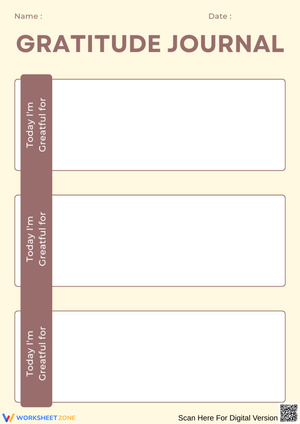
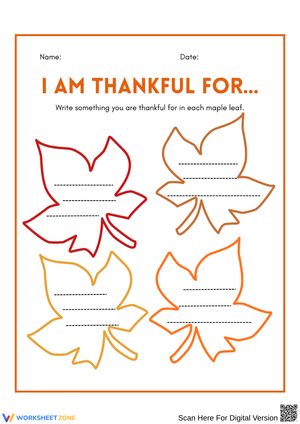
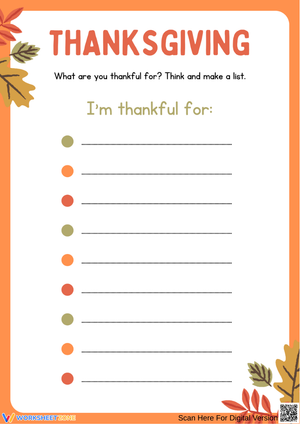
These i am thankful for printable worksheets for 2nd grade give teachers a ready-to-use set of structured writing activities that pair genuine emotional reflection with the sentence-level literacy skills second graders are actively building. Each worksheet pushes students past simple list-making — toward explaining what they value and why. The set works across the school year, not only during the two weeks surrounding Thanksgiving.
What Students Actually Practice
The i am thankful for printable worksheets for 2nd grade build one central writing skill: elaborated sentence completion. Second graders can write "I am thankful for my dog" without much effort, but finishing "I am thankful for my dog because..." requires a different cognitive move — connecting a feeling to a specific reason. That shift from naming to explaining sits exactly where 2nd-grade writing instruction lives, bridging opinion writing (W.2.1's expectation of reasons that support a claim) and personal narrative (W.2.3's requirement to describe feelings and experiences with detail).
Beyond sentence structure, students build vocabulary around relationships and emotions. Most seven-year-olds' emotional word bank runs thin: happy, sad, mad. Gratitude writing gives them a context to reach for words like appreciate, lucky, and important — not as isolated vocabulary drill, but as tools for saying what they actually mean. Worksheets in the set that include a word bank let students at different writing levels access the same language during the same lesson, which makes the activity easier to run in a mixed-ability class without splitting into separate tasks.
Mistakes Students Commonly Make — and What They Reveal
The most consistent error pattern: students default to possessions and screen time. "I am thankful for my tablet" shows up regularly, which is honest — but it tells teachers that those students haven't yet learned to recognize relational or experiential gratitude, the kind that involves people, moments, or opportunities. This isn't a moral gap; it reflects where most seven-year-olds are developmentally. Worksheets that follow up with targeted prompts — "Who at school helps you?" or "What place makes you feel safe?" — redirect students toward a wider range of reflection without requiring a lecture on thankfulness.
A second pattern is the circular because response. When a prompt reads "I am thankful for _______ because _______," many students write "I am thankful for my mom because my mom." They've absorbed the sentence structure but haven't internalized that because requires new information. One brief think-aloud during the whole-class introduction — "Does 'because my mom' tell my reader anything they didn't already know? Let me try again" — shifts this more effectively than written corrections after students have already moved on.
How to Fit These Worksheets Into Your Weekly Routine
Effective use starts before students pick up a pencil. Sharing something you're genuinely grateful for — not a canned example, but something real and specific, like being thankful for the aide who covered your afternoon small-group when you were pulled for a meeting — sets a tone of authenticity that students notice. They distinguish quickly between a teacher going through the motions and one who means what they say.
For scheduling, these work well as Monday morning writing to open the week on a reflective note, or as a 10-to-15-minute activity inside a dedicated SEL block. Teachers who keep completed worksheets in a running folder across the fall semester often find students voluntarily looking back at earlier entries, which creates a natural opportunity to discuss how their thinking has shifted. If you use i am thankful for printable worksheets for 2nd grade during morning meeting, follow the individual writing time with a brief share-out — hearing classmates name different kinds of gratitude tends to expand the range of ideas on subsequent worksheets in ways that teacher prompting alone rarely does.
Standard Alignment
These worksheets connect most directly to CCSS.ELA-LITERACY.W.2.3, which asks second graders to write narratives that include details about thoughts and feelings. Gratitude writing serves this standard well because the task is personally meaningful — students aren't inventing events but reflecting on real experiences, which lowers the cognitive barrier of content generation while keeping the craft demand intact. Teachers who use these worksheets inside a writing unit can treat finished gratitude entries as mentor texts when guiding students toward more extended personal narrative work later in the semester.
Adjusting the Set for a Range of Learners
For English Language Learners and students with limited writing fluency, the most practical adjustment is selecting worksheets that pair pictures with labeled sentence frames. A worksheet showing an image of a family, a school building, and a community helper alongside simple sentence starters gives ELL students a visual anchor for language access without reducing the thinking demand of the reflection itself. The goal remains genuine thought — the image supports vocabulary, not cognition.
At the other end, students ready for extended writing can treat each worksheet as a starting point. Have them take a completed sentence — "I am thankful for my grandmother because she teaches me her recipes" — and develop it into a short paragraph by adding a detail from a specific memory. That move toward elaborated personal narrative is exactly what W.2.3 tracks, and students given this extension consistently produce some of the strongest writing in the room, because the subject is close to them. For students who freeze on open-ended prompts entirely, narrowing the category helps: "Name one person at school who helped you this week" is far more manageable than an unrestricted gratitude prompt.
Frequently Asked Questions
Can these worksheets be used outside of November?
Yes, and they hold up better year-round than many teachers expect. Gratitude writing fits naturally into community-building units at the start of the year, into social studies discussions about family and neighborhoods, and into any SEL block focused on self-awareness. Most worksheets in the set don't rely on Thanksgiving-specific imagery, which keeps them appropriate from September through May without feeling out of season.
How much class time does a typical worksheet take to complete?
Most second graders finish the writing portion in 10 to 15 minutes when they've had a brief whole-class discussion first. Worksheets with a drawing or coloring component take closer to 20 minutes. If you're working within a tight window — the 12 minutes before a specials pickup, for instance — stick to text-only formats for that session and save the illustrated ones for days when students have more time to sit with their thinking.
What if a student is going through a difficult time at home?
This is worth thinking through before distributing any open-ended gratitude prompt. For students dealing with loss, instability, or family stress, "What are you thankful for?" can feel uncomfortable or even painful. A narrower, school-focused prompt — "Name one person in our classroom who has helped you" — is usually more approachable because it keeps the reflection within a space the student can control. Offering a drawing option as an alternative gives students a way to participate without disclosing anything they're not ready to share.
Where can I find these worksheets?
Worksheetzone carries a curated selection of i am thankful for printable worksheets for 2nd grade built specifically for classroom use — ready-to-print formats that span a range of writing levels and visual styles. Each worksheet requires no prep beyond downloading and printing, which matters on the mornings when planning time ran short.












 Interactive Worksheet Maker
 Quiz Maker
 Word Search Maker
 Crossword Puzzle Maker
 Word Scramble Generator
 Sentence Scramble Generator
 Handwriting Worksheet Generator
 Name Tracing Generator
 Fill In The Blank Generator