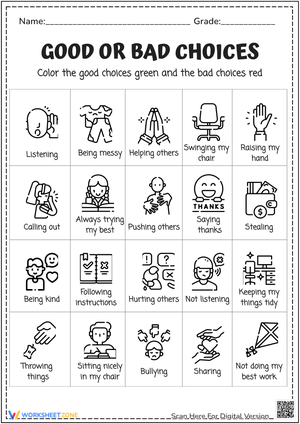
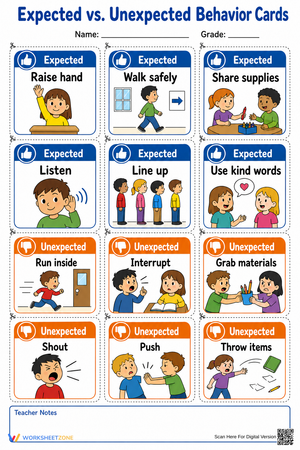
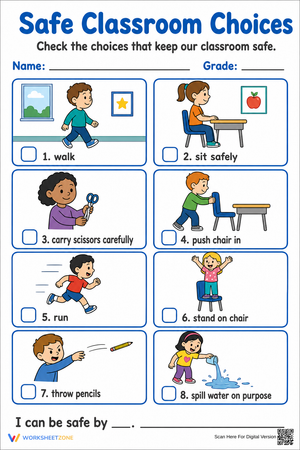
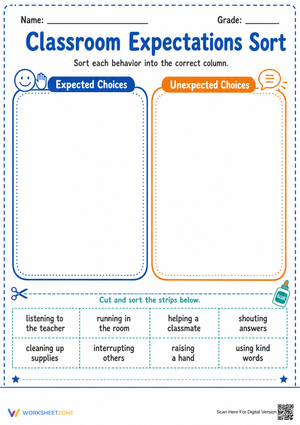
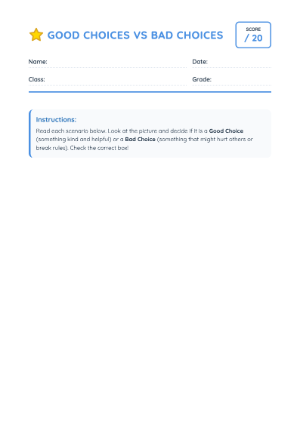
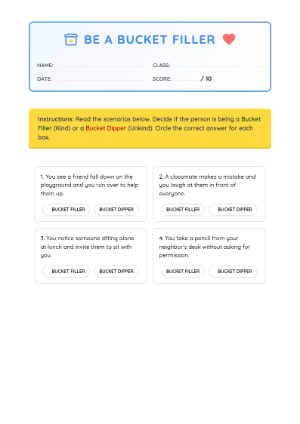
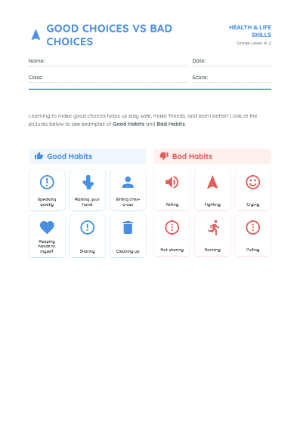
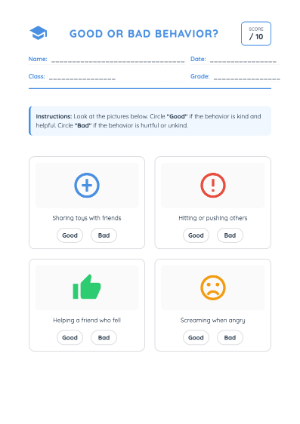
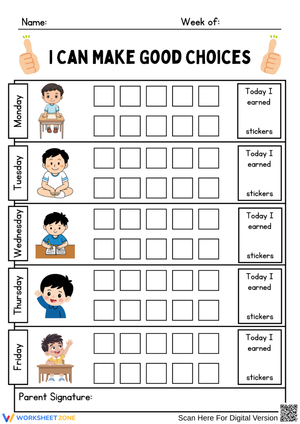
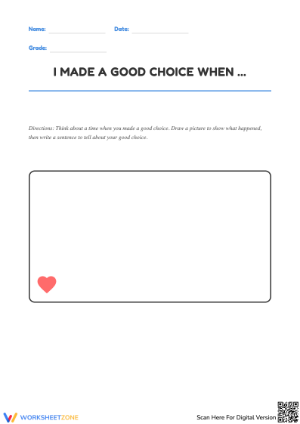
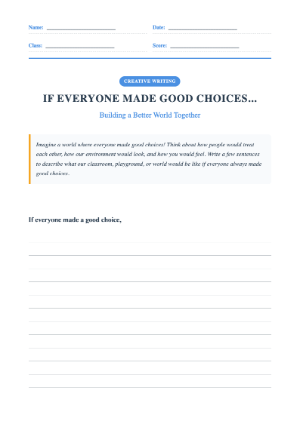
These 2nd grade good choices bad choices printable worksheets give teachers a concrete way to work through social decision-making with seven- and eight-year-olds — the age when kids shift from following rules by habit to actually reasoning about why certain behaviors matter. Each worksheet draws on sorting, cause-and-effect tracing, and structured reflection, making them practical for morning meeting, small-group instruction, and independent work throughout the school day.
What the Worksheets Actually Cover
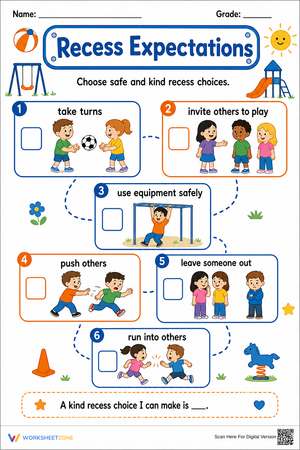
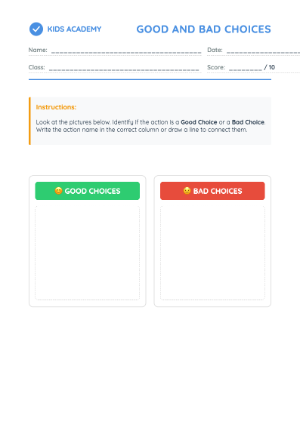
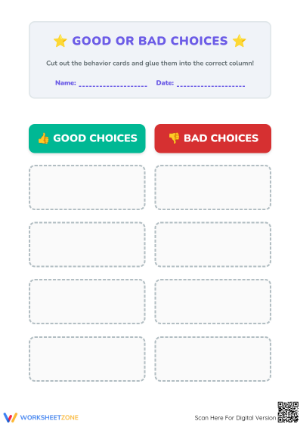
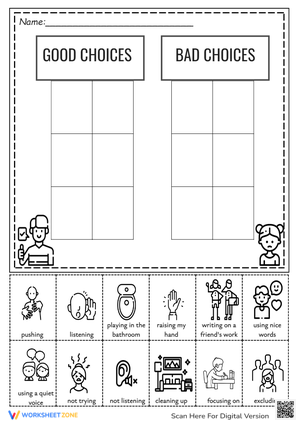
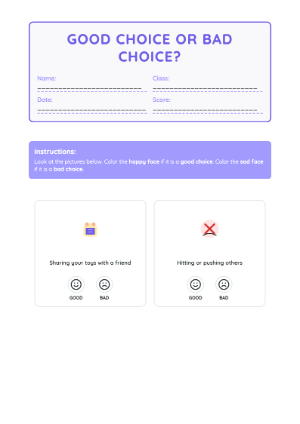
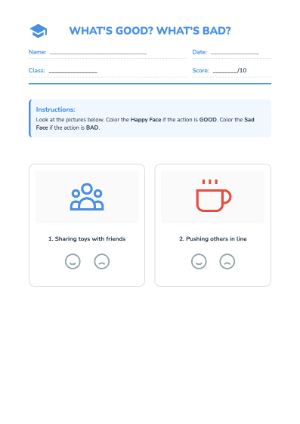
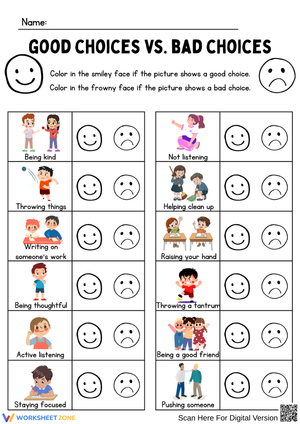
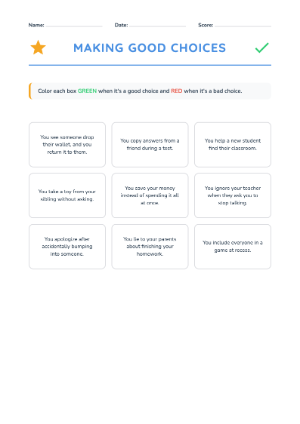
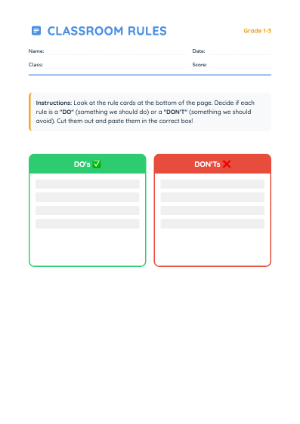
The 2nd grade good choices bad choices printable worksheets in this set break into distinct skill areas rather than repeating the same sorting format across every activity. Sorting illustrated or text-based scenarios is the entry point, but the instructionally valuable work lives in what surrounds that sorting task.
- Emotional precursors: Students identify the feeling that came before a behavior — frustration, boredom, embarrassment — and trace how that feeling connected to the choice that followed.
- Consequence mapping: After identifying a choice, students mark who was affected and how the situation changed. This moves beyond labeling into actual causal reasoning.
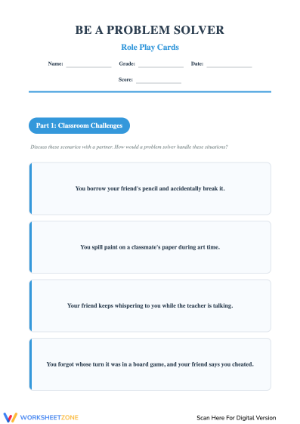
- Repair thinking: Some worksheets present a scenario where a bad choice has already occurred and ask students what could be done next — a skill many SEL lessons skip too quickly.
- Preference versus moral judgment: Several scenarios ask students to distinguish a choice that is actually wrong from one that is simply different from what a peer prefers. This distinction trips up most seven-year-olds and is worth naming explicitly.
The scenarios pull from moments students recognize: lunchroom conflicts, turn-taking on the playground, reacting when something feels unfair. Familiar contexts lower the cognitive load of the task so students can focus on the decision-making process rather than decoding an unfamiliar situation.
Student Errors Worth Catching Early
The most consistent confusion in this age group is around telling an adult. Students almost universally label "telling the teacher" as a bad choice because peer culture around tattling is already operating in second grade. The worksheet surfaces this directly — which is where it earns its place in a lesson. When a student marks "I told the teacher someone was being hurt" as a bad choice, that is information worth having and a conversation worth having in front of the whole class.
A second pattern is outcome-based reasoning. When students see a scenario where a bad choice "worked out" — the student who grabbed the last marker didn't get caught, finished the work, and received praise — a significant portion of seven-year-olds will label that a good choice because the result was favorable for the actor. This is exactly the developmental shift these worksheets are meant to move along: from judging choices by their results to judging them by their intent and their effect on others. Naming this during whole-group debrief makes the lesson land.
A third error is subtler. Students who have been told to "be friendly" and "include everyone" will sometimes mark choosing to read alone at recess as a bad choice, conflating a social preference with a moral wrong. When this appears in student work, it signals a deeper misunderstanding of what the good choice / bad choice framework is actually measuring — and it is worth addressing before that misunderstanding hardens.
Working These Into Your Lesson Plans
The most reliable insertion point is the five-minute arrival window before morning meeting. One sorting worksheet as students settle in primes them for the behavioral expectations of the day without eating into instructional time. Keeping a small stack accessible means the routine holds even on chaotic mornings.
Before recess is the second natural slot. A quick look at one scenario right before students go outside puts decision-making language in their heads at the exact moment they will need it. This does not need to be long — two or three minutes of discussion around a single scenario is enough. The timing matters more than the depth.
For the calm-down corner, post a completed example from a previous class discussion. A student who is dysregulated mid-transition cannot process verbal instruction, but they can look at a familiar image and remember the language from an earlier lesson. The worksheet becomes a visual anchor in that context rather than an assignment.
Small-group instruction is where the repair-thinking worksheets do their best work. These are not independent-practice formats — they need discussion to be useful. Students who rush through a sorting activity in five minutes will slow down and produce genuine thinking when the question shifts to "what could this student do now?"
Adjusting the Work for Different Learners
For students who need more support, picture-based versions of the sorting activities remove the reading barrier entirely. Read scenarios aloud during whole-group introduction, then let students work independently with the visual format. Pairing a student who needs support with a partner who reads while they sort preserves the social dimension of the activity for both students.
For students who move through the sorting quickly and accurately, the extension is straightforward: after marking a choice, they write a "because" statement explaining the reasoning behind it. A student who can sort correctly but cannot explain the categorization has not yet internalized the concept — the because statement surfaces that gap immediately and gives the teacher useful information about where the understanding actually is.
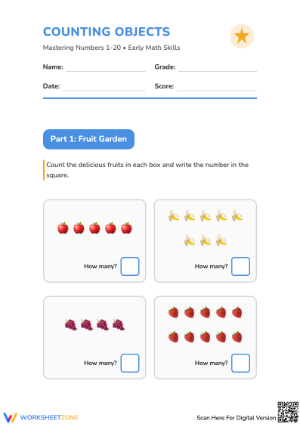
Students learning English benefit from the picture-heavy formats used across 2nd grade good choices bad choices printable worksheets — visual scenarios reduce the vocabulary load while still engaging students in the underlying reasoning. A brief verbal explanation in a small group before independent work keeps the task accessible without removing the thinking.
Standard Alignment
These worksheets address the CASEL Responsible Decision-Making competency, which covers identifying problems, analyzing situations, evaluating decisions, and reflecting on how choices affect personal and community well-being. In classroom terms, this competency describes the instructional work students need to practice before demonstrating independent decision-making in real situations — the worksheets cover that preparatory ground directly.
Illinois ISBE Goal 3 — "Demonstrate decision-making skills and responsible behaviors in personal, school, and community contexts" — maps directly to the sorting and consequence-tracing tasks in the set. Teachers in other states with formal SEL standards at the K-3 level will find similar alignment; most state frameworks describe the same competency CASEL names, even when the code numbering differs.
Frequently Asked Questions
How often should I use these during the week?
Two to three times per week builds the language and reasoning patterns students need without crowding out other instruction. Daily use makes sense during the first few weeks of school when behavioral expectations are being established. After that, two focused sessions per week — one for new skill introduction and one for review — maintain the learning effectively.
My students rush through the sorting and finish in two minutes. What should I do?
Add the because statement requirement. Students who can sort in two minutes cannot write a clear explanation in two minutes — the extension immediately slows the pace and deepens the thinking. You can also ask students to take one of their "good choice" scenarios and rewrite it as a bad choice, then explain what changed. That revision task requires understanding the reasoning behind the original label, not just pattern recognition.
Can I send these home for family use?
Yes, and it helps. When families use the same "good choice / bad choice" language at home, classroom instruction has more traction because students hear the same framework reinforced across different settings. Include a brief note explaining that these 2nd grade good choices bad choices printable worksheets are part of an ongoing classroom conversation — not a behavior report — so families understand the context before discussing the scenarios with their child.
Do these work for students already receiving additional behavioral support?
The sorting and cause-and-effect activities are useful starting points, but students with significant behavioral support needs require more than periodic independent practice. Use the worksheets as a shared reference point in check-in conversations or pull-out sessions rather than as a standalone intervention. The visual formats hold up well in one-on-one settings because there is no reading demand — the adult and student can work through a scenario image together without the student needing to decode text first.












 Interactive Worksheet Maker
 Quiz Maker
 Word Search Maker
 Crossword Puzzle Maker
 Word Scramble Generator
 Sentence Scramble Generator
 Handwriting Worksheet Generator
 Name Tracing Generator
 Fill In The Blank Generator