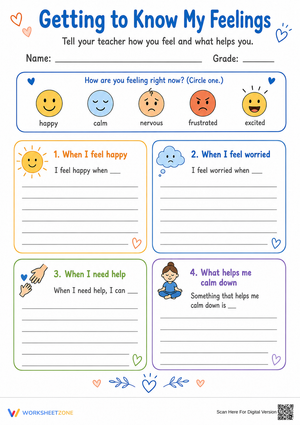
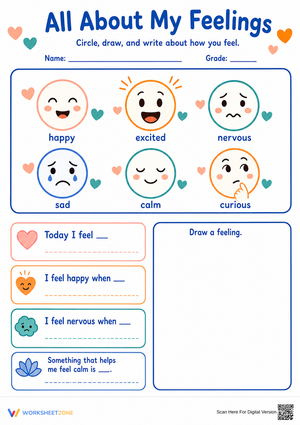
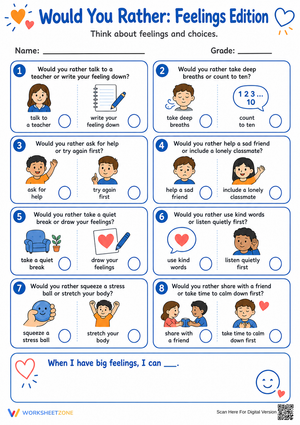
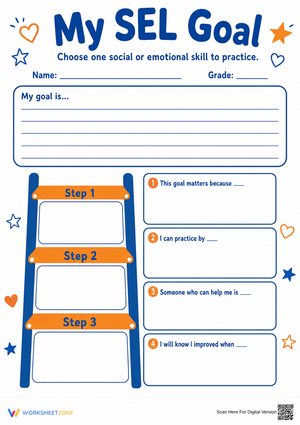
These 2nd grade emotions and feelings worksheets pdf give teachers a structured way to move students past the two-emotion vocabulary most arrive with — "happy" and "mad" — and into the more precise language second graders need to navigate the social demands of the school day. The set covers emotional identification, body awareness, perspective-taking, and coping strategy practice — material that fits into a morning meeting, a dedicated SEL block, or the five minutes before a transition.
What Students Practice Across the Set
Each worksheet focuses on a distinct emotional literacy skill rather than cycling through the same matching task. Across the set, students:
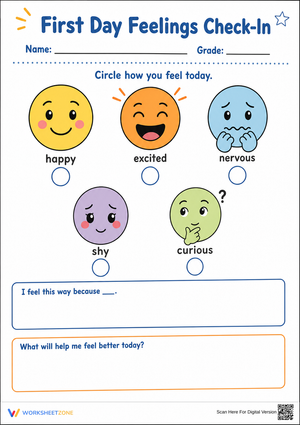
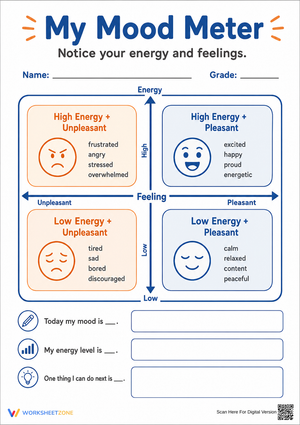
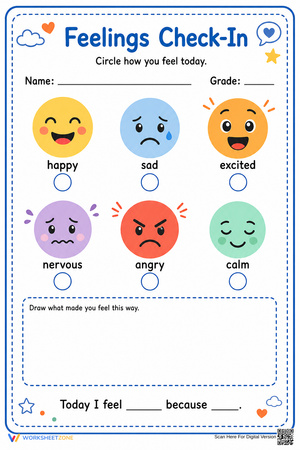
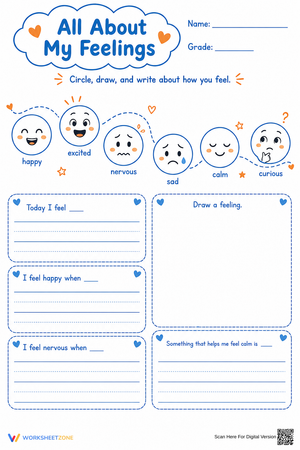
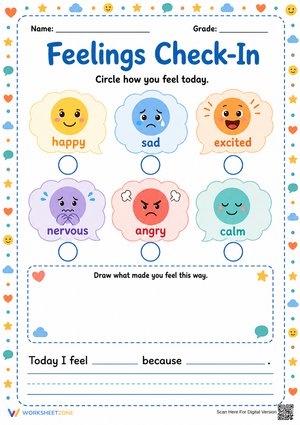
- Label emotions on illustrated faces using a word bank or their own vocabulary
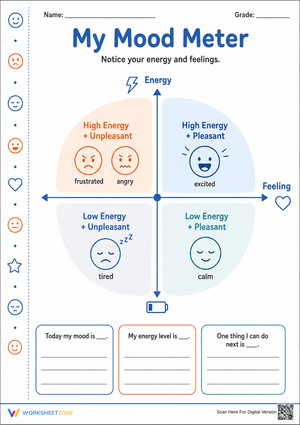
- Sort feelings by intensity on a simple scale, distinguishing between annoyed and furious or nervous and terrified
- Annotate a body outline to mark where they physically feel nervousness, excitement, or anger
- Complete brief written reflections connecting a described situation to an emotional response
- Identify what a character might be feeling beneath a visible surface emotion
The vocabulary range runs from familiar and concrete (worried, surprised, embarrassed) to slightly more layered (disappointed, relieved, conflicted). That range reflects a real developmental moment: second grade brings more sustained peer relationships and more complex social comparisons than first grade, and students start encountering feelings they don't yet have words for. Giving them those words before conflict arises is the whole point.
Student Error Patterns Worth Knowing Before You Teach This Set
The most consistent pattern in second-grade emotional literacy work is students treating anger as a standalone feeling rather than as a response to something underneath it. A student who looks angry is often embarrassed, scared, or hurt — those are the feelings driving the behavior. Several worksheets ask students to identify what a character might be feeling beneath a visible emotion, which makes that primary-versus-secondary distinction explicit during calm instructional time rather than mid-conflict. When students practice the "what's under it?" move at their desks, they can actually draw on it later when they need it.
A second error worth catching: students routinely read emotions from a single facial cue and miss body language entirely. A worksheet showing a child with a neutral face but slumped posture produces split answers across a class — some students read "fine," others read "sad." That disagreement is the teaching moment. The discussion that follows builds observational skills underlying empathy far more efficiently than any direct lesson treating empathy as an abstract concept.
Fitting These Worksheets Into the Rhythms of Your Week
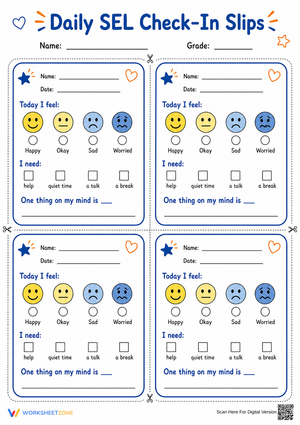
The most reliable entry point is the morning meeting — those five to eight minutes after attendance and before the academic day begins. A brief "circle the feeling that's closest to how you arrived today" task gives teachers immediate data on the room's emotional climate before introducing any content. That data matters in practical terms: six students circling "worried" on a Monday morning is information worth acting on before starting a new unit. With 2nd grade emotions and feelings worksheets pdf used this consistently, the vocabulary becomes part of the classroom's shared language instead of a unit that happened once in September and faded.
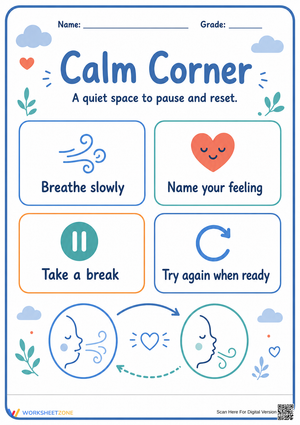
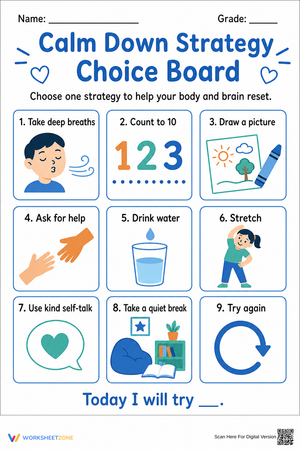
The coping strategy worksheets — the ones that pair a specific feeling with a concrete response — work best when introduced during calm, unhurried instructional time rather than pulled out mid-crisis. Students complete an "if I feel _______, then I can _______" frame during a regular SEL block, keep the finished worksheet at their desk, and reference it when they actually need it. That pre-loading works with how second graders process stress: they can follow a familiar, already-practiced procedure far more reliably than they can generate a new strategy under pressure.
Body Maps and the Physical Experience of Feeling
Several worksheets include a body outline where students mark where they feel particular emotions — the tight chest that comes with anxiety, the stomach sensation before a presentation, the heavy feeling some describe as sitting in their shoulders when they're disappointed. This somatic component tends to be the most surprising for students and, in practice, the most useful. A second grader who can say "I notice my stomach feels weird, which is probably nervousness" is far better positioned to self-regulate than a student who can only label an emotion after it has already surfaced as behavior. The body-awareness worksheet works especially well as a paired activity: students complete it individually, then compare with a partner. The immediate discovery that nervousness lives in different places for different people — and that both are normal — does more for classroom empathy than most explicit lessons on the topic.
Using These Worksheets With Students at Different Readiness Levels
For students who need more support, the illustrated worksheets — those with facial expressions and body posture already drawn — reduce the cognitive demand and let students focus on labeling and discussion rather than visualization. Students who are ready for more challenge can move from labeling emotions to writing a short explanation of a situation that would produce that feeling, or comparing two closely related emotions (nervous versus scared, proud versus happy) in a two-column response. For students with limited English proficiency, the visual worksheets carry much of the meaning on their own; pairing them with a bilingual feelings word bank makes the vocabulary accessible without changing the thinking the task requires. The 2nd grade emotions and feelings worksheets pdf format — printable, low-stakes, easy to reprint — also removes the pressure of pace, letting students work quietly without the format itself becoming a barrier.
Standard Alignment
These worksheets align with the CASEL (Collaborative for Academic, Social, and Emotional Learning) framework, specifically the Self-Awareness and Social Awareness competency domains. Self-Awareness covers recognizing one's own emotions and understanding how those emotions influence behavior; Social Awareness covers perspective-taking and recognizing others' emotional states. Most state-level SEL standards for second grade draw directly from this framework, so teachers working with district SEL benchmarks will find strong alignment in the identification, perspective-taking, and coping strategy components. The written reflection tasks also connect to second-grade ELA speaking and listening standards — naming and explaining an emotional response requires precise word choice and organized expression, the same skills students practice in oral and written academic work.
Frequently Asked Questions
How do these worksheets differ from a feelings chart or classroom poster?
A poster names emotions and shows faces. These worksheets ask students to do something with that information — sort, annotate, write, reflect. A feelings chart stays decorative unless students interact with it in a structured way. Each completed worksheet also creates a concrete record of where a student is in their emotional vocabulary development, which proves useful during parent-teacher conferences or when documenting growth over time.
At what point in the school year do these work best?
The identification and vocabulary worksheets work from the first week of school — they function as community-building activities while also teaching content. The coping strategy and self-regulation worksheets land better after a few weeks of establishing classroom norms, so they feel like a natural progression rather than a corrective response to early behavior problems. The body-awareness worksheet tends to work best in October or November, once students are comfortable enough with each other to share the comparison activity without self-consciousness getting in the way.
Can these travel home as homework, or do they need a classroom context?
Most of the identification and drawing worksheets travel home well — families can extend the conversation, and many parents appreciate having a concrete prompt for discussions about feelings. The coping strategy worksheets are more effective in the classroom, where the teacher can explain the rationale and students hear how peers approach the same scenarios. If you send any of the 2nd grade emotions and feelings worksheets pdf home, a brief parent note explaining the key vocabulary helps the conversation continue rather than stall at the kitchen table.
How do these fit alongside a published SEL curriculum?
These worksheets function as practice and reinforcement rather than as a standalone curriculum sequence. If your school uses Second Step, MindUP, or a similar program, each worksheet gives students additional repetitions with the vocabulary and skills those programs introduce — the kind of distributed practice that moves knowledge into long-term retention rather than lesson-day familiarity only.