




























Views
Downloads

Expected Behavior Cards | Printable Grade 1 SEL

Paste this activity's link or code into your existing LMS (Google Classroom, Canvas, Teams, Schoology, Moodle, etc.).
Students can open and work on the activity right away, with no student login required.
You'll still be able to track student progress and results from your teacher account.
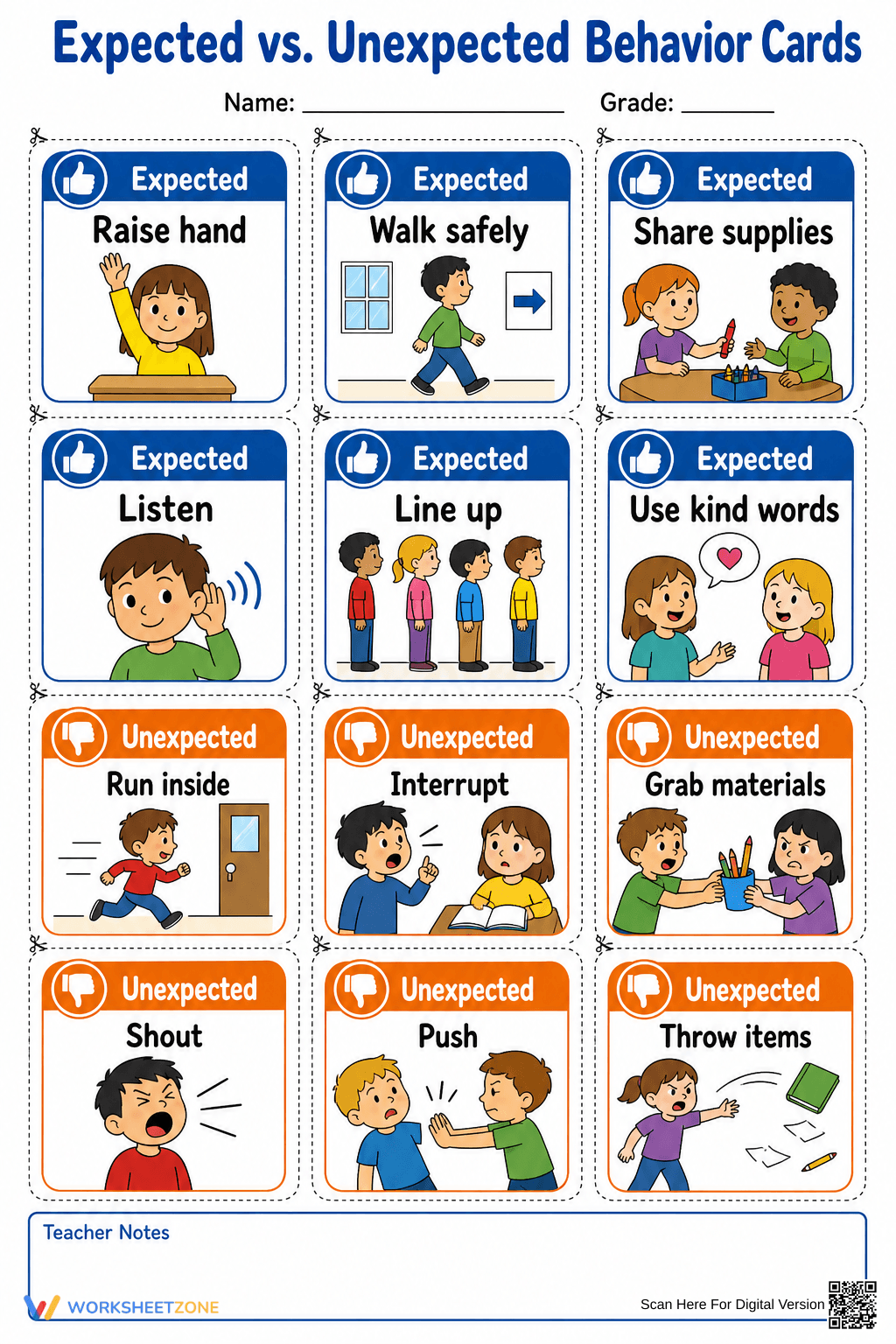
This expected versus unexpected behavior card set helps early elementary students identify appropriate classroom actions. By sorting these visual scenarios, learners build essential self-awareness skills. The clear illustrations provide immediate feedback, allowing young students to confidently distinguish between positive choices and disruptive actions.
At a Glance
- Grade: 1 · Subject: SEL
- Standard:
CCSS.ELA-LITERACY.SL.1.1.A— Follow agreed-upon rules for discussions and behavior- Skill Focus: Identifying expected behaviors
- Format: 1 page · 12 cards · No answer key · PDF
- Best For: Classroom management setup
- Time: 15–20 minutes
This single-page printable features 12 behavior cards arranged in a grid for easy cutting. Six cards illustrate expected behaviors (raising a hand, walking safely) marked with a blue thumbs-up. Six cards depict unexpected behaviors (running inside, interrupting) marked with an orange thumbs-down. Each card includes a simple label and illustration to support early readers.
Designed for immediate implementation with minimal setup:
- Print (1 min): Generate the PDF in color to maximize visual impact.
- Distribute (2 mins): Hand out sheets for students to cut, or pre-cut the 12 cards.
- Review (15 mins): Guide the class through a sorting activity.
Total teacher prep time is under two minutes, making this ideal for sub plans.
This activity aligns with CCSS.ELA-LITERACY.SL.1.1.A: Follow agreed-upon rules for discussions. It supports general SEL frameworks for self-management. Both standard codes can be copied directly into lesson plans, IEP goals, or district curriculum mapping tools.
Introduce these cards during morning meetings to establish clear classroom expectations. Teachers can hold up a card and ask students to explain why it is expected or unexpected. Alternatively, use the cards in a small-group sorting center. As a formative assessment tip, observe which students struggle to identify unexpected behaviors; this indicates a need for targeted reteaching. Expect completion in 15 to 20 minutes.
Designed for K-2 students who benefit from explicit visual behavior supports. It serves as an excellent differentiation tool for English Language Learners and students with special needs, as icons reduce reading demands. Pair these cards with a classroom anchor chart to reinforce concepts.
Explicit instruction in classroom routines using visual supports significantly improves student compliance and reduces disruptive incidents. According to Fisher & Frey (2014), providing clear, visual examples and non-examples of expected actions helps students internalize behavioral norms more effectively than verbal corrections alone. This resource directly targets CCSS.ELA-LITERACY.SL.1.1.A by requiring students to follow agreed-upon rules for discussions and behavior. By categorizing actions into expected and unexpected choices, educators foster a proactive rather than reactive classroom management system. The use of visual cards supports cognitive processing for early learners, ensuring that expectations are universally understood regardless of reading level. Implementing structured behavior sorting activities early in the academic year establishes a strong foundation for a safe, predictable learning environment, ultimately maximizing instructional time and supporting overall social-emotional development.


