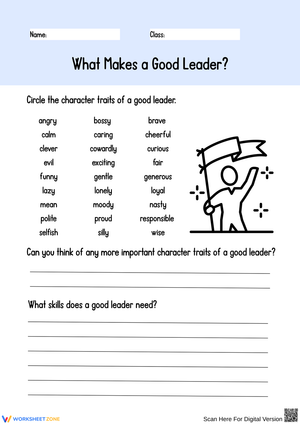
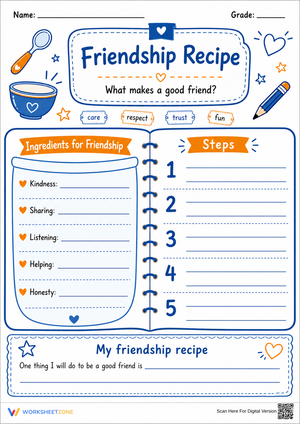
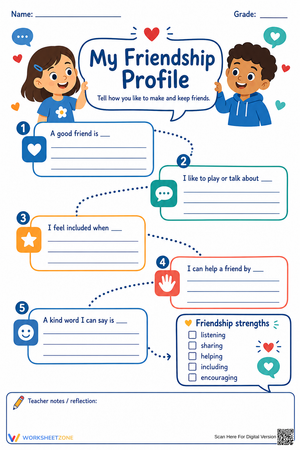
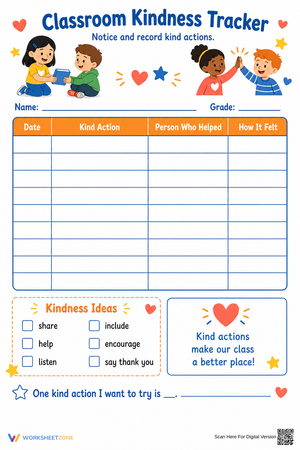
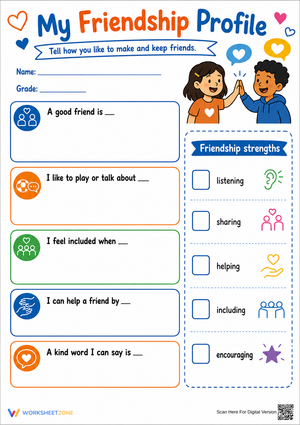
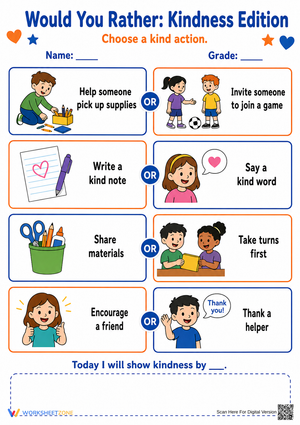
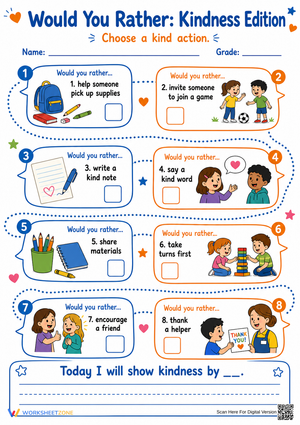
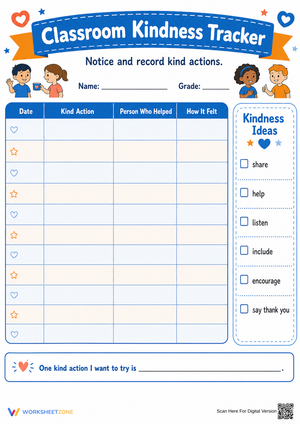
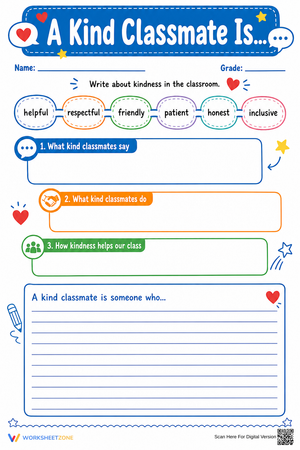
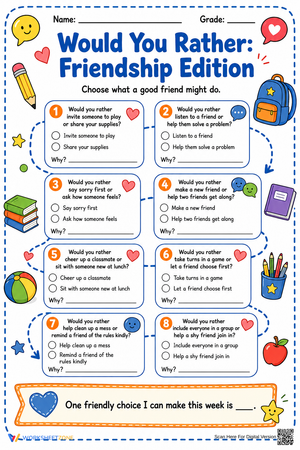
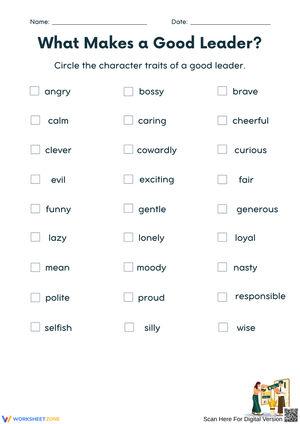
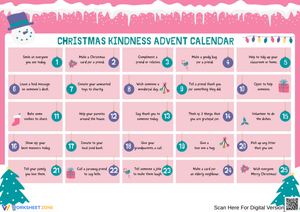
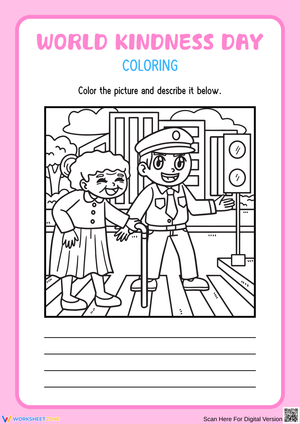
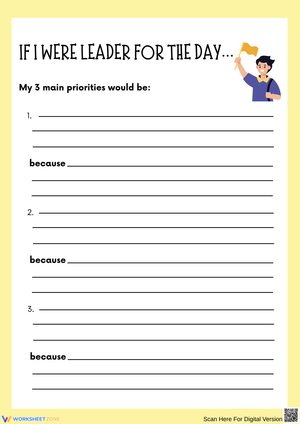
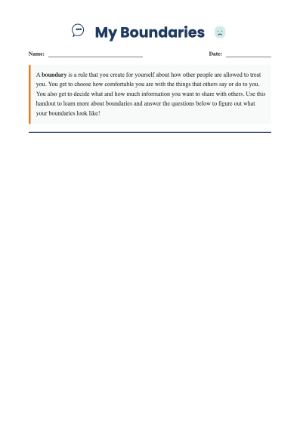
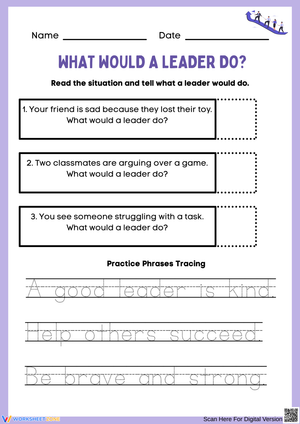
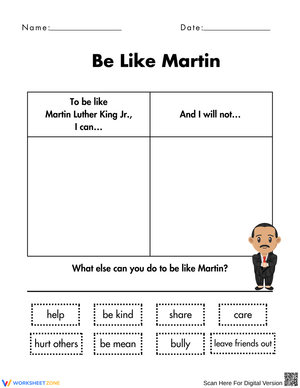
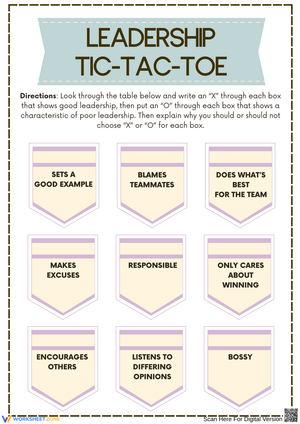
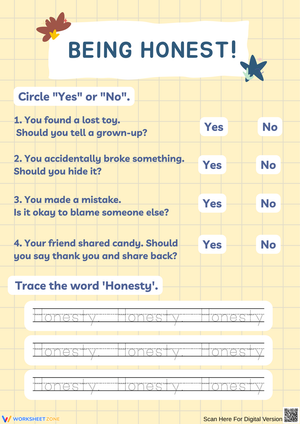
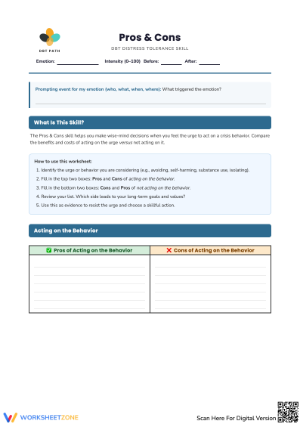
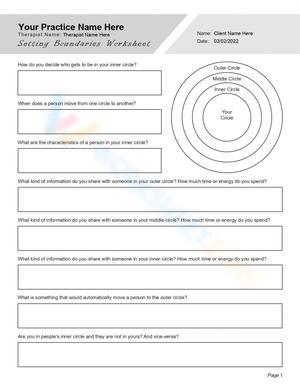
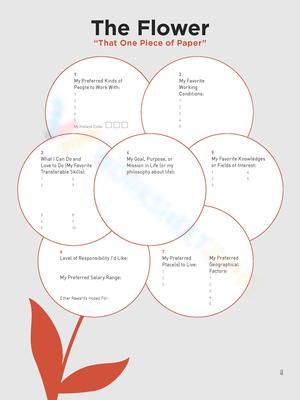
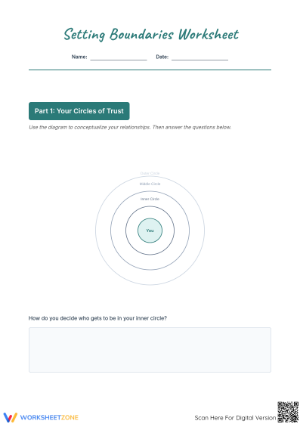
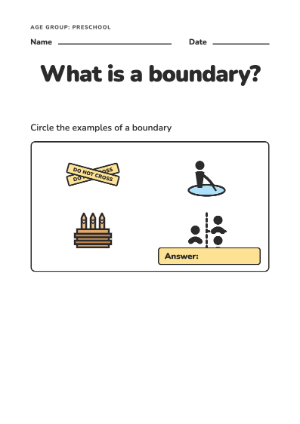
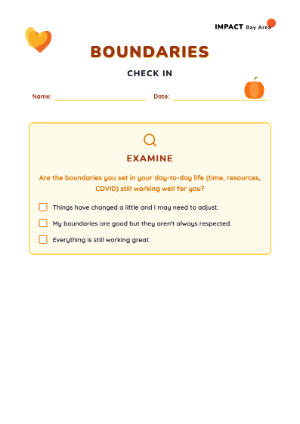
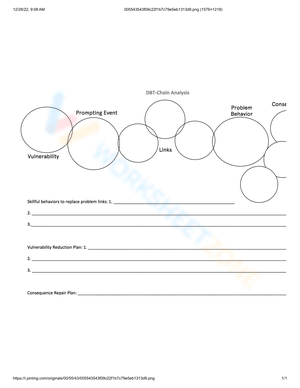
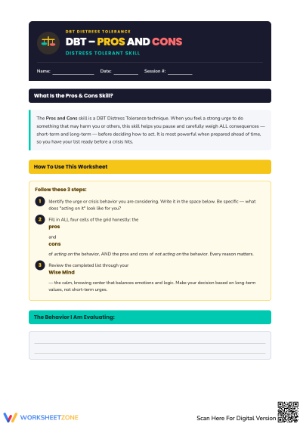
These 2nd grade behavior worksheets pdf resources give teachers a structured, ready-to-print set of activities that move social-emotional instruction from whole-class lecture into concrete, student-driven practice. The set covers self-regulation, perspective-taking, classroom expectations, and social problem-solving — the four areas where second graders most consistently arrive with uneven preparation. Each worksheet stands alone, so teachers can pull exactly what their class needs in a given week without working through a predetermined sequence.
The Specific Skills Targeted
Second grade sits at an interesting developmental intersection. Students this age have enough language to talk about feelings but not yet enough self-awareness to connect an emotion to a physical sensation in their body — and that gap is precisely where behavior instruction tends to break down. These worksheets address it directly across five skill areas:
- Emotion identification: Students label feelings in illustrated scenarios and match them to body cues — tight chest, clenched fists, a racing heart — rather than stopping at a word on a list.
- Self-regulation strategies: Students sort calm-down strategies by situation, then write a personal scenario and apply a chosen strategy to it.
- Perspective-taking: Students read a short social situation and write or draw what the other person might be feeling, with follow-up prompts asking them to explain why.
- Behavior sorting: Students categorize actions as expected or unexpected for a specific setting — hallway, library, small group — which removes the ambiguity that comes from stating general rules.
- Goal setting and self-monitoring: Students choose one specific behavior to track across a week, record whether they met it each day, and note what got in the way when they didn't.
The behavior-sorting worksheets earn their place quickly with students who can recite classroom rules fluently but apply them inconsistently. Having to physically place an action into a category forces more deliberate processing than hearing a rule repeated from the front of the room.
The Three Places Students Tend to Go Off Course
The most predictable error on reflection worksheets is surface-level compliance. A student writes "I took a deep breath" on a cool-down sheet not because it's what they actually did, but because they recognize it as the expected answer. These responses look complete until you sit with the student and ask, "What did the deep breath feel like in your body?" A blank stare signals that the reflection was social performance, not genuine self-monitoring. Naming this distinction explicitly before students start the worksheet — two minutes, nothing more — is worth the investment.
Perspective-taking activities surface a different pattern: second graders frequently conflate what they themselves would feel with what the character in the scenario is experiencing. A student writes "she would feel excited" because the situation sounds exciting to them personally, not because they reasoned through the character's specific circumstances. Teaching students to underline the detail in the scenario that supports their answer pushes them toward evidence rather than projection, and it's a habit that transfers across worksheets once students catch on.
Goal-setting sheets produce a third consistent error: students choose goals too broad to monitor. "Be nice" or "listen better" give a child no reliable way to know whether they've met the goal on a given day. Before students begin tracking, have them rewrite a vague goal as a specific, observable action. "Raise my hand before I speak during whole-group time" is something a student can actually check off and reflect on meaningfully at the end of the week.
Where and When These Worksheets Do Their Best Work
Morning meeting is the most natural entry point. A five-minute behavior lesson at the start of the day — using one worksheet as the discussion anchor — frames expectations before the class moves into academic work. Perspective-taking worksheets fit particularly well here because the scenario discussion gives every student a voice before the day's pressures begin. These activities sit inside a standard morning meeting structure without displacing the greeting, sharing, or morning message components.
The cool-down reflection sheets serve a separate function entirely and belong in the calm-down corner or at a designated reset seat, not during whole-group instruction. When a student is dysregulated, a short reflection worksheet gives them a structured task that redirects attention from the emotional trigger toward logical processing. The crucial condition is familiarity — the worksheet needs to have been introduced during a calm lesson earlier in the week so that reaching for it in a hard moment feels like routine rather than an additional demand.
Goal-tracking worksheets work best when paired with a brief Friday check-in. Students look at their week's marks, name one thing that helped them meet their goal, and share it with a partner — even three minutes during transition time is enough. Returning to the tracker across the week, rather than completing it once and filing it away, is what makes goal-setting a real habit rather than a one-time activity. That's spaced retrieval applied to behavioral self-monitoring, and at this age it makes a visible difference in how much students carry over into the following week.
Using the Set With a Mixed-Readiness Classroom
For students with a stronger emotional vocabulary, the response prompts extend naturally: instead of naming one feeling, students compare two characters' emotional responses and explain the difference in writing. This shifts the task from identification to analysis without requiring a separate worksheet.
Students who struggle with written expression do well when reflection prompts are read aloud by a partner or paraprofessional, with the student dictating or drawing the response instead. The thinking work stays the same; only the output changes. Keeping these students in the same lesson — rather than a separately simplified version — matters for classroom community as much as it matters for the individual student.
When differentiating 2nd grade behavior worksheets pdf activities for a mixed-readiness classroom, the most effective adjustment is almost always at the response level rather than the content level. Changing how a student responds — drawing, dictating, writing one sentence, writing a paragraph — addresses a range of readiness without splitting the class into parallel tracks.
For students receiving more intensive behavioral support, the behavior-sorting worksheets work well as a preview tool before a new school setting is introduced. Working through a sorting activity before a first library visit or a cafeteria lunch gives students a concrete mental picture of expected behavior before they're in the space. That kind of advance exposure cuts down on in-the-moment corrections that frustrate both the student and the adults around them.
Standard Alignment
Each worksheet in this 2nd grade behavior worksheets pdf set aligns with CASEL's core SEL competencies, particularly Self-Management and Social Awareness. CASEL's self-management competency at the elementary level explicitly includes impulse control, goal setting, and strategies for managing emotions — all of which appear directly in these activities. The social awareness competency covers perspective-taking and understanding why group norms exist, which the behavior-sorting and empathy-focused worksheets address in concrete, age-appropriate terms.
In states that have adopted formal SEL standards — including Illinois (ISBE SEL Standards Goals 1–3), Kansas, and Washington — these activities align to early elementary benchmarks for recognizing and managing emotions, demonstrating empathy, and making responsible decisions. For teachers in districts using PBIS frameworks, the goal-setting and self-monitoring worksheets connect to Tier 1 universal supports, while the reflection sheets function naturally within a Tier 2 check-in/check-out cycle. Completed worksheets filed as part of a student's behavioral growth portfolio give teams concrete evidence to reference during SST or IEP conversations.
Frequently Asked Questions
How do these worksheets fit alongside an existing PBIS system?
The goal-setting and self-monitoring sheets align directly with Tier 1 PBIS expectations, giving students a concrete way to track progress toward schoolwide behavior goals. The reflection worksheets are more naturally a Tier 2 tool — suited for students who need structured check-ins beyond universal classroom instruction. Teachers using a check-in/check-out protocol can replace generic daily rating sheets with these reflection prompts, which give students substantially more to think about than a numerical score on a scale of one to five.
Can individual students use these without whole-class instruction?
Yes, and that's one of the most common uses. A student who consistently struggles with transitions might work through the self-regulation sorting worksheet in a small group on Monday, then use the cool-down reflection sheet independently after a difficult transition on Wednesday — without the rest of the class seeing either worksheet. Because every worksheet stands alone, teachers pull exactly what matches the individual or group need without disrupting the larger class routine.
When during the year do different worksheets work best?
Behavior-sorting and classroom-expectations worksheets are most effective in the first six weeks, when students are still internalizing routines. Perspective-taking and empathy worksheets pick up traction mid-year once students know each other well enough that social scenarios feel real rather than hypothetical. Goal-tracking sheets earn their keep all year but deserve a fresh pull after winter break, when classes need to rebuild momentum. A teacher who matches the right 2nd grade behavior worksheets pdf selection to the right moment in the year will get more mileage from the set than one who works through everything in the same order every September.
Do students need prior SEL instruction before starting?
A baseline emotion vocabulary helps — students who can name more than "happy," "sad," and "mad" move through the identification activities more fluidly. But none of the worksheets assume students already know the skill being practiced. The sorting and categorizing activities introduce the concept through the task itself, and the instructions are written at a second-grade reading level. Direct prior instruction is helpful but not a prerequisite. For most students, the first time working through a new worksheet type is the lesson.