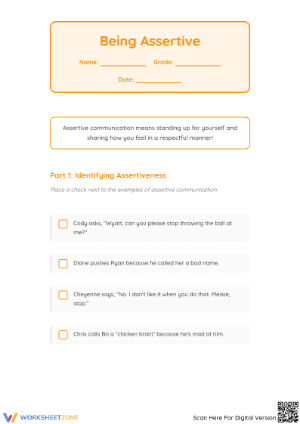
A behavior contract for a second grader should read like a short, friendly agreement rather than a formal document. It names the student, lists 3-4 target behaviors written in plain language, states what happens when the student meets the goal, and includes a spot for the teacher, student, and often a parent to sign. For 7- and 8-year-olds, simplicity matters more than detail. A contract with too many rules or abstract wording quickly loses a young student's attention, so the strongest templates fit on a single page with room for a sticker chart or checkbox tracker.
Why Behavior Contracts Work for 7- and 8-Year-Olds
Second grade is often described as a good starting point for behavior contracts because students at this age can read simple sentences, understand cause and effect, and grasp the idea of earning a reward for meeting a goal. Younger students may not yet connect a written agreement to their daily actions, while second graders are typically ready to track their own progress with adult support.
A meta-analysis reviewing 18 studies and 58 children found that behavior contracts produced a moderately strong positive effect on reducing problem behavior and increasing desired behaviors such as staying on task and finishing assigned work. That effect size is a useful benchmark for teachers deciding whether a contract is worth the setup time: the research suggests it is, particularly when a student's behavior is interfering with learning but has not escalated to a level requiring more intensive support.
Writing Clear, Observable Target Behaviors
The biggest mistake teachers make with behavior contracts is writing goals that are too vague to measure, such as be respectful or try harder. A second grader cannot self-monitor a goal like that. Effective contracts describe exactly what the behavior looks like: raise my hand before speaking, keep my hands and feet to myself, or stay in my seat during independent work. Limiting the contract to 3-4 of these observable behaviors keeps expectations realistic for a young student to track across a school day, and it keeps the contract useful for the teacher, who has to observe and record the behavior consistently.
When a teacher and student sit down to write the contract together, it helps to pick behaviors tied to a specific time of day or transition, such as morning meeting or lining up for recess. Narrowing the window makes the goal concrete and gives the student frequent, low-stakes chances to succeed rather than one long, hard-to-track school day.
Letting Students Choose Goals and Rewards
Behavior contracts tend to work better when the student has a voice in setting goals and choosing rewards, since ownership builds commitment in a way that an adult-imposed rule rarely does. With second graders, this might mean offering a short menu of reward options, like extra computer time, a sticker, or choosing a classroom job, and letting the student pick which one motivates them. Asking the student which behavior feels hardest to control also gives useful information and signals that the contract is a support tool, not a punishment.
Getting Parents on Board
Contracts are most effective when they are used consistently and reinforced at home, not treated as a one-time fix. Sending the contract home for a parent signature each day or week, and including a short note about how the day went, helps keep expectations aligned between school and home. Some teachers add a line on the contract where a parent can write a brief comment or add a home-based reward, which reinforces that the student's effort is being noticed in both settings.
Classroom Implementation
Behavior contracts are generally recommended as a targeted, individual intervention after simpler classroom management strategies, like proximity, visual reminders, or whole-class reward systems, have already been tried without enough success. A few practical steps make implementation smoother:
- Introduce the contract in a private, calm conversation, not in front of the class.
- Review the contract briefly at the same time each day so checking in becomes routine.
- Revisit and adjust the target behaviors every 1-2 weeks based on how the student is doing.
- Keep the tone encouraging; frame the contract as a way to help the student succeed, not as a warning.
- Track progress on a simple log so you can show growth over time to the student, parents, or a support team.
One 40-60 word citation capsule worth keeping on hand for staff meetings: A review of 18 studies involving 58 children, cited by the Council for Exceptional Children, found behavior contracts had a moderately strong positive effect on reducing problem behavior and increasing on-task engagement, supporting their use as a low-cost, individualized classroom intervention for elementary students.
Frequently Asked Questions
1. What should a 2nd grade behavior contract include?
It should include the student's name, 3-4 specific and observable target behaviors, a clear reward or consequence, a tracking method like a chart or checkboxes, and signature lines for the teacher, student, and ideally a parent.
2. How many behaviors should a behavior contract target at once?
Most effective contracts limit the focus to 3-4 behaviors so a young student can realistically track and remember them throughout the school day.
3. How often should teachers review or update a behavior contract with a student?
A brief daily check-in works well, with a more thorough review every 1-2 weeks to adjust goals, rewards, or the tracking method as the student's needs change.
4. Do behavior contracts actually work for young elementary students?
Research reviewing multiple studies has found behavior contracts produce a moderately strong positive effect on reducing problem behavior and increasing desired behaviors, and second grade is considered a reasonable age to start because students can understand simple written agreements.
5. How can teachers get parents involved in a behavior contract?
Sending the contract home for a signature, adding a short daily note about progress, and inviting parents to add a home-based reward all help keep expectations consistent between school and home.
















 Interactive Worksheet Maker
 Quiz Maker
 Word Search Maker
 Crossword Puzzle Maker
 Word Scramble Generator
 Sentence Scramble Generator
 Handwriting Worksheet Generator
 Name Tracing Generator
 Fill In The Blank Generator