


























Views
Downloads

Essential SEL Goal Setting Worksheet | Grades 2-6
Paste this activity's link or code into your existing LMS (Google Classroom, Canvas, Teams, Schoology, Moodle, etc.).
Students can open and work on the activity right away, with no student login required.
You'll still be able to track student progress and results from your teacher account.
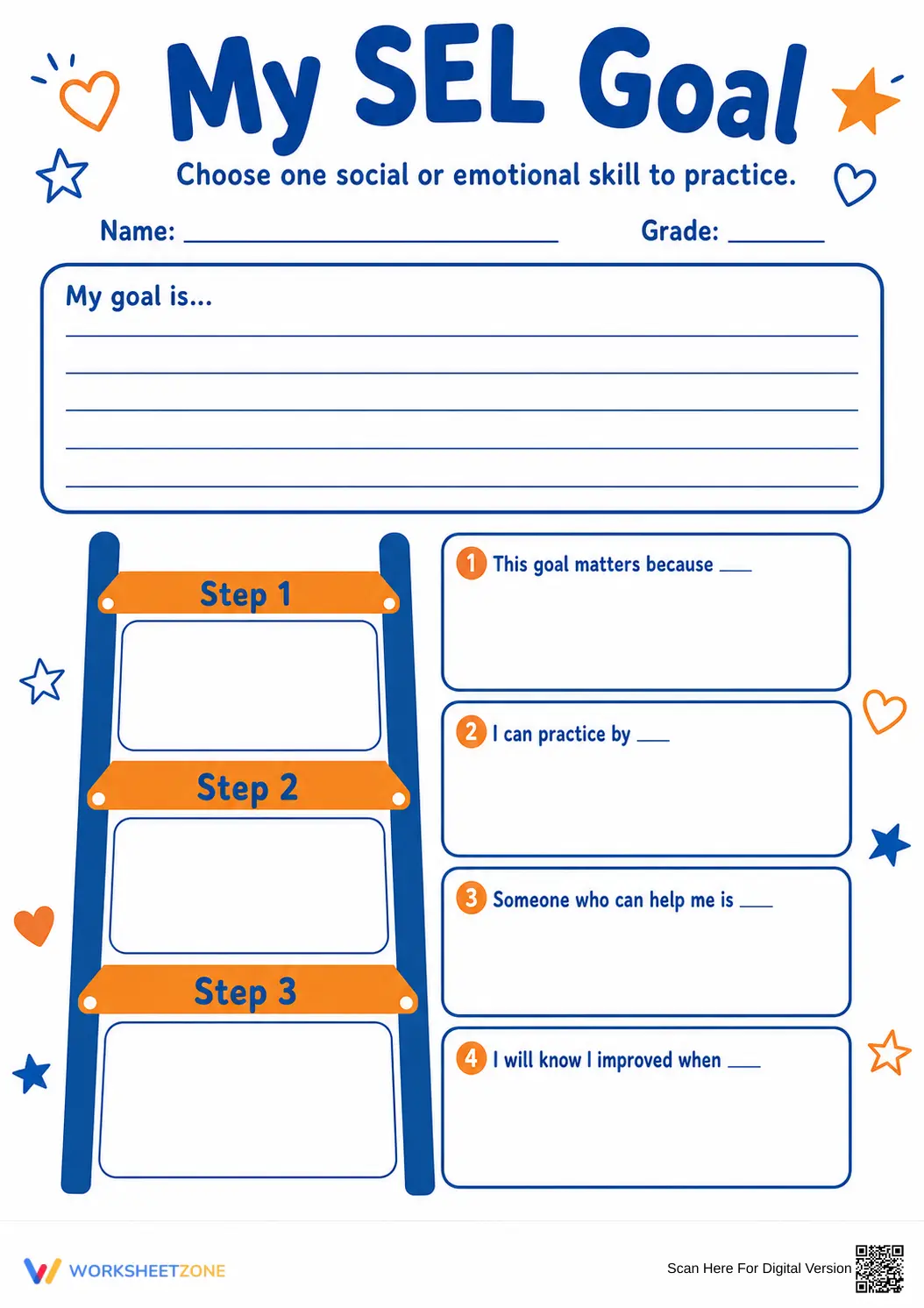
This SEL goal setting worksheet helps students in grades 2 through 6 identify specific social or emotional skills they wish to improve. By breaking down large objectives into manageable steps, students develop self-management and self-awareness. This resource provides a structured framework for personal growth and accountability in the classroom environment.
At a Glance
- Grade: 2-6 · Subject: Social Emotional Learning
- Standard:
CCSS.ELA-LITERACY.W.4.4— Produce clear and coherent writing in which the development and organization are appropriate to task.- Skill Focus: Goal Setting & Self-Management
- Format: 1 page · 8 prompts · No answer key needed · PDF
- Best For: Morning meetings or individual counseling sessions
- Time: 15–20 minutes
The worksheet features a visually engaging Goal Ladder with 3 distinct steps to help students visualize their progress. It includes a primary writing area for the main goal and four specific reflection prompts. These prompts guide students to identify why the goal matters, how to practice, who can support them, and how to measure success. The layout is clean and inviting for young learners.
Zero-Prep Workflow
- Print: Generate the single-page PDF for each student in less than 1 minute.
- Distribute: Hand out the sheets during a morning meeting, SEL block, or counseling session.
- Review: Spend 1 minute per student reviewing completed goals to provide immediate feedback and support.
This print-and-go design makes it an ideal choice for substitute lesson plans or unexpected schedule changes where meaningful student work is required.
Standards Alignment
This resource aligns with `CCSS.ELA-LITERACY.W.4.4`, which requires students to produce clear and coherent writing appropriate to the task and purpose. By articulating a personal goal and the steps required to achieve it, students practice organizational writing skills while developing emotional intelligence. Both standard codes can be copied directly into lesson plans, IEP goals, or district curriculum mapping tools.
How to Use It
Use this worksheet at the start of a new grading period or month to establish a growth mindset. It serves as an excellent formative assessment for self-management skills; observe whether students can identify realistic Step 1 actions. Completion typically takes 15 to 20 minutes depending on the depth of student reflection and the complexity of the chosen goal.
Who It's For
This page is designed for elementary and middle school students, particularly those working on self-regulation or social skills. It pairs naturally with an anchor chart about SMART goals or a direct instruction lesson on self-awareness. It is also suitable for small group intervention or Tier 2 SEL support.
Research from Fisher & Frey (2014) emphasizes that structured goal-setting frameworks significantly improve student agency and academic persistence. By utilizing the `CCSS.ELA-LITERACY.W.4.4` standard within a social-emotional context, this worksheet bridges the gap between literacy and personal development. The use of a visual ladder graphic supports cognitive scaffolding, allowing students to see the path toward mastery. According to the RAND AIRS 2024 report, explicit instruction in self-management skills leads to a 10% increase in positive classroom behavior. This worksheet provides the necessary structure for students to internalize these skills through written reflection. By identifying a specific helper and success criteria, students engage in metacognitive planning that is essential for long-term behavioral change. This evidence-based approach ensures that SEL instruction is both measurable and impactful for diverse learners in the modern classroom.


