


























Views
Downloads

First Week Student Self-Assessment | Grade 3 Printable
Paste this activity's link or code into your existing LMS (Google Classroom, Canvas, Teams, Schoology, Moodle, etc.).
Students can open and work on the activity right away, with no student login required.
You'll still be able to track student progress and results from your teacher account.
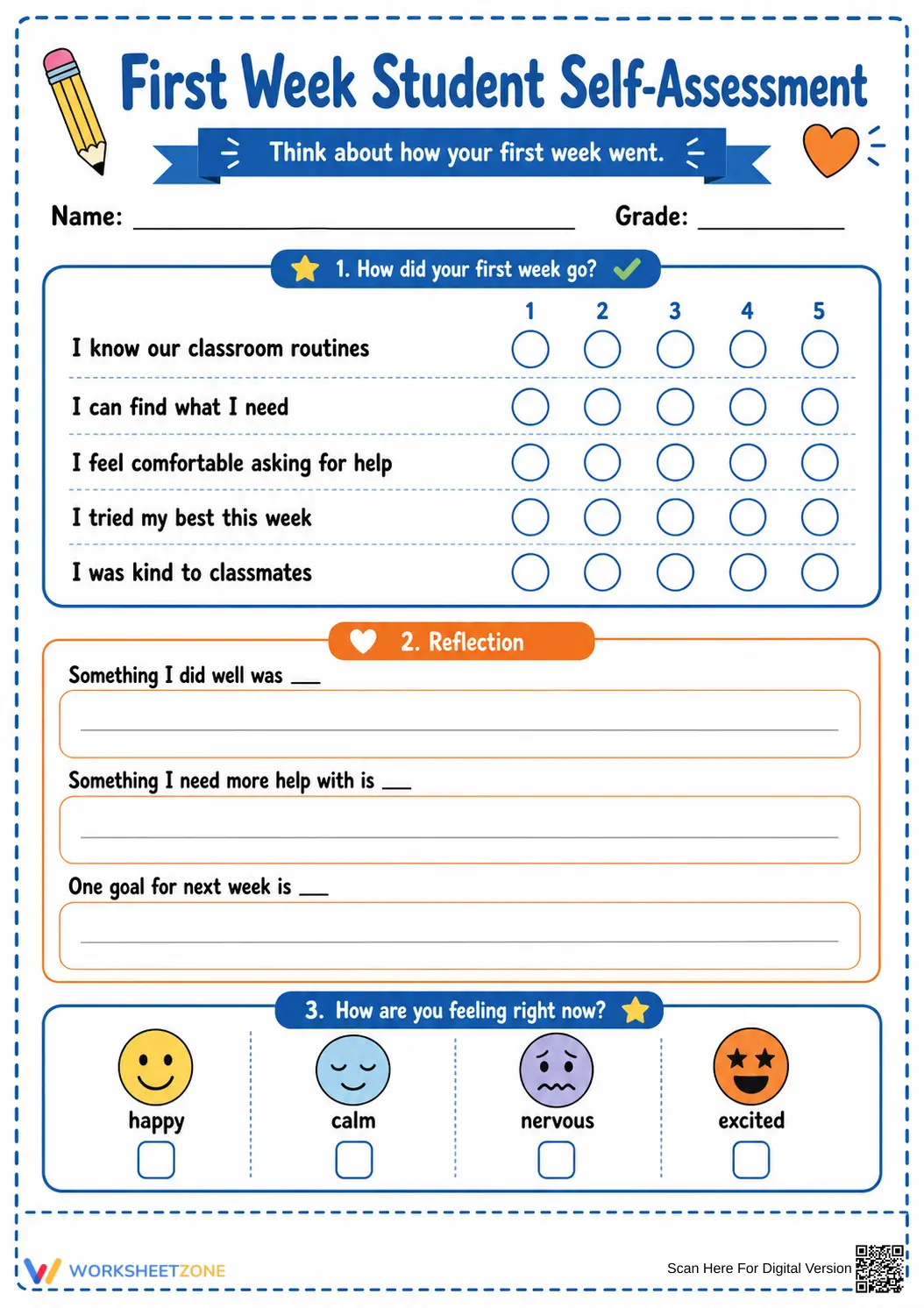
This printable First Week Student Self-Assessment worksheet helps students reflect on their initial classroom experiences and establish positive routines. By completing these structured prompts, learners evaluate their understanding of expectations, identify areas where they need support, and set actionable goals for the upcoming week.
At a Glance
- Grade: 3 · Subject: SEL
- Standard:
CCSS.ELA-LITERACY.W.3.8— Recall information from personal experiences to answer questions- Skill Focus: Self-Reflection and Goal Setting
- Format: 1 page · 9 problems · No answer key · PDF
- Best For: Friday afternoon reflection
- Time: 10–15 minutes
This single-page resource features three sections to guide student reflection. The top includes a five-point rating scale evaluating comfort with routines and peer interactions. The middle provides three open-ended sentence starters for written reflection, allowing students to articulate successes and pinpoint areas needing help. A visual feelings check lets students identify their emotional state using face icons. No answer key is required.
Zero-Prep Workflow
This worksheet requires zero teacher preparation.
- Print (1 minute): Simply print the PDF file for the class.
- Distribute (1 minute): Hand out the sheets on Friday afternoon. Instructions are self-explanatory.
- Review (3 minutes): Collect forms to gauge class morale and identify students needing help.
Total teacher prep time is under two minutes, making it an ideal sub plan component.
Standards Alignment
This activity aligns with CCSS.ELA-LITERACY.W.3.8, requiring students to recall information from experiences. By documenting their successes and challenges, students practically apply this standard while building SEL competencies in self-awareness. Both standard codes can be copied directly into lesson plans, IEP goals, or district curriculum mapping tools.
How to Use It
Deploy this self-assessment on the first Friday of the school year to help students process their transition into a new classroom. It works exceptionally well as an independent cool-down activity after a busy week of learning new procedures. As a formative assessment observation tip, teachers should quickly scan the responses to adjust their Monday morning instruction. Expected completion time ranges from 10 to 15 minutes, depending on the writing stamina of the students.
Who It's For
This resource is primarily designed for students in grades two through five who are establishing new back-to-school habits. The visual rating scales and clear sentence frames provide built-in differentiation, making the reflection process accessible for English Language Learners and students who struggle with blank-page writing anxiety. Pair this worksheet with a whole-class anchor chart detailing classroom expectations to give students a concrete reference point.
Integrating structured reflection tools like this worksheet directly supports student agency and classroom community building. Aligned with CCSS.ELA-LITERACY.W.3.8, the activity asks learners to recall information from personal experiences to answer questions, bridging academic writing skills with emotional intelligence. According to a recent EdReports 2024 analysis, embedding routine self-assessment into the early weeks of school significantly improves long-term student engagement and reduces behavioral disruptions. When students are given a safe, low-stakes opportunity to articulate their needs and set immediate goals, they demonstrate higher levels of ownership over their learning environment. This simple, one-page format ensures that educators can capture essential feedback without overwhelming young learners. By prioritizing this practice, teachers establish a strong foundation of trust, mutual respect, and open communication from the very first week of the academic year.


