Social studies worksheets printable for 12th grade cover the content that shows up on state graduation assessments — US Government, Economics, and Civics — with each worksheet targeting a specific skill rather than surveying an entire unit. Students graph supply and demand shifts, evaluate Supreme Court majority opinions against their dissents, and work through constitutional scenarios that require identifying which branch holds the relevant authority. The set gives teachers materials that hold up across bell-ringers, mid-unit practice, pre-seminar preparation, and formative assessment.
What's Inside the Set
Government worksheets cover the structure and limits of each branch, the mechanics of checks and balances, and the full legislative path a bill travels from committee markup through floor votes to presidential action. Students don't just name the three branches — they apply branch powers to specific scenarios and cite the constitutional text that grants the authority.
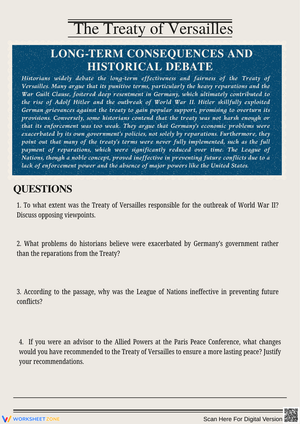
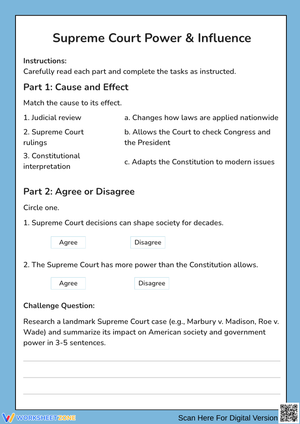
Primary source worksheets bring students into direct contact with the Federalist Papers, landmark Supreme Court opinions (Marbury v. Madison, Tinker v. Des Moines, Brown v. Board of Education), and civil rights-era speeches and executive orders. Each worksheet provides a document excerpt, a set of context questions, and a final argument prompt requiring students to take and support a position — the format they will encounter in AP Government and AP US History assessments.
Economics worksheets in the set cover several core areas of the standard senior-year sequence:
- Supply and demand curves, including both movement along a curve and shifts of the entire curve
- Fiscal versus monetary policy, and how each tool affects inflation and employment
- GDP components and what changes in them signal about economic health or contraction
- Opportunity cost and comparative advantage in domestic and international trade contexts
Several economics worksheets use real-world data sets that students graph and interpret, rather than pre-drawn figures they simply label. Civics worksheets address voting rights history, the distinction between civil liberties and civil rights, media literacy, and local government structure.
Mistakes Students Make That These Worksheets Help You Catch
The most consistent error on primary source worksheets is summarizing instead of analyzing. A student asked "What is the author's argument?" will write a paraphrase of what the document says rather than an evaluation of why the author frames it that way. On a Federalist No. 51 worksheet, a student will write "Madison says ambition must counteract ambition" without explaining why he presents that as a structural solution rather than a moral failing. The follow-up prompts built into each worksheet — "Why does this design matter?" and "What problem does this structure address?" — push students past reporting and into actual analysis.
In economics, confusion between movement along a demand curve and a shift of the entire curve appears in almost every class at the start of the unit. Students move a point along the existing line when the scenario calls for the curve itself to shift left. The graphing worksheets address this by pairing parallel examples side by side — one scenario requiring movement along the curve, one requiring a full shift — so students can see the distinction without a full re-teach from the front of the room.
A third pattern worth anticipating: students consistently conflate civil liberties with civil rights. They understand both terms loosely but use them interchangeably in written responses, collapsing a meaningful legal distinction. The civics worksheets treat the two concepts separately across multiple exercises, giving students enough distributed practice to hold the distinction through summative assessments.
Lesson-Planning Ideas to Get the Most From These Worksheets
Government and civics content lands in 12th grade because it's the last formal instruction most students receive before they turn 18 and become eligible to vote. That context changes the weight of a bell-ringer about voting rights or the electoral process — it's not review for its own sake. A focused 10-minute warm-up on how a bill becomes law, or what the 14th Amendment's equal protection clause actually covers, is preparation for real civic participation. These worksheets surface what students retained from prior instruction and tell you within five minutes where re-entry is needed before moving forward.
Economics graphing worksheets fit best mid-unit, after direct instruction but before individual independent practice. Pair students and let them work through the exercise together. The disagreements that come up — "No, that's a shift, not a movement" — do more instructional work than anything a teacher could say at the same moment. The productive friction between partners is the point.
Primary source analysis worksheets serve a different function. Use them the day before a Socratic seminar: students annotate the document, work through the guided questions, and arrive in class with a position already formed. That preparation turns the seminar from a split between students who read it and students who didn't into a real exchange of supported interpretations. For dual-enrollment and pre-AP sections, the primary source format in social studies worksheets printable for 12th grade — document excerpt, context questions, argument prompt — mirrors AP document-based question structure closely enough to double as direct exam prep.
Standard Alignment
The worksheets align to the C3 Framework for Social Studies State Standards published by the National Council for the Social Studies. Government and civics worksheets address D2.Civ.1.9-12, which asks students to distinguish the powers and limits of governmental institutions at all levels, and D2.Civ.5.9-12, which requires students to evaluate citizens' and institutions' effectiveness in addressing social and political problems. Economics worksheets address D2.Eco.1.9-12, covering individual and collective decision-making under conditions of scarcity. Primary source analysis worksheets also meet CCSS.ELA-LITERACY.RH.11-12.6, which asks students to evaluate authors' differing points of view on the same historical event using primary and secondary sources. In most school calendars, the D2.Civ indicators fall in first-semester government and the D2.Eco indicators in second-semester economics — which is when teachers most often find that the textbook's built-in practice falls short of what district and state assessments actually require.
Differentiating These Worksheets Across Ability Levels
Teachers who use social studies worksheets printable for 12th grade in mixed-ability classrooms rarely need to build parallel versions of the same activity — the existing format has enough flex built in. For students who struggle with open-ended written response, the structured-prompt format reduces the blank-page problem. Instead of "analyze this document," the question reads: "What decision does the author want the reader to make, and what two pieces of evidence support it?" That level of specificity is enough for most students to begin without direct intervention.
For students in advanced or honors sections, the guided prompts can be covered: provide the primary source alone and assign only the final argument prompt. The exercise becomes more demanding without changing the underlying content. For English language learners, the primary source worksheets pair well with a short vocabulary list covering recurring Latinate legal terms — judicial review, enumerated, concurrent, appellate — terms that represent a language barrier rather than a content gap. Removing that barrier lets teachers assess what students actually understand about constitutional structure, not what they can decode from eighteenth-century diction.
Frequently Asked Questions
How long does each worksheet take to complete?
Most government and civics worksheets run 10 to 15 minutes for on-level students. Primary source analysis worksheets — which include a document excerpt, context questions, and an argument prompt — typically run 20 to 25 minutes. Economics graphing worksheets vary: a supply and demand exercise takes about 15 minutes, while a multi-variable fiscal policy worksheet can run 25 minutes or more when students work independently.
Are these worksheets suitable for AP Government or dual-enrollment courses?
The primary source analysis and constitutional scenario worksheets translate directly to AP Government and AP US History preparation. The document-based format matches what students encounter on AP exams, and the economics worksheets reach the conceptual depth of introductory macroeconomics at the college level. Teachers in dual-enrollment sections regularly use the economics worksheets as unit assessment practice.
Do the economics worksheets use current data?
Several worksheets include data drawn from recent federal economic indicators — GDP growth figures, Consumer Price Index changes, and unemployment rates. These are marked within the set so teachers can locate them quickly. Using real figures matters in economics instruction: students who track a trend they recognize from the news retain the underlying concept more reliably than students working from hypothetical examples. That's also why social studies worksheets printable for 12th grade incorporating current economic data are worth revisiting as conditions change — the instructional content stays the same, but updated figures keep the examples from feeling dated.