


























Views
Downloads

Classroom Seating Chart Planner | Essential Teacher Tool
Paste this activity's link or code into your existing LMS (Google Classroom, Canvas, Teams, Schoology, Moodle, etc.).
Students can open and work on the activity right away, with no student login required.
You'll still be able to track student progress and results from your teacher account.
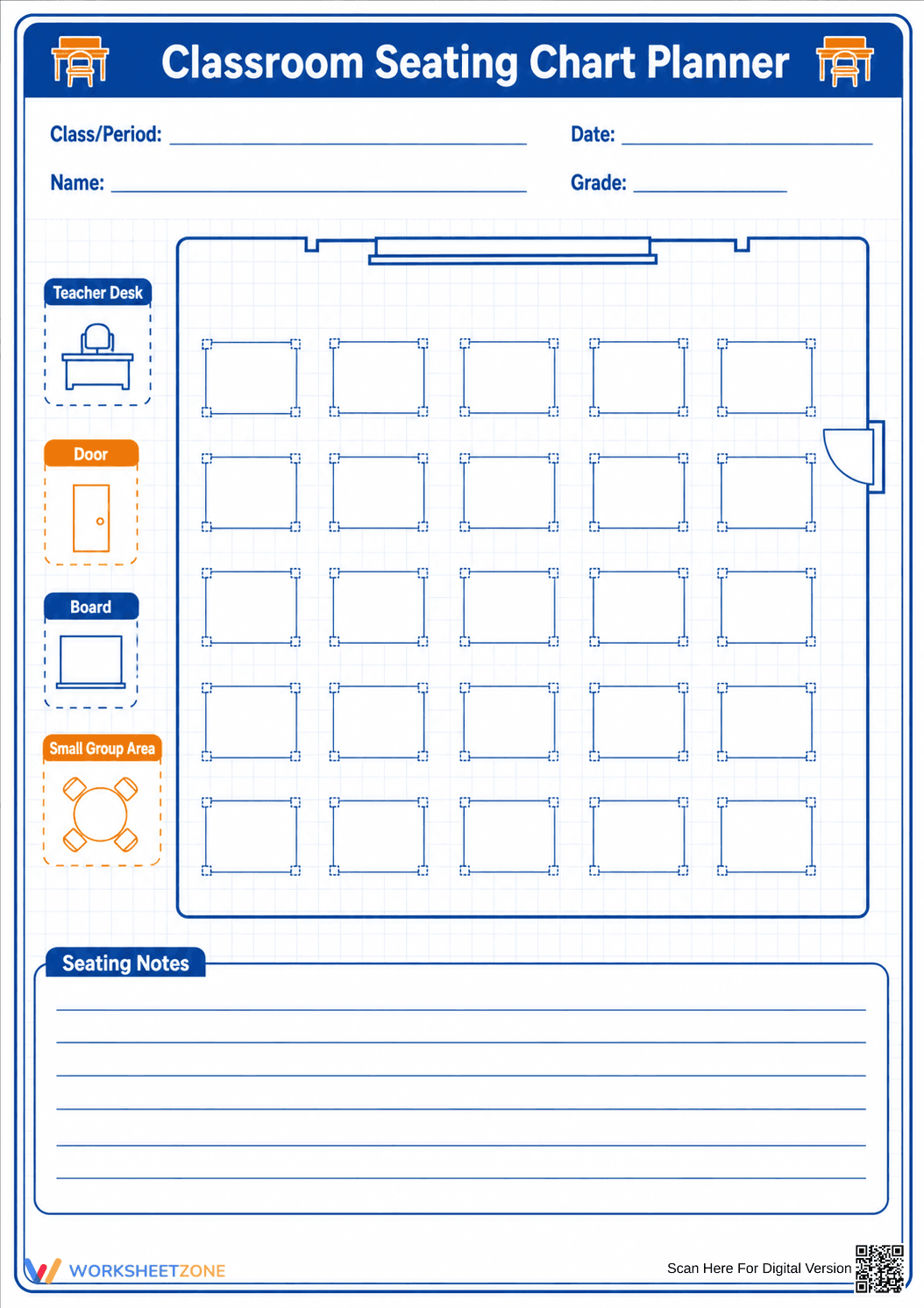
This Classroom Seating Chart Planner provides a streamlined way for educators to organize their physical learning environment. By mapping out student placement, teachers can optimize classroom flow and support behavioral management strategies. This tool ensures that every student has a designated space that maximizes their focus and accessibility to instructional materials.
At a Glance
- Grade: K-12 · Subject: Classroom Management
- Standard:
K-12.MGMT.1— Organize physical classroom space to support student learning and safety- Skill Focus: Classroom Organization
- Format: 1 page · 25 desk slots · Teacher notes section · PDF
- Best For: Back-to-school planning and sub folders
- Time: 5–10 minutes
The planner features a clean, professional layout with a 5x5 grid of movable-style desk rectangles. It includes dedicated icons for the teacher's desk, the door, the whiteboard, and a small group area to provide a comprehensive top-down view of the room. A wide Seating Notes section at the bottom allows for recording specific student needs, medical alerts, or IEP accommodations alongside the visual map.
Zero-Prep Workflow
- Print: Select the PDF and print one copy for each class period or section in less than 30 seconds.
- Distribute: Keep these in a teacher binder or substitute teacher folder for immediate reference during transitions.
- Review: Update the chart as needed throughout the term to reflect new seating arrangements or behavioral adjustments. Total teacher prep time is under 2 minutes.
While not a student-facing academic standard, this resource aligns with K-12.MGMT.1, which focuses on the professional ability to organize a physical environment that is conducive to learning. Effective seating arrangements are a cornerstone of classroom management and student safety. This standard code can be copied directly into lesson plans, IEP goals, or district curriculum mapping tools.
Use this planner during the first week of school to establish a structured environment. It is also an excellent formative tool; by noting student interactions on the chart, teachers can identify which pairings lead to the highest engagement. Expected completion time for a full room layout is approximately 10 minutes per class period.
This resource is designed for K-12 teachers across all subjects. It is particularly useful for middle and high school teachers who manage multiple class periods and need a quick visual reference for attendance and participation. It pairs naturally with a printed class roster or a behavioral tracking sheet to create a complete management system.
Research by Fisher & Frey (2014) emphasizes that the physical arrangement of a classroom significantly impacts student behavior and academic performance. A well-designed seating chart allows for better proximity control and reduces off-task behavior by placing students in optimal learning positions. According to the RAND AIRS 2024 report, teachers who utilize structured organizational tools report higher levels of classroom control and lower stress during transitions. This planner addresses the need for a visual representation of the classroom, facilitating better communication with substitute teachers and support staff. By using the K-12.MGMT.1 framework, educators can ensure their room layout supports both direct instruction and collaborative group work. This document serves as a professional artifact for teacher evaluations, demonstrating a commitment to creating a safe and orderly learning environment for all students.


