Dred Scott vs Sandford Worksheets for 12th Grade
These dred scott vs sandford worksheets for 12th grade give seniors direct practice with one of the most instructionally demanding cases in American constitutional history. The 1857 ruling touches constitutional interpretation, 19th-century racial ideology, legislative authority, and the legal meaning of citizenship simultaneously — which is exactly what makes it worth teaching at the senior level, because students cannot summarize their way through it. The set requires them to read, annotate, compare, and argue.
Skills These Worksheets Build
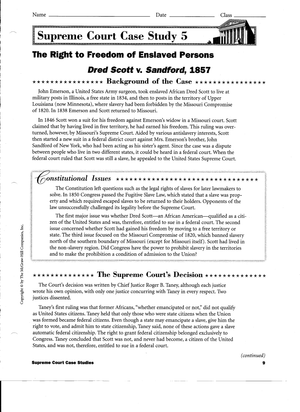
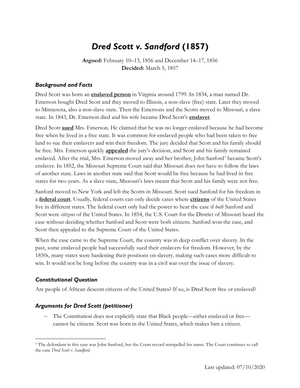
The foundational skill is timeline reconstruction. Dred Scott's legal claim depended entirely on the sequence of his movements — Illinois (a free state), the Wisconsin Territory (free under the Missouri Compromise of 1820), then back to Missouri (a slave state). Students who cannot reconstruct that geography and its governing law cannot evaluate the argument. Each worksheet in the factual record section asks students to map each jurisdiction Scott entered and identify the specific legal authority that applied: Illinois statehood, the Northwest Ordinance's territorial legacy, the Missouri Compromise's prohibition on slavery north of 36°30', and Missouri's slave code upon his return. That groundwork prevents the common error of treating this as a generic freedom lawsuit rather than a carefully jurisdictional claim.
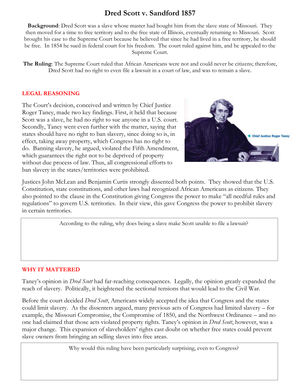
Primary source comparison sits at the center of the set. Students annotate passages from Chief Justice Taney's majority opinion alongside Justice Benjamin Curtis's dissent — not just reading, but marking the constitutional clause each justice cites and writing a one-sentence paraphrase of the legal argument in the margin. The exercise is harder than it looks. Taney's opinion issues three distinct rulings: whether Scott had standing to sue in federal court, whether the Missouri Compromise was constitutional, and whether enslaved people constituted protected property under the Fifth Amendment's Due Process Clause. Students routinely conflate these, treating the decision as a single holding rather than a compound constitutional argument. Curtis's dissent deserves close attention for a different reason — it is an originalist argument, not a moral one. He assembled historical evidence showing that African Americans had voted on the Constitution's ratification in several states, attacking Taney's historical claims on their own methodological terms. Students who recognize that difference are ready for a substantive conversation about judicial interpretation.
The third skill cluster connects the 1857 ruling to its constitutional correction. One worksheet places the citizenship passage from Taney's majority opinion directly alongside Section 1 of the 14th Amendment, and students identify, sentence by sentence, where the amendment's language responds to specific claims in the ruling. This is more rigorous than simply knowing that the 14th Amendment "overturned Dred Scott." It trains students to read both documents at the sentence level and to understand how the amendment process functions as a corrective mechanism — something neither lecture nor textbook summary makes visible in the same way.
Building These Worksheets Into Your Unit Plan
The dred scott vs sandford worksheets for 12th grade work well in a three-day sequence: a foundational session on the factual and historical record, a document analysis session on the primary sources, and a synthesis session where students take and defend a position. The synthesis can take several forms — a Socratic seminar on the limits of judicial power, a structured academic controversy, or a mock appellate court where students argue from the Constitution as it existed in 1857, setting aside what they know about the Reconstruction Amendments. That last constraint matters. Requiring students to work within the actual legal framework of the antebellum period forces a different kind of historical thinking than working backward from a known outcome.
The glossary worksheet earns its place on day one. Taney's opinion is dense 1850s legal prose, and students who stall on vocabulary like "domicile of origin" or the archaic phrasing around territorial sovereignty never get to the constitutional analysis. Pairing those phrases with plain-language equivalents lets students direct their attention to the structural arguments. This matters most when students are reading both Taney and Curtis in the same session — the Curtis dissent runs long and requires sustained focus to follow the historical evidence he builds paragraph by paragraph.
What Students Get Wrong About This Case
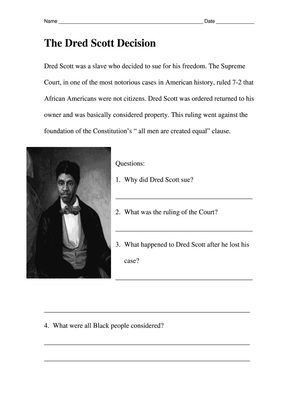
The most persistent misconception is that Dred Scott simply lost a lawsuit. Students read it as a narrow ruling against one man's freedom claim. They miss that Taney's opinion made sweeping constitutional declarations — none of which were strictly necessary to decide Scott's individual case — and that these declarations had immediate national consequence. The worksheets address this directly: before analyzing any portion of the opinion, students list each of Taney's three holdings separately, which forces them to see the ruling's scope before they start evaluating its reasoning.
A second recurring error involves the 14th Amendment. Students frequently say the 14th Amendment "ended slavery" — collapsing it with the 13th — or state that the Supreme Court "reversed" the Dred Scott decision when it was actually overturned through the amendment process. That distinction matters for understanding how constitutional self-correction works. The worksheet placing Taney's citizenship language directly next to Section 1 of the 14th Amendment makes the mechanism concrete in a way that fixes this confusion reliably.
A subtler error: students who recognize that Curtis was morally right tend to assume his argument was a moral one. It was not. Curtis relied on historical evidence — 18th-century citizenship records, documented voting participation — to challenge Taney's originalist claims on their own methodological ground. Students who miss this write about Curtis as a progressive voice rather than as a legal scholar who applied historical methodology more rigorously than the Chief Justice did. The annotation worksheet asks students to identify the type of evidence Curtis uses in each paragraph, which surfaces this distinction without the teacher having to state it outright.
Standard Alignment
These dred scott vs sandford worksheets for 12th grade align to several CCSS ELA-Literacy standards for grades 11–12 in History/Social Studies:
- RH.11-12.1 — Cite specific textual evidence from primary and secondary sources; the annotation work on Taney's and Curtis's opinions addresses this standard at the sentence level.
- RH.11-12.6 — Evaluate authors' differing points of view on the same historical event; the majority/dissent comparison worksheet targets this standard directly.
- RH.11-12.8 — Assess the reasoning in historically or technically complex texts; the constitutional analysis sections require students to evaluate Taney's logic against the actual text of the Fifth Amendment and Article III's standing requirements.
In AP U.S. History, the case falls under Key Concept 5.2.I — the intensification of sectional tensions over slavery's expansion — and Key Concept 5.3.I, which covers the political realignment of the 1850s. Teachers using these resources in an AP Government course will find them relevant to the judicial interpretation unit, specifically the tension between judicial restraint and judicial activism in politically charged cases.
Leveling the Work: Adjustments for Stronger and Weaker Readers
For students who struggle with 19th-century primary sources, the glossary worksheet and pre-reading annotation frames reduce the initial barrier. Instead of reading the full opinions cold, these students work from excerpted passages paired with sentence-level guiding questions: What claim is Taney making here? What constitutional clause does he cite? What evidence does Curtis offer in response? That structure keeps students analyzing rather than stalling on unfamiliar syntax.
Students ready for more depth can extend into the political context surrounding the ruling. Taney was a Jacksonian appointee; the decision was 7-to-2; President-elect Buchanan had been privately briefed on the outcome before his inauguration and alluded to it in his inaugural address. For these students, dred scott vs sandford worksheets for 12th grade become a case study not just in constitutional law but in how political context shapes judicial reasoning — a question that maps directly onto AP Government prompts about the independence of the federal judiciary.
Frequently Asked Questions
How did the ruling affect the legal status of enslaved people in free states?
By treating enslaved people as property protected under the Fifth Amendment's Due Process Clause, the Court implied that slaveholders could bring enslaved individuals into free territory without surrendering ownership. This directly undermined the legal logic that had long governed freedom suits — that residence in a free jurisdiction conferred freedom. Northern states had relied on that principle as the foundation of their anti-slavery statutes, and the ruling created widespread fear that slavery could no longer be excluded anywhere within federal jurisdiction, regardless of state law.
What role did the Missouri Compromise play in Scott's argument, and what happened to it?
Scott's claim to freedom rested partly on his time in the Wisconsin Territory, where the Missouri Compromise of 1820 explicitly prohibited slavery. Taney's majority opinion declared the Compromise unconstitutional, ruling that Congress had never possessed the authority to ban slavery in the territories. That declaration nullified Scott's jurisdictional argument and simultaneously stripped the federal government of its primary legislative tool for managing slavery's westward expansion. Northerners who had treated the Compromise as settled law for nearly 40 years received the ruling as proof that a Slave Power was manipulating the federal government — a reaction that accelerated the collapse of the Second Party System.
How does the 14th Amendment specifically respond to Taney's citizenship argument?
Taney argued that African Americans had never been intended as citizens under the original Constitution and therefore lacked standing to sue in federal court. The first sentence of the 14th Amendment — establishing birthright citizenship for all persons born or naturalized in the United States — directly nullifies that claim. It requires no racial qualification, and by embedding the definition in the constitutional text itself, it placed the question beyond the reach of a future Court majority inclined to revisit it on similar grounds. That is why the amendment's drafters wrote it in terms of persons, not categories of persons: the universality was deliberate.
Clear All