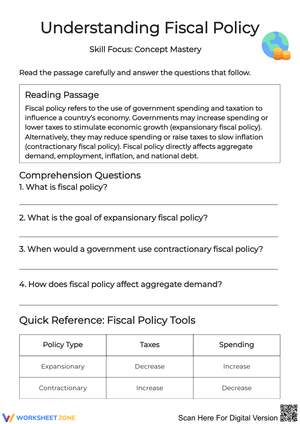
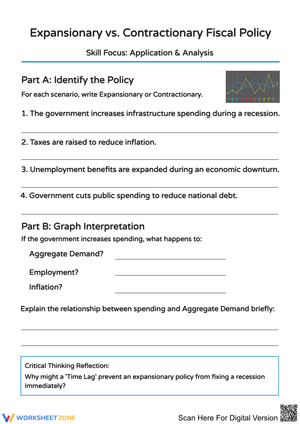
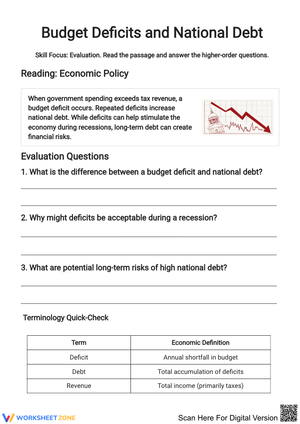
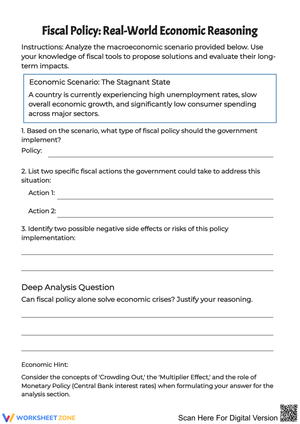
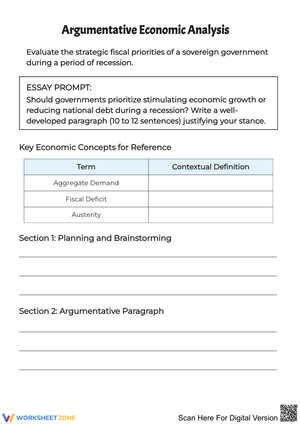
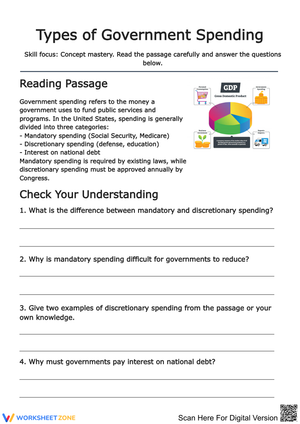
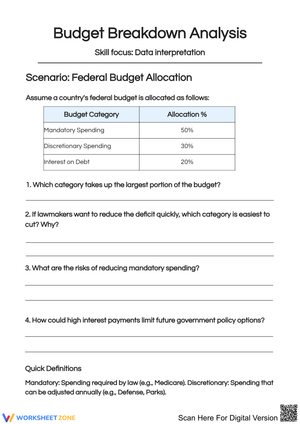
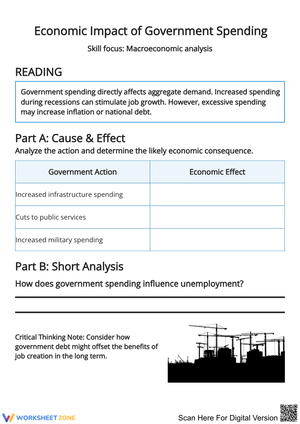
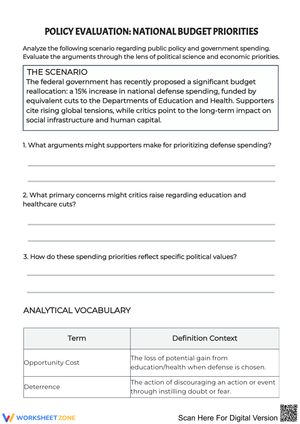
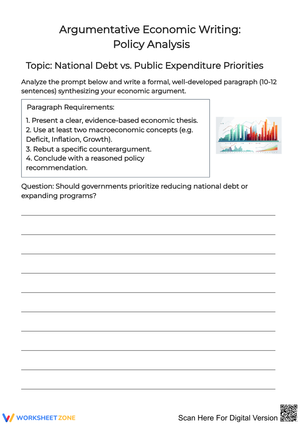
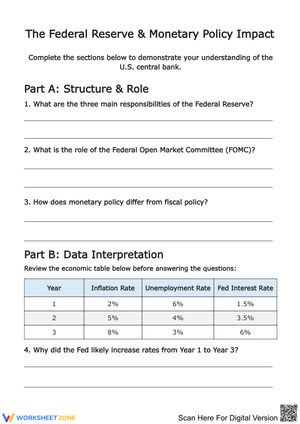
These economics pdf worksheets for 12th grade cover the full instructional sequence — supply and demand, GDP measurement, fiscal and monetary policy, comparative advantage, and personal finance — giving teachers concrete, printable practice that holds up across a semester-long course. Each worksheet stands alone, so it drops cleanly into an existing unit plan without requiring any reorganization.
The Specific Skills and Content These Worksheets Target
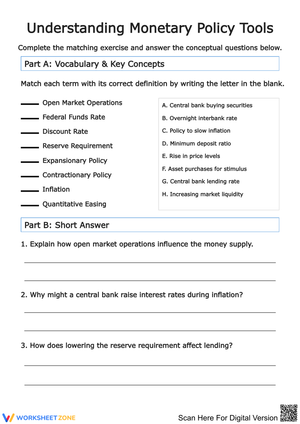
On the macroeconomics side, students calculate real versus nominal GDP, interpret Consumer Price Index data to find inflation rates, and trace the spending multiplier's effect on aggregate demand. The monetary policy worksheets ask students to sequence an open-market purchase by the Fed — from bond purchase through money supply expansion to interest rate change — a chain of reasoning that trips up even students who understand the individual steps in isolation.
Microeconomics worksheets center on supply and demand graph analysis: labeling equilibrium, predicting the direction of price and quantity changes after a shift, and distinguishing a shift in the curve from a movement along it. Market structure exercises ask students to sort firm behaviors — price-setting authority, output decisions, barriers to entry — across perfect competition, monopolistic competition, oligopoly, and monopoly. International trade worksheets build around opportunity cost tables for comparative advantage and exchange rate interpretation for importers and exporters. The personal finance set addresses budgeting, credit scores, compound interest calculations, and behavioral economics: students identify anchoring bias in pricing scenarios and calculate how loss aversion distorts a savings decision — content that reflects where state and national standards have moved over the past decade.
Where Students' Economic Reasoning Tends to Slip
The single most persistent error in 12th-grade economics is the shift-versus-movement confusion on supply and demand graphs. A student who correctly states that rising consumer income increases demand will still draw a new point on the original curve rather than shifting the whole curve outward. These worksheets build in sequential graph-labeling steps — draw the shift, mark the new equilibrium, record the direction of price and quantity changes — which forces students to execute the full reasoning sequence rather than stopping at the verbal answer.
Comparative advantage exercises surface a different and very reliable error. Given a production possibilities table, students are asked to determine which country holds the comparative advantage in each good. The reliable mistake: they compare absolute output numbers rather than calculating opportunity cost ratios. A student writes "Country A should produce wheat because it produces more wheat per worker" without ever dividing. These worksheets address this by requiring students to complete a labeled opportunity cost column before drawing any conclusion — the skipped step becomes visible on the paper rather than invisible in the student's head.
GDP measurement exercises catch a subtler problem. Students who know the expenditure formula — consumption plus investment plus government spending plus net exports — routinely add transfer payments like Social Security or unemployment benefits to the government spending column, not recognizing that transfers do not represent direct government purchases of goods and services. That error appears on AP assessments and on many state end-of-course exams, so catching it during practice matters.
Planning These Worksheets Into Your Weekly Instructional Flow
Bell-ringer use produces the highest return for these materials. A five-minute monetary policy scenario at the start of class — "What happens to interest rates if the Fed buys bonds? Show the sequence." — pulls students into economic thinking before the lecture goes abstract. The economics pdf worksheets for 12th grade that cover Fed policy work particularly well this way: students who have committed an answer on paper at 8:05 engage differently with the lecture that follows than students who arrive cold.
Exit tickets are the other reliable slot. A single GDP calculation or a short comparative advantage problem in the last eight minutes gives immediate data on where the room is. Students who write transfer payments into the expenditure formula on Thursday's exit ticket get a targeted correction Friday morning, before that misconception travels into the weekend and hardens.
Pair work suits the market structure worksheets well. Two students sorting firm behaviors into a four-column chart will argue with each other in ways that surface misconceptions faster than individual seatwork does. Give pairs three minutes, then cold-call one pair per column. The disagreement is often more instructive than the correct answer.
Standard Alignment
The Council for Economic Education's Voluntary National Content Standards in Economics provides the most widely used benchmark for this content. Standard 7 (Markets — Trade, Exchange, and Interdependence) and Standard 9 (Competition and Market Structure) align with the microeconomics worksheets. Standard 11 (Money and Inflation) and Standard 20 (Fiscal and Monetary Policy) map directly to the macroeconomics set. The international trade worksheets correspond to Standards 5 and 6, which address specialization and the gains from trade.
For teachers in states using the C3 Framework, the economics dimension (D2.Eco) at the 9–12 band spans fifteen standards. D2.Eco.2.9-12 — applying decision-making models to economic reasoning — connects to the personal finance and behavioral economics worksheets. D2.Eco.4.9-12 — evaluating competition among buyers and sellers in specific markets — maps to the market structure exercises. These alignments matter for lesson plan documentation and department review, particularly where economics is a standalone graduation requirement, which now includes roughly thirty states.
Adjusting the Set for Students at Different Points in Their Understanding
For students who struggle with graphing, the supply and demand worksheets that pre-draw the axes and label the curves remove the visual setup work so students can focus on the analytical question — what shifts, why, and in which direction. The expectation stays the same: label the new equilibrium and state the direction of price and quantity changes. Reducing the drawing burden does not mean reducing the reasoning standard.
Students who move through the standard exercises quickly benefit from extension questions built into the international trade worksheets: after determining comparative advantage from an opportunity cost table, they analyze how a tariff changes the effective cost calculation for domestic producers — the same framework applied under messier, real-world conditions. The behavioral economics exercises in the personal finance set serve a similar function; designing a nudge that would alter a specific consumer behavior requires synthesis, not just application.
For economics pdf worksheets for 12th grade used in co-taught sections, the GDP measurement exercises respond well to a structured two-column organizer built during direct instruction — what counts in the expenditure formula, what does not — before students work the worksheet independently. Students with extended-time accommodations find the step-by-step calculation format in the money multiplier exercises manageable without any modification to the content standard itself.
Frequently Asked Questions
Do these worksheets require prior coursework beyond a standard introductory economics unit?
No. The set assumes students have had basic exposure to supply and demand — the kind covered in most 11th-grade social studies survey courses or in the first two weeks of a dedicated economics class. The personal finance and behavioral economics worksheets require only arithmetic; no statistics or calculus background is assumed. Teachers whose students arrive with stronger quantitative preparation can use the built-in extension questions without creating separate materials.
How do these fit in AP Economics sections running alongside a standard course?
The macro and micro worksheets cover content with significant overlap with AP Microeconomics and AP Macroeconomics. Graph-labeling exercises — marking shifts, identifying new equilibrium, explaining the adjustment mechanism — are core AP skills, and these worksheets give non-AP students a version of that practice at accessible difficulty. AP teachers sometimes use the same worksheet for initial concept exposure before moving to released free-response prompts as the course progresses. The economics pdf worksheets for 12th grade in this set do not replicate the format of AP free-response questions, so they function as concept practice rather than exam simulation.
Are teacher answer keys included?
Yes. Each worksheet comes with an answer key that shows intermediate steps for calculation and graph-labeling exercises — not just the final answer. That detail matters when reviewing student work quickly between classes: seeing exactly where a student's reasoning diverged from correct is more useful than marking items wrong and moving on.












 Interactive Worksheet Maker
 Quiz Maker
 Word Search Maker
 Crossword Puzzle Maker
 Word Scramble Generator
 Sentence Scramble Generator
 Handwriting Worksheet Generator
 Name Tracing Generator
 Fill In The Blank Generator