These 12th grade behavior worksheets printable resources give seniors structured practice with something rarely addressed explicitly in academic preparation: analyzing the gap between what they intend to communicate and what others actually receive. The set covers perspective-taking, cognitive bias, conflict resolution, and ethical decision-making — skills with immediate stakes once students leave the building for college, work, or independent living.
Skills These Worksheets Build
Each worksheet targets a distinct competency within social-emotional reasoning, and the level of analysis expected here is deliberately higher than what appears in 9th or 10th grade SEL materials. Seniors are expected not just to name an emotion or identify a conflict, but to explain the structural and cognitive factors that produced it.
- Fundamental attribution error — students examine why they overweight personality explanations ("she's just rude") while underweighting situational context ("she hadn't slept and was managing a family emergency")
- Active listening and non-verbal interpretation — annotation tasks where students mark a scenario or dialogue transcript to identify where communication fractured and why
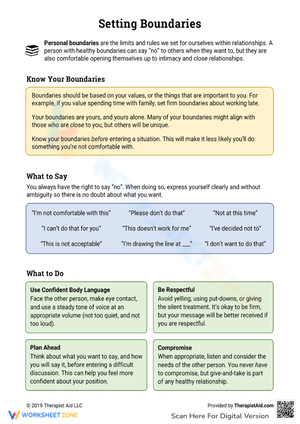
- Assertiveness vs. aggression — rewriting exercises where students revise aggressive statements into assertive ones while preserving the substantive message
- Perspective-taking through case studies — detailed character profiles requiring students to reconstruct a conflict from at least two vantage points before drawing conclusions
- Ethical dilemma analysis — structured prompts that require naming the competing values at stake before students stake out a position
- Social accountability — reflection tasks examining how group dynamics diffuse or intensify individual responsibility
The 12th grade behavior worksheets printable case study materials situate scenarios in college orientation, workplace onboarding, and shared housing contexts rather than high school hallways. That placement is intentional. Seniors completing these worksheets in April recognize the situations as their near future, which raises the stakes enough to keep engagement real.
Student Thinking Patterns Worth Watching and Correcting
The fundamental attribution error worksheet reliably exposes something worth catching: students who correctly identify the bias in a stranger's behavior within a written scenario will, in the same class period, attribute a classmate's tardiness entirely to laziness — no contextual reasoning applied. The worksheet makes that contradiction visible in a way that discussion alone cannot. Students can see their own reasoning on paper and register the inconsistency themselves. That moment of self-confrontation is where the actual learning tends to happen.
The assertiveness rewriting tasks reveal a separate blind spot. Many seniors conflate directness with hostility, particularly students who have learned that stating needs plainly invites social conflict. Their instinct is to soften the language until the request itself disappears. The exercise asks them to hold the substantive content of the message while adjusting tone only — a distinction that takes two or three attempts before most students get real traction. Resist the impulse to demonstrate the correct rewrite on the first pass; watching students work toward it themselves is more instructive for them and more informative for you as the teacher.
On the ethical dilemma worksheets, the most consistent error is skipping the value-identification step entirely and jumping straight to a conclusion. Students justify whatever outcome they already preferred. Making that step a graded checkpoint — not optional, not something to circle back to — typically interrupts the pattern before it sets.
Where These Worksheets Fit in Real Teaching Weeks
These worksheets fit cleanly inside advisory periods, but they often work better embedded in content-area instruction. When a class is analyzing Othello or The Kite Runner, the fundamental attribution error worksheet drops naturally into character analysis — students apply the same analytical framework to Iago or Assef that they would to a peer. The SEL content gains traction because it connects to material students are already academically accountable for.
For conflict resolution and assertiveness worksheets, individual completion followed by a small-group debrief consistently outperforms either format used alone. Students who fill out the worksheet in silence first arrive at the group conversation with a position already formed, and the discussion moves faster and goes deeper. Groups of three work better than four for this structure — with four, one student typically defaults to passive listening rather than contributing.
These 12th grade behavior worksheets printable resources also fit naturally into college application preparation. The perspective-taking skills required to reconstruct a conflict from multiple angles transfer directly to writing about a challenge in a personal statement, or to fielding behavioral interview questions. Naming that connection explicitly before students start — especially in late spring when seniors have mentally checked out — raises engagement noticeably.
Working Across Readiness Levels With the Same Set
Students who need more support benefit from a brief class discussion before independent work begins, one that builds shared vocabulary around terms like "attribution" and "social accountability." Without that grounding, lower-readiness students tend to describe events rather than analyze causes. That surface-level drift is most visible in the case study worksheets, where the prompt explicitly asks for explanation but students who haven't internalized the analytical vocabulary default to retelling what happened instead.
For students who move through worksheets quickly and produce thorough first responses, counter-analysis is the most productive extension: ask them to construct the strongest possible defense of the position they argued against. If a student concluded that Character A behaved unethically, have them write Character A's best-case justification. That reversal works the same analytical muscle from a harder angle, and the writing it produces is noticeably more rigorous than simply expanding on an already-solid first response.
The 12th grade behavior worksheets printable format supports quiet differentiation because each worksheet stands independently — teachers can assign different worksheets from the set to different students without it being apparent that different work is happening in the room.
Standard Alignment
These worksheets align most directly with CASEL's 9–12 SEL competencies, particularly social awareness (perspective-taking, empathy, recognizing diverse social norms) and responsible decision-making (evaluating personal, interpersonal, and community consequences before acting). The analytical writing demands of the case study and ethical dilemma worksheets connect to CCSS.ELA-LITERACY.W.11-12.1 (argument supported by evidence and clear reasoning) and CCSS.ELA-LITERACY.SL.11-12.1 (substantive collaborative discussion that builds on others' ideas). Many state college-and-career-readiness frameworks now include explicit social-emotional standards for graduating seniors alongside academic benchmarks — these worksheets address both tracks simultaneously rather than requiring teachers to treat them as separate priorities.
Frequently Asked Questions
Do these worksheets work in content-area classes, or are they better suited to advisory and SEL periods?
They work in both, but content-area embedding is often more effective. When behavior analysis connects to a novel, a historical event, or a case study already in the curriculum, students engage more seriously because the context feels academic rather than therapeutic. The assertiveness and conflict resolution worksheets slot particularly well into English classes; the ethical dilemma materials fit naturally in Social Studies or Government.
How much class time should I budget for a typical worksheet?
Individual completion of a case study or ethical dilemma worksheet takes roughly 15–20 minutes for students working thoughtfully. The assertiveness rewriting tasks run shorter — about 10–12 minutes — because the task is more concrete. If you plan a debrief discussion afterward, add another 10–15 minutes. The debrief is where most of the transfer happens, so cutting it short to save time usually costs more than it saves.
Some of my students have lived through real interpersonal conflict. Could these scenarios hit too close?
The worksheets use hypothetical scenarios, which provides useful analytical distance. That said, a few conflict scenarios — particularly those involving social exclusion or unequal power dynamics — can surface real feelings for some students. Framing the activity as analytical before students begin ("we're examining these patterns in a fictional case, not re-living personal situations") reduces that risk considerably. If your cohort has experienced significant interpersonal conflict as a group, loop in your school counselor for follow-up conversations.
What makes the analytical demands here different from earlier-grade SEL materials?
Earlier-grade SEL materials typically focus on emotion identification, basic de-escalation, and self-regulation. These resources assume that foundation is already in place and move into more demanding territory — students are expected to explain why behaviors occur by naming cognitive, contextual, and social factors, not just describe what happened. The cognitive bias worksheets in particular require a level of self-critical analysis that most 9th graders aren't developmentally positioned to do with consistency.