Mastering 12th Grade Boundaries: Comprehensive Lesson Resources for Independence
These 12th grade boundaries worksheets pdf give school counselors and advisory teachers a set of structured activities built around the decisions seniors are already facing — who gets access to their time, their emotional energy, their digital space, and their physical presence. The set addresses boundary recognition, assertive communication, and digital privacy in formats that hold up in both a 50-minute class period and a shorter advisory block.
What the Set Covers
Each worksheet targets a specific skill within the broader arc of boundary-setting rather than treating the topic as one undifferentiated concept. Skills across the set include:
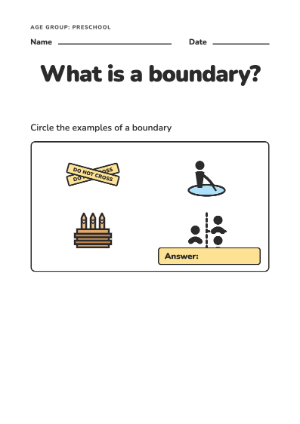
- Identifying the four boundary types — physical, emotional, mental, and digital — and mapping where a student currently draws each line
- Distinguishing assertive communication from passive or aggressive responses, including practice rewriting statements from one register to another
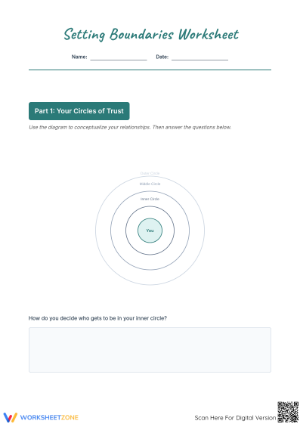
- Completing boundary-mapping exercises using a concentric-circle format, with students annotating what level of access different people in their lives actually have
- Reflecting on digital habits: who can see location data, what an employer or admissions reader would find in a public profile, and what to do when someone pressures them to stay constantly reachable
- Scripting real-life phrases for common senior-year situations — lending money to a friend, declining a social obligation during finals, telling a future roommate about sleep needs
The concentric-circle boundary map deserves specific mention because it tends to generate more honest self-disclosure than open-ended journaling. When students assign names to rings and label what each person is allowed to know or access, they frequently discover mismatches — someone placed in the close-friend ring who actually behaves more like an acquaintance. That recognition is the kind of insight that drives real classroom discussion, and it surfaces organically without the teacher having to push.
Mistakes Students Make That These Worksheets Help You Catch
The most predictable error at this grade level is confusing assertive language with aggressive language. A student asked to write a boundary statement about shared study time will often produce something like "You need to stop texting me when I'm studying" — which is a demand directed at another person, not an expression of the student's own need. The assertive version is "I turn my phone off from 8 to 10 on weeknights so I can focus." The distinction sounds small, but students who default to other-directed language tend to create the exact conflict they were trying to avoid. These worksheets address this explicitly, with side-by-side sentence pairs that make the difference visible before students attempt their own writing.
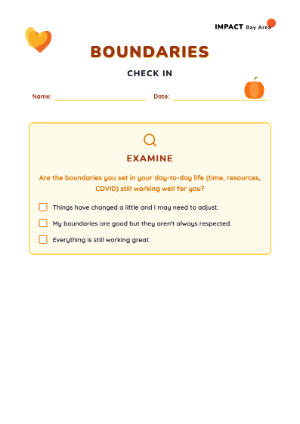
A second consistent pattern: students understand digital boundaries in theory but underestimate how much access they've already granted. When a worksheet asks them to list every app that currently has their location, most students stop at two or three — then discover during the activity that the actual number is closer to eight or ten. That gap between perceived and actual exposure is the kind of cognitive dissonance that makes the lesson stick in a way a lecture never would.
How to Build These Worksheets Into Your Lesson Plans
Most teachers use the boundary-mapping worksheet as an entry point early in the unit, before introducing communication skills. It works well as a 20-minute independent activity followed by a structured small-group debrief — not a full share-out, just pairs comparing what surprised them. That low-stakes structure reduces the self-consciousness seniors often bring to SEL content. From there, the assertiveness worksheets sequence naturally, moving students from identification to practice over several sessions.
Using the 12th grade boundaries worksheets pdf in advisory periods rather than a dedicated health or SEL class works well when the teacher frames each one as a practical life-skills task rather than a feelings exercise. Seniors are more willing to engage when they can see an immediate application — "this is for the roommate conversation you'll have in four months" lands better than "this will help you understand yourself." The digital-habits worksheet works particularly well the week after college deposit deadlines, when students are already mentally orienting toward their next environment and asking real questions about how much of themselves they want visible online.
Adjusting These Worksheets for a Range of Learners
For students who process quickly and want more depth, the concentric-circle map can be extended with a written analysis of one relationship where the student suspects the boundary is misaligned — what the current dynamic looks like, what the preferred dynamic would look like, and what one specific conversation might change. This moves the activity from recognition to planning, which is a more demanding cognitive task and gives faster finishers something substantive to do rather than waiting.
Students who struggle with open-ended reflection do better when given sentence frames for the journaling components. Frames like "One situation where I said yes when I meant no is ___" provide enough structure that thinking isn't blocked by a blank page. One honest limitation worth naming: these activities do surface disclosures. Students dealing with real, active boundary violations — not hypothetical ones — should be redirected to the counselor before completing the reflective sections independently. Teachers should be prepared for that possibility every time the set is used.
When used in a mixed-readiness group, the 12th grade boundaries worksheets pdf also allow for natural differentiation through the tiered discussion questions at the end of each worksheet. Teachers can direct different students toward different question levels without making the distinction visible to the class — the questions look like a numbered list, not a tracked assignment.
Frequently Asked Questions
Are these worksheets appropriate for advisory periods, or do they work better in a dedicated SEL or health class?
Both settings work, but the framing matters more than the course label. In advisory, the most effective approach is tying each worksheet to a specific upcoming moment — move-in day, a first job interview, a shared apartment. In a dedicated class, the worksheets fit naturally into a unit sequence. The shorter reflection worksheets work well as warm-up activities; the boundary-mapping worksheet needs at least 25 minutes to be useful and shouldn't be rushed.
What if students push back on the content as too personal?
Resistance is most common during the assertiveness worksheets, particularly when students are asked to rewrite passive or aggressive statements. Framing the task as a writing exercise — "rewrite this sentence so it uses an 'I' statement" — rather than a personal confession reduces resistance significantly. Students who object to disclosing their own experiences can complete the worksheet using a hypothetical third person. The skill transfer still happens, and forcing personal disclosure on resistant seniors rarely produces genuine reflection anyway.
How does the digital-privacy worksheet avoid feeling like a lecture about screen time?
The digital-habits worksheet uses an audit format — students inventory their actual settings rather than read a list of recommendations. Audit formats work because they require students to look at real data about their own behavior, which is harder to dismiss than general guidance. When the 12th grade boundaries worksheets pdf take this approach, students are more likely to identify something they want to actually change rather than performing agreement and moving on.
Do any worksheets address boundaries in professional contexts, like a first job?
Several worksheets use workplace scenarios alongside peer and family situations — declining overtime that conflicts with class, telling a manager you need advance notice for shift changes, setting communication norms with a new supervisor. These are scenarios many seniors encounter within months of completing the set, which keeps the practice grounded. Students who are already working part-time often bring the most specific, useful examples to these discussions.
Clear All