


























0
Views
0
Downloads

0.0
0
Save
0 Likes
Share
Personal Boundary Worksheet
0 Views
0 Downloads
Paste this activity's link or code into your existing LMS (Google Classroom, Canvas, Teams, Schoology, Moodle, etc.).
Students can open and work on the activity right away, with no student login required.
You'll still be able to track student progress and results from your teacher account.
Information
Description
What It Is:
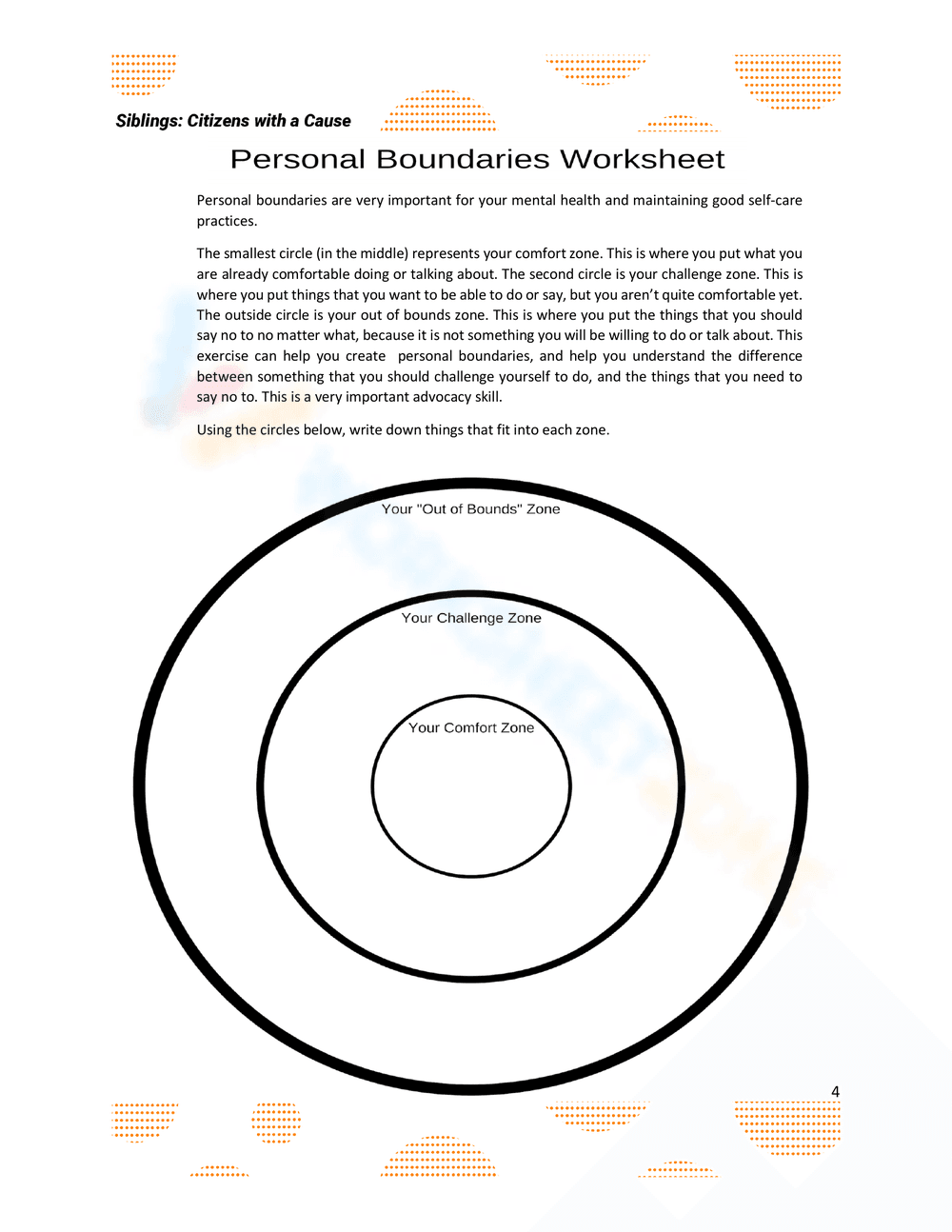
This is a worksheet titled 'Personal Boundaries Worksheet.' It presents a diagram with three concentric circles labeled 'Your Comfort Zone,' 'Your Challenge Zone,' and 'Your 'Out of Bounds' Zone.' The worksheet explains that the comfort zone represents things you are already comfortable doing, the challenge zone represents things you want to be able to do but aren't quite comfortable with, and the out of bounds zone represents things you should say no to. The worksheet instructs the user to write down things that fit into each zone to help create personal boundaries.
Grade Level Suitability:
This worksheet is suitable for late middle school (grades 7-8) and high school (grades 9-12). The concepts of personal boundaries and self-care require a level of maturity and self-awareness typically developed in these grades.
Why Use It:
This worksheet helps students identify their personal boundaries and understand the difference between their comfort zone, challenge zone, and out-of-bounds zone. It promotes self-awareness, mental health, and the development of advocacy skills by encouraging students to reflect on their own limits and needs.
How to Use It:
Read the descriptions of each zone. Then, think about activities, situations, or topics. Write these down inside the circle that best represents how you feel about each one. For example, write things you are comfortable with in the 'Comfort Zone' circle, things you want to try in the 'Challenge Zone,' and things you are not willing to do in the 'Out of Bounds' zone.
Target Users:
This worksheet is beneficial for teenagers and young adults who are learning about personal boundaries, self-care, and mental health. It can be used by educators, counselors, or therapists working with these age groups.
This is a worksheet titled 'Personal Boundaries Worksheet.' It presents a diagram with three concentric circles labeled 'Your Comfort Zone,' 'Your Challenge Zone,' and 'Your 'Out of Bounds' Zone.' The worksheet explains that the comfort zone represents things you are already comfortable doing, the challenge zone represents things you want to be able to do but aren't quite comfortable with, and the out of bounds zone represents things you should say no to. The worksheet instructs the user to write down things that fit into each zone to help create personal boundaries.
Grade Level Suitability:
This worksheet is suitable for late middle school (grades 7-8) and high school (grades 9-12). The concepts of personal boundaries and self-care require a level of maturity and self-awareness typically developed in these grades.
Why Use It:
This worksheet helps students identify their personal boundaries and understand the difference between their comfort zone, challenge zone, and out-of-bounds zone. It promotes self-awareness, mental health, and the development of advocacy skills by encouraging students to reflect on their own limits and needs.
How to Use It:
Read the descriptions of each zone. Then, think about activities, situations, or topics. Write these down inside the circle that best represents how you feel about each one. For example, write things you are comfortable with in the 'Comfort Zone' circle, things you want to try in the 'Challenge Zone,' and things you are not willing to do in the 'Out of Bounds' zone.
Target Users:
This worksheet is beneficial for teenagers and young adults who are learning about personal boundaries, self-care, and mental health. It can be used by educators, counselors, or therapists working with these age groups.


