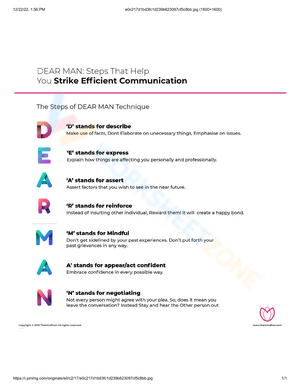
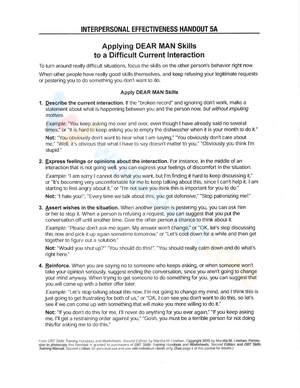
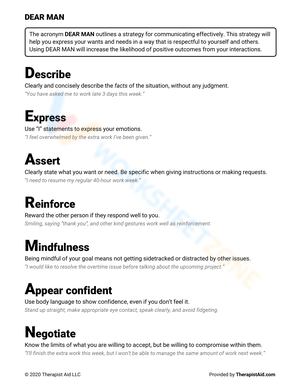
These dear man worksheets printable for 12th grade give teachers a structured entry point into one of the most teachable interpersonal effectiveness skills in the DBT toolkit. The set works through the full acronym — Describe, Express, Assert, Reinforce, Mindful, Appear Confident, Negotiate — using scenario-based exercises built around situations seniors actually face: asking for a letter of recommendation, pushing back on a schedule change at a part-time job, setting limits with a college roommate they haven't met yet. Senior year is the last classroom window most students will have to practice high-stakes communication before adult institutions start expecting them to handle it on their own.
What Each Worksheet Covers
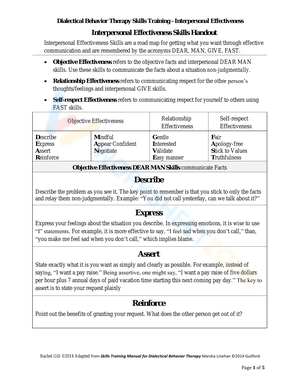
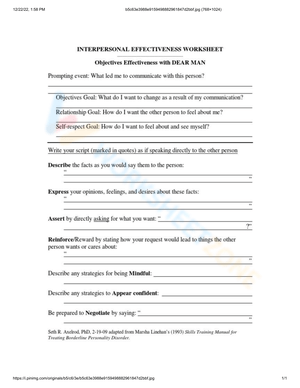
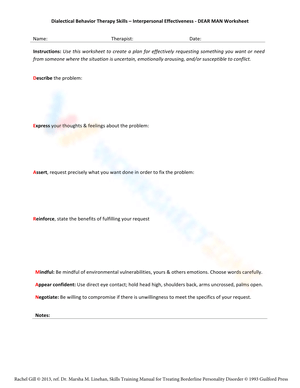
Each worksheet in the set targets a distinct slice of the DEAR MAN process, so teachers can sequence them across a unit or pull individual worksheets for a single lesson. The first group focuses on the DEAR portion of the framework — students read a scenario, write a Describe statement using only observable facts, draft an Express statement in first-person language, articulate a specific Assert (what they are asking for or declining), and compose a Reinforce statement that names a genuine benefit for the other person. The second group targets the MAN components: students evaluate sample dialogues for confidence markers, identify moments where the speaker drifted from the objective, and draft alternative endings that demonstrate productive Negotiation.
Several worksheets ask students to read transcript-style dialogue excerpts and mark where the DEAR MAN technique breaks down. That annotation task sharpens observation in a way that lecture doesn't. Students begin noticing mid-sentence slippage — a factual opening line that quietly becomes a character judgment two sentences later — and naming it precisely is what makes the correction stick.
Mistakes Students Make Worth Addressing Early
The most consistent error pattern in student work is the collapse between Describe and Express. Seniors understand the distinction in the abstract — facts versus feelings — but in practice, "I feel like you never take my schedule seriously" slips through as if it qualifies as an Express statement when it's actually a disguised evaluation of the other person. The cleaner version separates the two cleanly: "We agreed I'd have Saturdays off, and I've been scheduled three Saturdays in a row" (Describe), followed by "I feel frustrated when commitments change without conversation" (Express). That distinction requires repeated correction before it holds.
Reinforce is the other consistent stumbling block. Twelfth graders can draft a serviceable Describe and a clear Assert, but Reinforce asks them to think from inside the other person's perspective — to name what the listener values and show how agreeing to the request serves that. Students who rush Reinforce tend to write something generic: "This would be good for both of us." That version gives the listener nothing to hold onto. Pushing students toward the specific — "You'll have my full attention for the rest of the shift if we get this resolved now" — is where the skill actually matures rather than just getting memorized.
A smaller but notable error: students frequently misread "Appear Confident" as a license for pressure. They raise their volume in role-play, cut off the hypothetical listener, lean into the confrontation. The distinction between communicating that your needs are valid and pushing until the other person gives in is worth explicit classroom time, because conflating the two dismantles the relationship protection the framework is built to provide.
Working These Into Your Senior Year Curriculum
The most natural entry point for dear man worksheets printable for 12th grade is a school counselor-teacher co-teaching block, particularly in the fall semester when college application pressure and senior privilege conflicts are both running hot at the same time. If co-teaching isn't available, an advisory or homeroom period works well for the introductory worksheets, with the full-script exercises moving into an English, psychology, or life skills class once students have the basic framework down. The role-play component — where students draft a complete DEAR MAN script and then read it with a partner playing the other role — needs at least 35 uninterrupted minutes to produce real practice. Trying to run role-play in the 10 minutes before a passing period produces thin, rushed work that doesn't transfer.
Use the scenario worksheets as formative assessment tools. Walk the room during pair work and check the Reinforce lines first — that's the fastest read on who is still reasoning from their own perspective versus who has started modeling the listener's interests. Students still writing generic Reinforce statements need a brief individual conversation, not a re-lecture to the group. Keeping feedback targeted at that one component, rather than commenting on everything at once, reduces cognitive overload and lets students make one real revision instead of five shallow ones.
Standard Alignment
These worksheets align with CCSS.ELA-LITERACY.SL.11-12.1, which asks students to "initiate and participate effectively in a range of collaborative discussions" and to "propel conversations by posing and responding to questions that probe reasoning and evidence." The DEAR MAN structure gives students a concrete method for doing exactly that in high-stakes interpersonal contexts — grounding requests in observable evidence (Describe, Assert) and sustaining productive exchange without losing the objective (Mindful, Negotiate). The set also addresses CASEL's Relationship Skills and Responsible Decision-Making competencies, which many districts now track formally at the 12th grade level. For curriculum coordinators building toward both ELA and SEL reporting requirements, the set covers ground in both columns of a standards crosswalk.
Adjusting the Set Across a Range of Learners
For students who arrive with limited exposure to DBT vocabulary — or who have shaky command of "I" statements because SEL instruction has been inconsistent across their grade levels — begin the unit with the Describe-only worksheet before introducing the full framework. Presenting all seven components at once is more than some students can hold simultaneously at the start. Giving those students a fully worked example of a complete DEAR MAN script alongside the blank worksheet also helps; they're not building from nothing, but they still have to write their own version for a different scenario.
Dear man worksheets printable for 12th grade are equally usable in individual counseling and small-group settings, where scenarios can be swapped out for ones drawn directly from a student's real situation. In a whole-class context, preset scenarios keep the work manageable for everyone. In a counseling session, using the student's actual situation dramatically increases transfer. Students with significant anxiety around confrontation often need a staged rehearsal — write the full script, read it aloud once alone, then read it with someone else in the room — before they feel ready to use it in the actual conversation.
Frequently Asked Questions
Are these worksheets specific to DBT programs, or can a general classroom teacher use them?
Any teacher or counselor can use these worksheets without a clinical background. The DBT framework underpins the skill, but the scenario-based format and the step-by-step prompts make the tasks self-explanatory once students have a brief overview of what each letter in the acronym means. Most teachers find that 10 minutes of direct instruction — or a short reference card — is enough preparation before students can work through the exercises on their own. A school counselor co-teaching the unit adds useful depth, but the worksheets hold up without that partnership.
How many class periods does the full set take to cover?
A typical sequence runs three to five class periods depending on how much role-play is included. The introductory Describe/Express worksheets move quickly — most seniors finish within 20 minutes, with the remaining time used for discussion and error review. The full-script worksheet, where students draft a complete DEAR MAN response to a scenario and then role-play it with a partner, takes a full period on its own. Teachers who pull two or three worksheets rather than running the complete set can address the core skill in a single double-block period or two standard 50-minute meetings.
Can students use these worksheets to plan real conversations outside of class?
That's one of the more practical uses of the set. Students regularly return to their completed worksheets before conversations they're nervous about — talking to a parent about gap year plans, asking a manager to adjust a shift, addressing a concern with a coach about playing time. Writing out the script beforehand builds deliberate preparation that reduces in-the-moment emotional reactivity, which is exactly the point of the Mindful component. Dear man worksheets printable for 12th grade give students a repeatable format they can apply to new situations long after the classroom unit ends.












 Interactive Worksheet Maker
 Quiz Maker
 Word Search Maker
 Crossword Puzzle Maker
 Word Scramble Generator
 Sentence Scramble Generator
 Handwriting Worksheet Generator
 Name Tracing Generator
 Fill In The Blank Generator