




























0
Views
0
Downloads

Save
0 Likes
Share
Worksheet: Behavior Chain Analysis Template
0 Views
0 Downloads

Paste this activity's link or code into your existing LMS (Google Classroom, Canvas, Teams, Schoology, Moodle, etc.).
Students can open and work on the activity right away, with no student login required.
You'll still be able to track student progress and results from your teacher account.
Information
Description
What It Is:
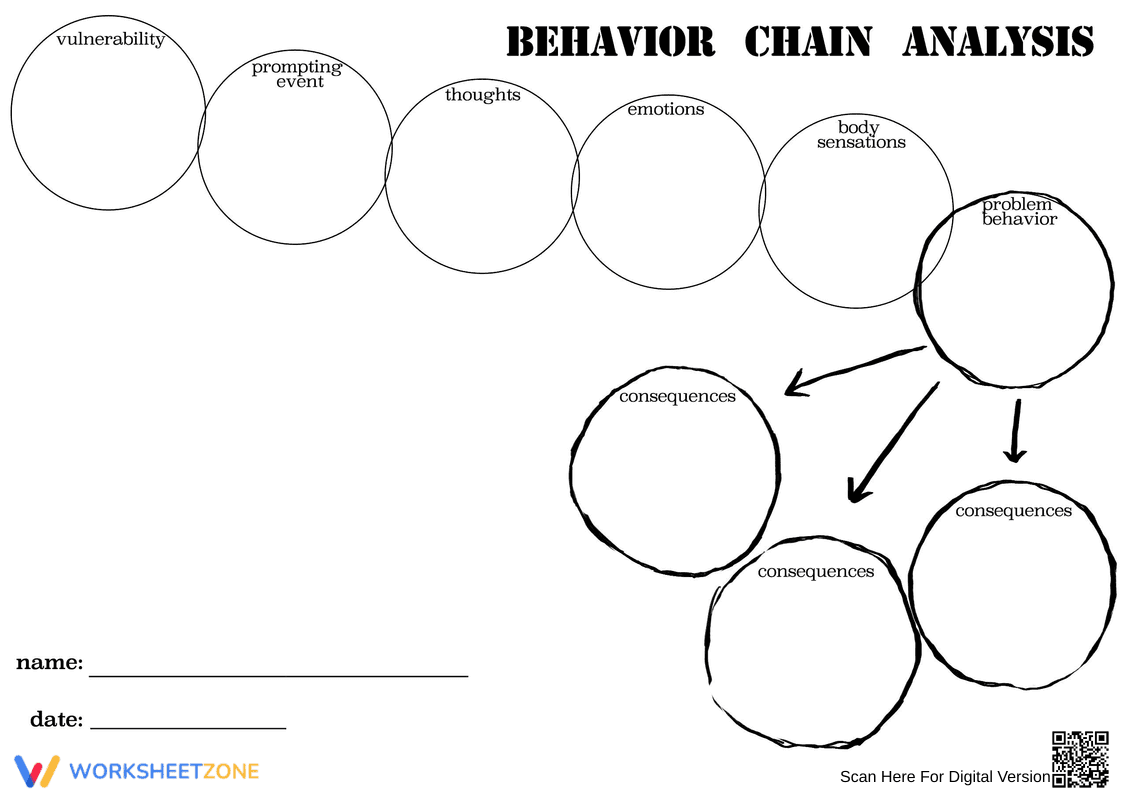
This is a worksheet titled 'Behavior Chain.' It presents a series of blank circles labeled 'vulnerability,' 'prompting event,' 'thoughts,' 'emotions,' and 'body sensations.' Below this sequence are two circles labeled 'consequences' with arrows indicating a flow from the initial chain. The worksheet also includes spaces for name and date.
Grade Level Suitability:
This worksheet is suitable for grades 6-12, particularly in health, psychology, or social-emotional learning contexts. The concepts involved require abstract thinking and self-reflection, making it appropriate for middle and high school students.
Why Use It:
This worksheet helps students understand the sequence of events leading to specific behaviors. It encourages self-awareness by prompting them to identify their vulnerabilities, triggers, thoughts, emotions, and physical sensations in relation to particular situations and their consequences.
How to Use It:
Students should begin by identifying a specific behavior they want to analyze. Then, they fill in each circle with details relevant to that behavior: their vulnerabilities at the time, the prompting event that occurred, their thoughts, emotions, and body sensations. Finally, they identify the consequences of their behavior.
Target Users:
This worksheet is beneficial for students in counseling, therapy, or social skills groups, as well as those studying psychology, health, or social-emotional learning. It can also be used by individuals seeking to improve their self-awareness and understand their behavior patterns.
This is a worksheet titled 'Behavior Chain.' It presents a series of blank circles labeled 'vulnerability,' 'prompting event,' 'thoughts,' 'emotions,' and 'body sensations.' Below this sequence are two circles labeled 'consequences' with arrows indicating a flow from the initial chain. The worksheet also includes spaces for name and date.
Grade Level Suitability:
This worksheet is suitable for grades 6-12, particularly in health, psychology, or social-emotional learning contexts. The concepts involved require abstract thinking and self-reflection, making it appropriate for middle and high school students.
Why Use It:
This worksheet helps students understand the sequence of events leading to specific behaviors. It encourages self-awareness by prompting them to identify their vulnerabilities, triggers, thoughts, emotions, and physical sensations in relation to particular situations and their consequences.
How to Use It:
Students should begin by identifying a specific behavior they want to analyze. Then, they fill in each circle with details relevant to that behavior: their vulnerabilities at the time, the prompting event that occurred, their thoughts, emotions, and body sensations. Finally, they identify the consequences of their behavior.
Target Users:
This worksheet is beneficial for students in counseling, therapy, or social skills groups, as well as those studying psychology, health, or social-emotional learning. It can also be used by individuals seeking to improve their self-awareness and understand their behavior patterns.


