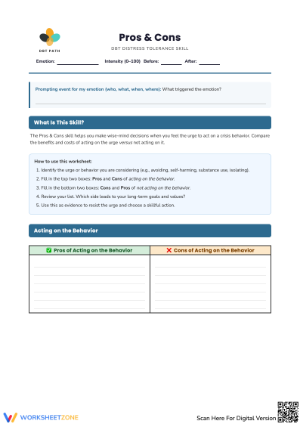
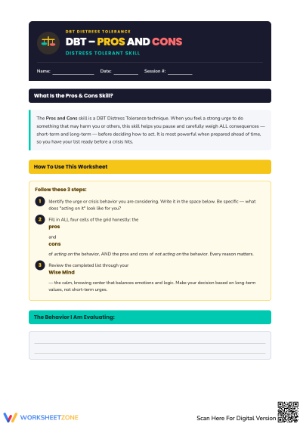
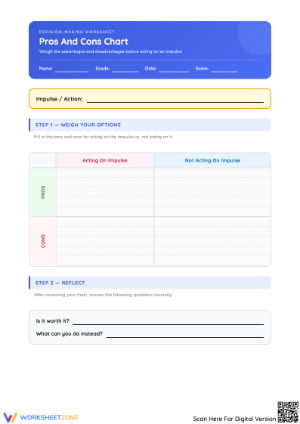
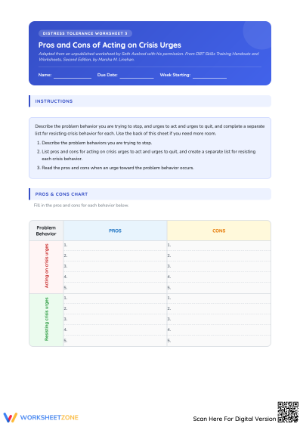
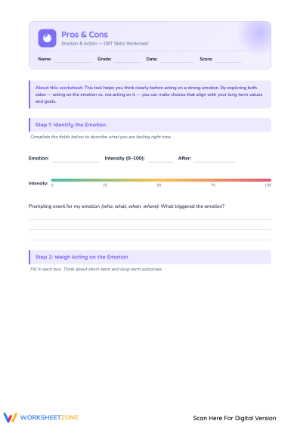
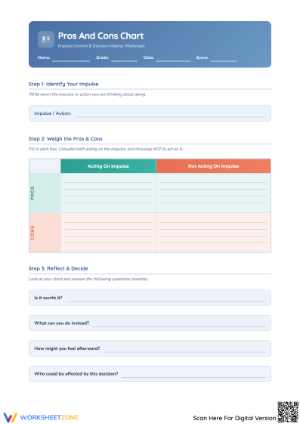
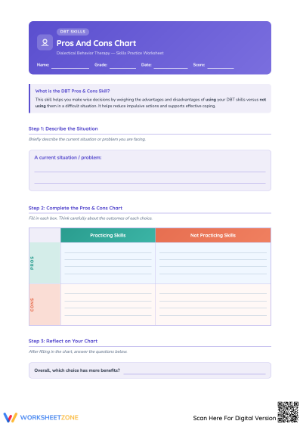
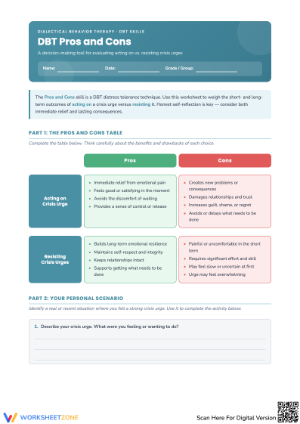
These 12th grade dbt pros and cons worksheets pdf resources give school counselors and senior-year teachers a structured, reusable framework for one of DBT's most counterintuitive distress tolerance skills. The Pros and Cons technique is not a standard decision-making list — it requires students to evaluate both acting on an urge and resisting it, generating four distinct categories of consequences rather than two. For seniors facing the compressed pressure of graduation, college applications, and shifting identities, having that structure on paper is what makes the skill usable under real stress.
What the Four Quadrants Actually Ask Students to Do
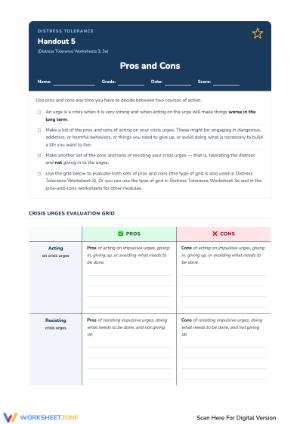
Each worksheet walks students through the same four-cell grid: pros of acting on an urge, cons of acting, pros of resisting, and cons of resisting. The fourth quadrant — costs of resisting — is the one that distinguishes this tool from simplified wellness exercises. When a student writes "I'll feel physically anxious for hours" under cons of resisting, they're validating their own experience, and that validation is load-bearing in DBT. Without it, the framework reads as a lecture dressed up in a table format.
Students practice with realistic senior-year scenarios: responding to a hostile text message, skipping a college essay deadline, walking out of a class mid-conflict. What shows up consistently in student work is a heavily weighted pros-of-acting column filled in quickly and a nearly empty pros-of-resisting column — not because students lack reasons to resist, but because those reasons require more deliberate thinking to access under stress. Moving through all four quadrants is the skill itself, not a prelude to it.
Frequent Student Errors Worth Watching For
The most common problem isn't filling out the wrong quadrant — it's treating the pros-of-resisting column as a list of moralizing "you should" statements. Students write "I'll be a better person" or "it's the right thing to do" under pros of resisting. These entries feel hollow when students actually need them under pressure. Teachers get better results by asking students to connect resisting to something concrete and personally meaningful: "I keep my eligibility status," "I don't have to explain myself to my parents later," "I actually sleep tonight." Abstract virtue has very little traction at 11 p.m. before a hard conversation.
A second pattern worth catching: students collapse the four quadrants into two by treating pros-of-resisting as identical to cons-of-acting. The entries become word-for-word mirrors. That collapse signals that the student isn't yet distinguishing between avoiding a negative outcome and actively gaining something by tolerating distress — and those are genuinely different motivational levers. Asking students to circle any entries that appear in both quadrants and then revise one of them usually surfaces the distinction in under three minutes.
Building the Skill Before It's Needed: Lesson-Planning Strategies
The most reliable approach is to introduce the four-quadrant format during a calm period — mid-week, after morning check-in, when no one is already activated. Waiting until a student is in crisis to hand them a worksheet is the instructional equivalent of explaining fire safety procedures during a fire. Linehan's training protocols place Pros and Cons firmly in the pre-crisis category: the habit of pausing becomes available under pressure because it was practiced when the stakes were low.
For 12th grade specifically, Wednesday advisory or a dedicated SEL block works well. Start with a shared scenario — something low-stakes and age-appropriate, like deciding whether to send an impulsive reply in a group chat — and walk all four quadrants aloud before students attempt one independently. Pair work on a second scenario lets students see that classmates have similar urges and very different reasoning, which normalizes the skill and the vulnerability it asks for. When teachers fold 12th grade dbt pros and cons worksheets pdf resources into an existing advisory rotation rather than treating the skill as a standalone lesson, completion rates improve and students are more likely to reference the framework outside of school.
Standard Alignment
DBT skills instruction at the secondary level aligns with the Social Awareness and Self-Management competency areas in CASEL's SEL framework, specifically the impulse control and stress management capacities under Self-Management. Within DBT's own training structure, Pros and Cons falls under the Distress Tolerance module — designated as Distress Tolerance Handout 5 in Linehan's DBT Skills Training Handouts and Worksheets (second edition, 2015) — and is listed as appropriate for adolescent and adult populations. Many state SEL standards map directly onto CASEL domains, giving counselors a clear documentation pathway. School counselors implementing DBT-informed programming frequently anchor this skill to IEP and 504 goals around emotional regulation, which makes the 12th grade dbt pros and cons worksheets pdf format practical for both instructional and compliance purposes.
Tailoring the Set for Different Learners
Students with high emotional reactivity sometimes freeze when confronted with a blank four-quadrant grid during independent work. A useful adjustment is to pre-populate one or two entries across different quadrants — not always the same quadrant, and never the most emotionally loaded one. This gives students a starting point without foreclosing their thinking. For students who move through the format quickly and find it straightforward, a second-pass prompt — "Now rank these entries by how much weight they actually carry for you this week" — extends the cognitive work without requiring a separate worksheet.
Students who have prior exposure to CBT or general problem-solving curricula sometimes dismiss the four-quadrant format as familiar territory. For them, the meaningful distinction to draw out is the cons-of-resisting quadrant — it's the piece most cognitive restructuring models omit entirely. Asking those students to argue for the urge as seriously as possible, rather than treating the worksheet as a foregone conclusion, repositions the exercise as more intellectually honest. For students receiving ongoing support from a school counselor, using 12th grade dbt pros and cons worksheets pdf materials as part of a regular structured check-in gives the skill a consistent practice context beyond the classroom — which is where durable habit formation actually happens.
Frequently Asked Questions
What makes the DBT version different from a standard pros and cons list?
A standard list evaluates a single choice. The DBT version splits the analysis into four categories — benefits and costs of acting on an urge, plus benefits and costs of resisting it. The fourth category, the costs of resisting, is what virtually every other decision-making tool omits. Acknowledging that tolerating distress is genuinely uncomfortable is not a concession to the impulse — it's what makes the framework feel honest enough to actually consult during a hard moment rather than dismiss as forced positivity.
How often should students practice this outside of a crisis situation?
Once a week during low-stress periods builds the habit reliably. The goal is for the four-quadrant structure to become automatic enough that a student can run through it quickly — mentally or on paper — when they're already emotionally elevated. That automaticity comes from repetition with easy scenarios first, which frees up cognitive capacity to apply the same structure when the emotional stakes are genuinely high.
What if a student can't identify any pros for resisting the urge?
That's usually a sign the student is connecting resistance to abstract values rather than concrete outcomes. Redirect by asking about a near-term goal that matters to them personally — staying eligible for a team, keeping a specific relationship intact, not having to explain the situation to someone they respect. Resistance looks very different when it's tied to something the student actually wants rather than something they're told they should want.
Can this skill be used effectively by classroom teachers, or does it require a counselor?
Pros and Cons is one of the DBT techniques that transfers well into general classroom use without a clinical context. It doesn't involve trauma processing, exposure work, or any technique that requires licensure. A teacher can introduce it as an emotional regulation strategy with no formal DBT training — though reading Linehan's handout on the skill before introducing it to students is worth the fifteen minutes. When significant distress is present, a counselor referral is always appropriate, but the four-quadrant framework itself is classroom-safe.












 Interactive Worksheet Maker
 Quiz Maker
 Word Search Maker
 Crossword Puzzle Maker
 Word Scramble Generator
 Sentence Scramble Generator
 Handwriting Worksheet Generator
 Name Tracing Generator
 Fill In The Blank Generator