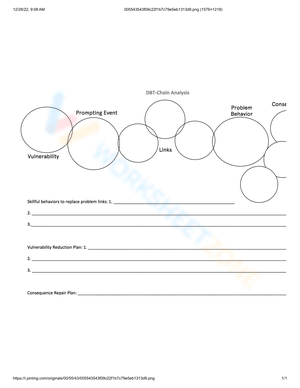
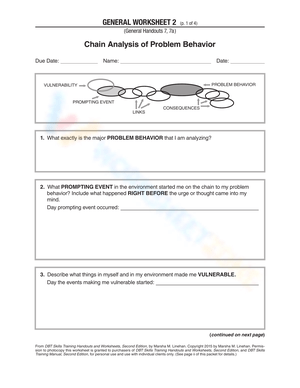
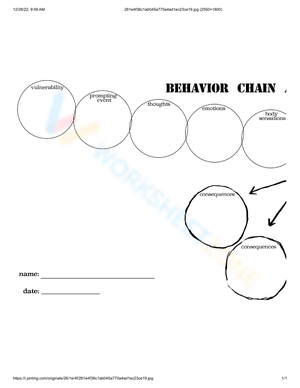
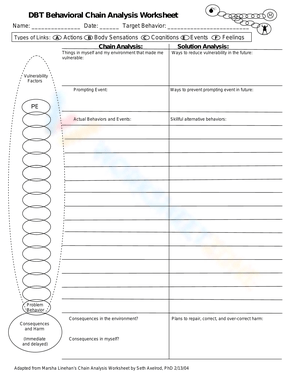
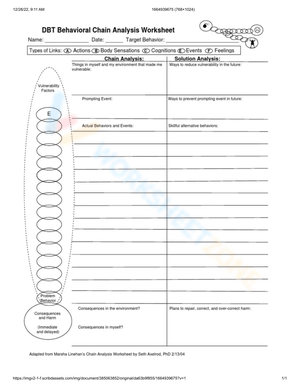
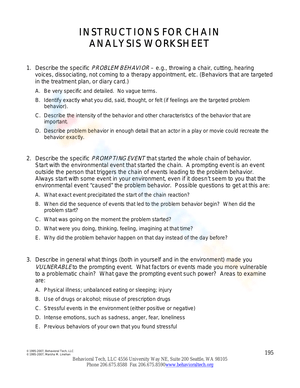
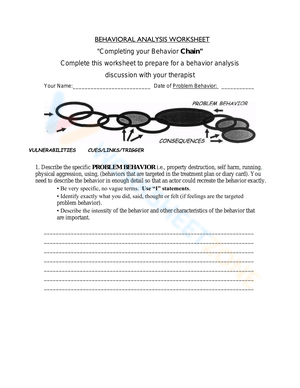
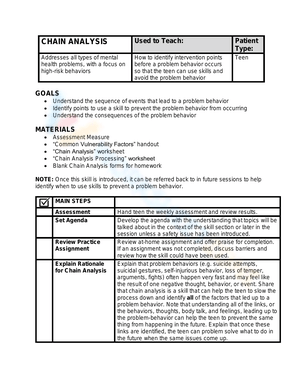
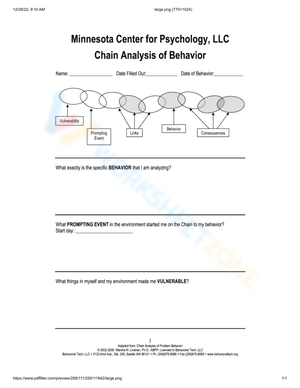
These dbt chain analysis worksheets printable for 12th grade give teachers a ready-to-use set of structured self-reflection tools that walk students through all eight steps of a behavioral chain — from identifying the prompting event to planning concrete harm repair. Each worksheet targets one complete analysis cycle, so students develop the habit of mapping a single behavior in full before moving on rather than skimming the process.
What Students Practice Across the Set
Each worksheet guides students through the full DBT chain analysis sequence in one sitting. The first step asks for a level of behavioral specificity that most 12th graders have never applied to themselves — not "I freaked out" but "I sent three hostile texts to my group project partner at 11 p.m. and then ignored the class the next morning." That precision is not nitpicking; the rest of the analysis depends on it. From there, students identify the prompting event, then work back through their vulnerability factors: the stressors that had already lowered their emotional threshold before the trigger appeared. A college rejection, four nights of disrupted sleep, a fight with a parent over tuition — these belong in the analysis, and most students skip them entirely the first time.
The middle links of the chain are where the real work happens. Students map the internal experience between the trigger and the behavior: the specific intrusive thought, the physical tension that preceded it, the split-second decision point they usually blow past. Most seniors have never slowed that sequence down enough to see it. The final steps move outward — examining consequences, identifying which DBT skill could have interrupted the chain, planning prevention, and writing out what repair the behavior requires. Every worksheet in the set ends with that repair step, which is what separates chain analysis from ordinary journaling.
Mistakes Students Make That These Worksheets Help You Catch
The most consistent error is treating the vulnerability section as optional filler. Students will name the trigger carefully and narrate the outburst in detail, then write "stressed, I guess" in the vulnerability box and consider it done. But that section is where senior-year context lives — the cumulative weight of GPA calculations, the social disorientation of watching friend groups fracture before graduation, the physical exhaustion of holding a part-time job while finishing college applications. When students name those factors specifically rather than generically, the entire analysis changes in quality. They stop seeing their behavior as a character flaw and start seeing it as a sequence that had preconditions.
A second pattern is compressing the middle of the chain. Students collapse the internal experience entirely: "teacher corrected me in front of the class" as the trigger, "I walked out" as the behavior, nothing in between. That gap is the whole point of the exercise. The worksheet format requires them to account for each thought and physical sensation separately and place them in order. Once students do this even once, they understand — concretely, not abstractly — that there was a moment of choice inside what felt like an instantaneous reaction.
Fitting Chain Analysis Into Your Weekly Schedule
These worksheets work best when they are not emergency interventions. Introducing chain analysis during a calm, structured SEL block — not in the aftermath of an incident — gives students the distance they need to engage honestly. Many 12th-grade advisories run a 15-to-20-minute morning block three days a week; that is enough time to work through two or three steps per session, then return to the same worksheet the following day. Students who try to complete the entire analysis in one rushed pass reliably shortchange the middle steps, which are the most instructionally valuable.
A reliable approach before students touch their own material is to model the process using a low-stakes fictional scenario — a character from a novel the class has read, or a hypothetical situation with no real stakes in the room. Walking through all eight steps out loud first reduces defensiveness when students apply the structure to themselves. After the model lesson, each worksheet functions as independent practice while you circulate and prompt specificity wherever entries go thin.
Keep the final steps visible when you close a session. The prevention and repair steps are what distinguish chain analysis from rumination. If class ends before students reach them, they leave having only catalogued a failure. dbt chain analysis worksheets printable for 12th grade are structured so that every analysis cycle finishes with a forward-looking commitment — and students need protected time to get there.
Adjusting the Set for a Range of Learners
Students who already work with a school counselor or outside therapist often move through the eight steps faster and with more emotional precision. For those students, push toward the prevention-planning step: ask them to name specific coping skills — TIPP, opposite action, radical acceptance — next to the links where those skills could have interrupted the chain. The worksheet gives them room for that level of analysis if they are ready for it.
Students with limited self-reflection experience tend to stall at the vulnerability section because they simply lack language for internal states. A short printed reference list — common vulnerability factors tied to senior-year pressures specifically, such as financial stress about post-graduation plans, romantic relationship strain, identity uncertainty — placed alongside the worksheet gives those students enough vocabulary to get started without turning the activity into a lecture. The worksheet itself does not change; what changes is what you put next to it.
Students with IEPs or 504 plans addressing executive functioning challenges sometimes struggle with the sequencing demands of the middle links. Numbering those links explicitly — "Link 1, Link 2, Link 3" — rather than presenting them as a free-form narrative helps students hold the structure in place while they generate the content. Reducing the minimum number of required links from eight to five for those students still produces a complete, usable analysis without triggering the shutdown that comes from a form that looks too demanding at first glance.
Standard Alignment
These worksheets align with CASEL's self-awareness and self-management competencies at the high school level — specifically the expectation that students can identify and describe their emotional states, recognize the relationship between thoughts, feelings, and behaviors, and apply strategies for managing stress during high-stakes periods. At 12th grade, CASEL's SEL benchmarks also address goal setting and planning, which maps directly onto the prevention and repair steps that close each worksheet. Districts running MTSS Tier 2 behavioral supports will find that each completed worksheet produces a written, datable record of a student's self-identified triggers, vulnerabilities, and named skill alternatives — the kind of documentation that satisfies progress-monitoring requirements at the secondary level without requiring additional data collection tools.
Frequently Asked Questions
Do students need prior DBT experience to use these worksheets?
No. Each worksheet includes brief embedded definitions for terms like "prompting event," "vulnerability factors," and "problem behavior," so students can follow the sequence without a separate introduction to the DBT framework. A five-to-ten minute whole-class orientation using the chain metaphor is enough context for most seniors to get started. Students who have encountered DBT in therapy or a prior SEL curriculum will move faster, but they are not at an advantage on the analysis itself — that depends on honesty and specificity, not prior knowledge.
Is chain analysis appropriate for whole-class use, or only for students with behavioral incidents?
Chain analysis is appropriate for whole-class use in 12th grade because every student — not just those with documented behavioral concerns — faces high-stakes decisions, impulsive moments, and real consequences during their senior year. Using it as a universal practice normalizes self-reflection rather than marking it as a corrective tool. That said, you know your students: if someone is in an especially raw emotional state or still actively processing a serious incident, this is not the moment to assign the worksheet. dbt chain analysis worksheets printable for 12th grade are most productive when students are regulated enough to reflect — not when they are still inside the event.
How do I handle privacy concerns around completed worksheets?
This is a real and practical concern worth addressing before you distribute the set. Students disclose more honestly when they know their worksheets will not be read aloud, shared without consent, or used as disciplinary evidence. A folder system, a sealed-envelope option, or a clear verbal agreement about confidentiality — with the mandatory reporting exception explicitly stated — sets the right conditions. Some teachers collect completed worksheets only to verify completion, not to read content, and reserve deeper reflection for individual student-teacher conferences. Any format that gives students a sense of control over their own disclosure produces better analysis work.
Can these worksheets be used in a school counseling office?
School counselors use dbt chain analysis worksheets printable for 12th grade in individual sessions because the eight-step format structures the conversation without requiring the counselor to drive every question — the worksheet does that work. In a counseling context, the repair step often becomes the center of the session, since that step demands the most relational courage and tends to produce the most immediate behavioral change. The worksheets are built for both classroom and counseling settings, and the format holds up in both.












 Interactive Worksheet Maker
 Quiz Maker
 Word Search Maker
 Crossword Puzzle Maker
 Word Scramble Generator
 Sentence Scramble Generator
 Handwriting Worksheet Generator
 Name Tracing Generator
 Fill In The Blank Generator