


























Views
Downloads




Personal Boundaries Guide | Grade K-2 Essential
Paste this activity's link or code into your existing LMS (Google Classroom, Canvas, Teams, Schoology, Moodle, etc.).
Students can open and work on the activity right away, with no student login required.
You'll still be able to track student progress and results from your teacher account.
This personal boundaries worksheet helps early learners understand physical and social limits through interactive visual tasks. Students learn to identify what constitutes a boundary and how to express their needs effectively. By focusing on body autonomy, this resource empowers children to navigate social interactions with confidence and respect for themselves and others.
At a Glance
- Grade: Kindergarten · Subject: English
- Standard:
CCSS.ELA-LITERACY.SL.K.1— Participate in collaborative conversations with diverse partners about kindergarten topics and texts- Skill Focus: Personal boundaries and body autonomy
- Format: 5 pages · 9 problems · Answer key included · PDF
- Best For: Social-emotional learning and morning meetings
- Time: 15–20 minutes
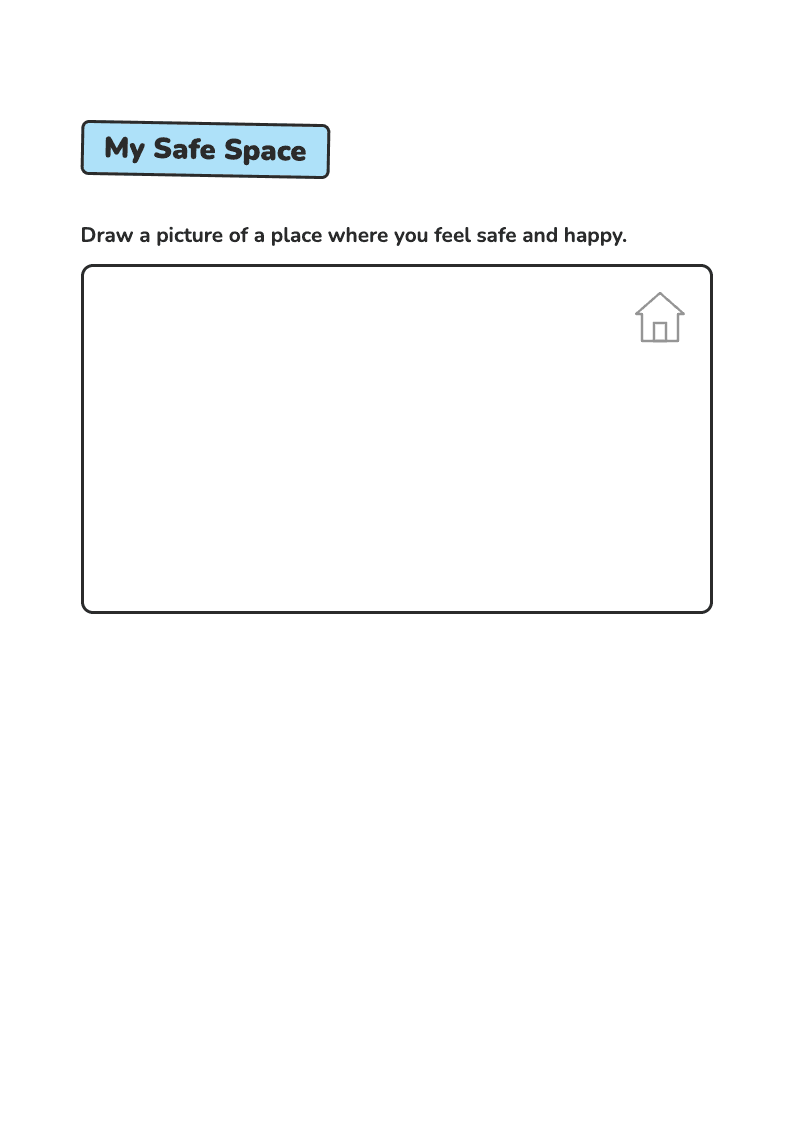
The 5-page PDF includes engaging activities designed for young minds. It features a visual identification task, a creative drawing prompt to illustrate self-love, and four social scenarios. Additionally, it provides a dedicated space for students to draw their safe space and concludes with fill-in-the-blank affirmations regarding body ownership and personal rights.
Zero-Prep Workflow
This resource is designed for immediate classroom use. First, print the 5-page packet (30 seconds). Second, distribute the sheets during a morning meeting or SEL block (1 minute). Third, review the answers and drawings as a whole group to facilitate discussion (10 minutes). Total teacher preparation time is under 2 minutes, making it an ideal resource for substitute folders.
Standards Alignment
This resource aligns with `CCSS.ELA-LITERACY.SL.K.1`, which requires students to participate in collaborative conversations with diverse partners about kindergarten topics. By defining and discussing boundaries, students practice the essential turn-taking and listening skills mandated by this standard. This standard code can be copied directly into lesson plans, IEP goals, or district curriculum mapping tools.
How to Use It
Use this worksheet during a dedicated Social-Emotional Learning block or as a follow-up to a read-aloud about personal space. For formative assessment, observe how students respond to the "Yes/No" scenarios to identify who may need additional support understanding consent. Expected completion time ranges from 15 to 20 minutes depending on the depth of classroom discussion.
Who It's For
This resource is primarily for Kindergarten and Grade 1 students, though it is suitable for any early learner developing social awareness. It is an excellent pairing for school counseling sessions or small group interventions. The simple language and heavy use of visuals make it accessible for English Language Learners and students with developmental delays.
According to the RAND AIRS 2024 report on social-emotional learning, explicit instruction in personal boundaries during early childhood significantly improves student self-regulation and classroom climate. This worksheet addresses the foundational skill of identifying physical and social limits, which aligns with CCSS.ELA-LITERACY.SL.K.1 by fostering the communication skills necessary for collaborative environments. By using visual prompts and simple "Yes/No" scenarios, the resource helps students internalize the concept of body autonomy and consent. Research indicates that students who receive structured SEL support are 11 percentile points higher in academic achievement compared to peers. This 5-page PDF provides a structured framework for teachers to introduce these complex topics without extensive preparation. It serves as a vital tool for developing the self-awareness required for healthy interpersonal relationships throughout a student's academic career and beyond.


