These nervous system worksheets for 11th grade give anatomy and physiology teachers a structured way to move students from basic anatomical labeling to genuine physiological reasoning—covering neuron structure, action potential mechanics, brain anatomy, spinal cord organization, and the autonomic subdivisions across a full unit's worth of activities. Each worksheet addresses a discrete, assessable concept rather than sampling broadly across several at once, which makes them easier to slot into specific points in the unit sequence.
The Specific Skills Each Worksheet Builds
The labeling work begins with multipolar neuron diagrams. Students identify dendrites, the soma, the axon, the myelin sheath, the nodes of Ranvier, and the axon terminals—and then explain what each structure does rather than just naming it. A separate worksheet takes students through the voltage changes during an action potential: resting membrane potential (typically negative 70 mV inside the membrane), depolarization as sodium rushes in through voltage-gated channels, repolarization as potassium exits, and the brief hyperpolarization before the cell resets. Graphing these stages on a blank axis forces students to internalize the sequence rather than passively recognize it on a pre-labeled diagram.
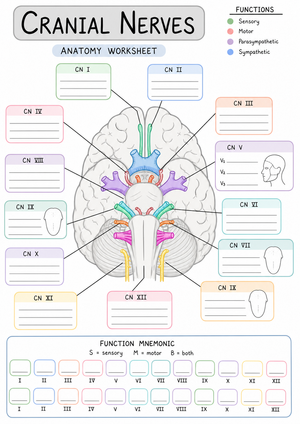
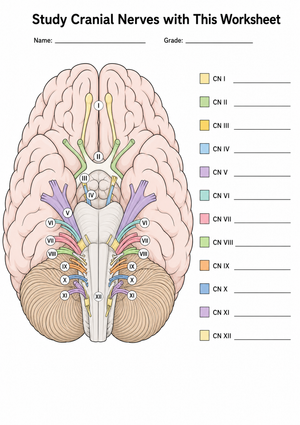
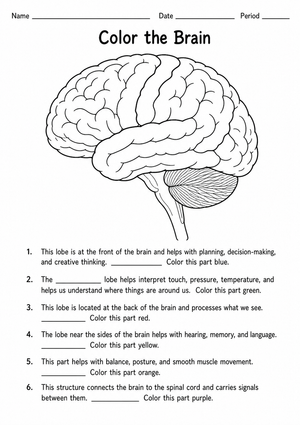
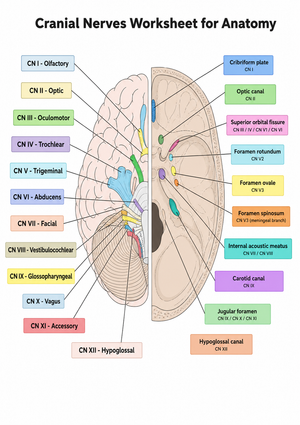
Brain anatomy worksheets require students to mark and differentiate the four lobes of the cerebrum, the cerebellum, the three brainstem subdivisions (medulla oblongata, pons, midbrain), and the limbic structures involved in memory formation and emotional regulation. Additional worksheets cover the spinal cord cross-section and the reflex arc—two topics that appear consistently on AP Biology and anatomy exams and that students consistently underestimate in complexity.
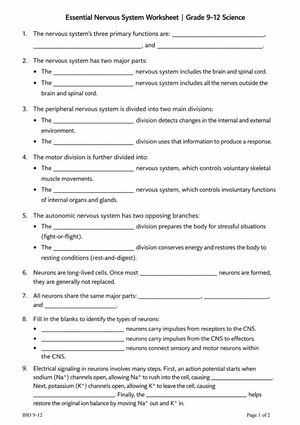
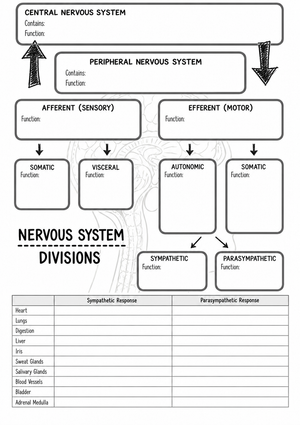
Flowchart activities map the nervous system hierarchy from CNS to PNS, somatic to autonomic, and sympathetic to parasympathetic. Students fill in the branches and add concrete examples of each subdivision's actions, anchoring the categories to real body responses rather than abstract labels. One worksheet addresses the synapse in isolation—neurotransmitter release, diffusion across the synaptic cleft, receptor binding, and reuptake—so students see exactly where pharmacological agents like SSRIs or acetylcholinesterase inhibitors intervene in the signaling process.
Student Mistakes Worth Catching Before the Exam
The most consistent error in student work involves myelin and saltatory conduction. Students write that an action potential "travels along" the myelin sheath rather than jumping between nodes of Ranvier. They've encountered the term "saltatory" but map it loosely to a bouncing motion instead of grasping that the action potential regenerates only at each node while the myelinated internodal membrane stays electrically silent. A worksheet that asks students to shade the active membrane segments—and explicitly leave the myelinated stretches blank—addresses this more efficiently than any written clarification in the margin.
The afferent/efferent reversal is a second predictable stumble. Students who can define both terms correctly will still draw the reflex arc with motor signals traveling toward the CNS and sensory signals traveling away from it. The underlying problem is that "afferent" and "efferent" are abstract Latin-rooted terms with no physical referent. Requiring students to annotate signal direction with directional arrows—not just label the neuron type—catches the reversal before the test does.
A third error appears reliably during action potential graphing: students draw the resting membrane potential line at zero rather than below it. This shifts every subsequent phase upward by 70 mV, making the threshold of excitation nearly unrecognizable on the graph. Requiring students to mark the resting line first, before plotting any other stage, prevents most of these errors without additional instruction.
Standard Alignment
These worksheets address NGSS HS-LS1-2, which asks students to develop and use a model to illustrate the hierarchical organization of interacting systems that provide specific functions within multicellular organisms. In classroom terms, that means students must explain how individual neurons form nerves, how nerves communicate with the CNS, and how the CNS generates a coordinated response—not just identify the parts. Nervous system worksheets for 11th grade that require students to trace a complete reflex arc or map the body's physiological response to a sudden blood pressure drop meet this performance expectation directly, because the task itself demands hierarchical reasoning rather than isolated recall.
For teachers in AP Biology courses, the action potential graphing worksheet maps to Big Idea 2 and Learning Objective 2.B.3, which addresses membrane potential and signal transduction. The synapse diagram—requiring students to trace neurotransmitter release, receptor binding, and signal termination—also fits here and pairs naturally with any extension connecting nervous system function to drug mechanisms or neurological conditions.
Building These Worksheets Into the Unit Sequence
Start the unit with neuron anatomy labeling before any direct instruction on electrophysiology. Students who already have the vocabulary—axon, myelin, node, terminal—absorb the action potential mechanism faster because they're not managing new terminology at the same time as new physics. This is a cognitive load reduction move that costs about fifteen minutes of a prior lesson and pays back during the action potential lecture when students aren't stopping to ask what an axon terminal is.
Nervous system worksheets for 11th grade work particularly well as consolidation tasks during the last twenty minutes of class—not as homework—when students need to process what they just heard in lecture rather than coast. The reflex arc worksheet, specifically, is one that students think they understand until they sit down to draw it. It reliably surfaces the afferent/efferent confusion within the first five minutes, which makes it a more useful mid-class checkpoint than a capstone assessment.
The synapse diagram worksheet functions well the day before a quiz as a self-diagnostic tool. Have students complete it without notes first, then check their work against the textbook. Any term they misplace or leave blank tells them—not the teacher—exactly where the gap is. That self-assessment step has more lasting impact on retention than a corrected paper returned the following week.
For the autonomic system flowchart, pair it with a brief scenario set: students read a short situation (sprinting from a threat, digesting a large meal, sitting quietly before bed) and mark which autonomic branch is dominant and what specific physiological changes follow. This keeps the worksheet from collapsing into pure memorization.
Tailoring These Worksheets for a Range of Learners
Students who struggle with the action potential graph benefit from a version with the time axis and membrane potential axis pre-labeled, so they plot the curve rather than also constructing the graph framework from scratch. Removing that one layer of demand lets them focus on the biological sequence. This adjustment takes about two minutes to make before printing and doesn't require a fundamentally different worksheet—just the axis labels filled in.
For students moving ahead of the class, the neuron labeling diagram becomes a starting point rather than an endpoint. Extend the task by asking them to annotate each structure with the consequence of its damage: demyelination, as in multiple sclerosis, produces slowed and unpredictable signal transmission because saltatory conduction fails between nodes. A student who can write that explanation next to the myelin sheath label is working well above basic identification, using the same diagram everyone else labeled.
Nervous system worksheets for 11th grade can also be tiered by the type of question attached to the same core diagram. The foundational version asks students to label and define. The on-level version asks them to explain cause-and-effect relationships. The extended version presents a clinical case—a patient with a transected spinal cord, or a drug that blocks acetylcholine receptors—and asks students to predict the physiological outcome. All three versions use the same underlying image; what changes is the cognitive demand of the questions.
Students with strong reading comprehension but weak spatial recall often find the flowchart activities easier entry points than the anatomical labeling worksheets. Starting those students with sequence tasks—reflex arc ordering, autonomic division mapping—builds confidence before returning to spatial identification on the neuron or brain diagram.
Frequently Asked Questions
What is the best order to assign these worksheets across a nervous system unit?
Start with neuron anatomy labeling, then move to action potential graphing once students have the structural vocabulary in place. Follow that with the synapse diagram, which bridges the electrical and chemical sides of signaling. Brain anatomy and spinal cord cross-section worksheets work well in the middle of the unit when students have context for why structure matters. Finish with the reflex arc and the autonomic system flowchart, which require students to integrate everything into a systems-level picture.
How does the action potential worksheet handle students who find graphing tasks difficult?
The action potential worksheet provides a pre-drawn axis with membrane potential marked on the vertical axis (from negative 90 mV to positive 40 mV) and time on the horizontal axis. Students plot five labeled points—resting state, threshold, peak depolarization, repolarization, hyperpolarization—connect them, and annotate which ion channels are active at each stage. Students who freeze in front of open-ended graphing tasks do better with this constrained format because the domain of the task is clear from the start and they can put their attention on the biology.
Which worksheets are most directly useful for AP Biology compared to a standard anatomy and physiology course?
The action potential graphing worksheet and the synapse diagram carry the most weight in AP Biology, where the emphasis falls on molecular mechanisms and signal transduction rather than gross anatomy. Standard anatomy and physiology courses typically weight the brain labeling, spinal cord cross-section, and reflex arc activities more heavily, since those appear on practical exams where students identify structures on physical models. Both course types use the neuron anatomy worksheet regularly—the difference is whether the follow-up questions ask students to identify or to explain.












 Interactive Worksheet Maker
 Quiz Maker
 Word Search Maker
 Crossword Puzzle Maker
 Word Scramble Generator
 Sentence Scramble Generator
 Handwriting Worksheet Generator
 Name Tracing Generator
 Fill In The Blank Generator