




























Views
Downloads

Essential Cranial Nerves Worksheet | Grade 9-12 Biology

Paste this activity's link or code into your existing LMS (Google Classroom, Canvas, Teams, Schoology, Moodle, etc.).
Students can open and work on the activity right away, with no student login required.
You'll still be able to track student progress and results from your teacher account.
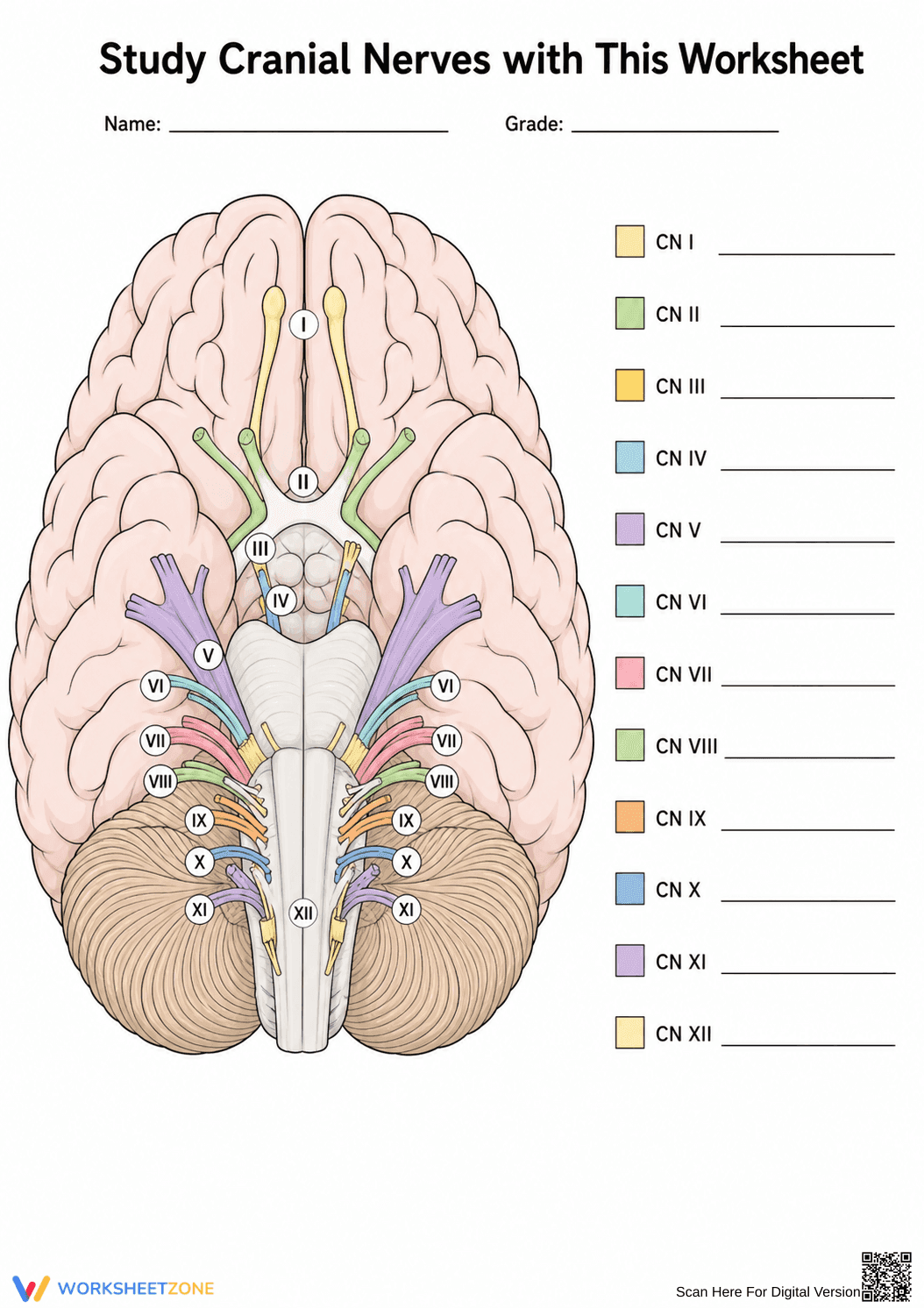
This anatomy resource provides a clear, color-coded diagram for students to identify the twelve cranial nerves from a ventral brain perspective. By mapping CN I through CN XII, learners develop a spatial understanding of the peripheral nervous system and its connection to the brainstem. It ensures students master complex neuroanatomical terminology through visual association and active recall.
At a Glance
- Grade: 9-12 · Subject: Biology
- Standard:
HS-LS1-2— Develop a model to illustrate the organization of interacting systems- Skill Focus: Cranial nerve identification
- Format: 1 page · 12 problems · Answer key included · PDF
- Best For: Anatomy review and formative assessment
- Time: 15–20 minutes
The worksheet features a high-resolution anatomical illustration of the human brain's underside. It includes 12 distinct color-coded lines pointing to specific nerve origins, paired with a corresponding key for students to write the names of the nerves, ranging from the Olfactory to the Hypoglossal nerve. The layout is clean and professional, suitable for inclusion in a lab manual or as a standalone study guide.
This resource is designed for immediate classroom implementation. 1. Print: Select the single-page PDF and print enough copies for your section (30 seconds). 2. Distribute: Hand out the diagrams as a warm-up or exit ticket (1 minute). 3. Review: Use the provided key to check student accuracy or display the diagram on a projector for a whole-class review (5 minutes). Total teacher prep time is under 2 minutes, making it an ideal sub plan or last-minute review tool.
Aligned to `HS-LS1-2`, this worksheet requires students to model the organization of the nervous system by identifying specific components of the brain-body interface. It supports the understanding of how specialized structures facilitate communication within the organism. This standard code can be copied directly into lesson plans, IEP goals, or district curriculum mapping tools.
Use this as a formative assessment after a lecture on the peripheral nervous system to gauge student recall of nerve locations. Alternatively, assign it as a pre-lab activity before a sheep brain dissection to help students orient themselves to the ventral surface. Expect students to complete the labeling in approximately 15 to 20 minutes depending on their prior knowledge of the nervous system.
This worksheet is ideal for high school biology, AP Biology, or introductory Anatomy and Physiology students. It provides necessary scaffolding for visual learners who benefit from seeing the physical origin points of each nerve. Pair this with a 3D brain model or a cranial nerve mnemonic anchor chart for maximum retention during your human body systems unit.
The identification of cranial nerves is a foundational requirement in secondary life science education, directly supporting the HS-LS1-2 framework for understanding hierarchical organization in multicellular organisms. Research by Fisher & Frey (2014) emphasizes that visual labeling tasks serve as effective scaffolds for complex anatomical vocabulary, bridging the gap between conceptual understanding and technical mastery. By requiring students to associate numerical designations (CN I-XII) with specific anatomical landmarks, this worksheet reinforces the spatial reasoning skills necessary for advanced medical and biological studies. According to the RAND AIRS 2024 report on instructional materials, high-quality visual aids significantly reduce cognitive load during the acquisition of specialized scientific terminology. This resource provides a structured, evidence-based approach to neuroanatomy that is both accessible for students and efficient for educators seeking to meet rigorous state and national standards.


