


























Views
Downloads

Grade 11-12 Cranial Nerves — Printable No-Prep Worksheet
Paste this activity's link or code into your existing LMS (Google Classroom, Canvas, Teams, Schoology, Moodle, etc.).
Students can open and work on the activity right away, with no student login required.
You'll still be able to track student progress and results from your teacher account.
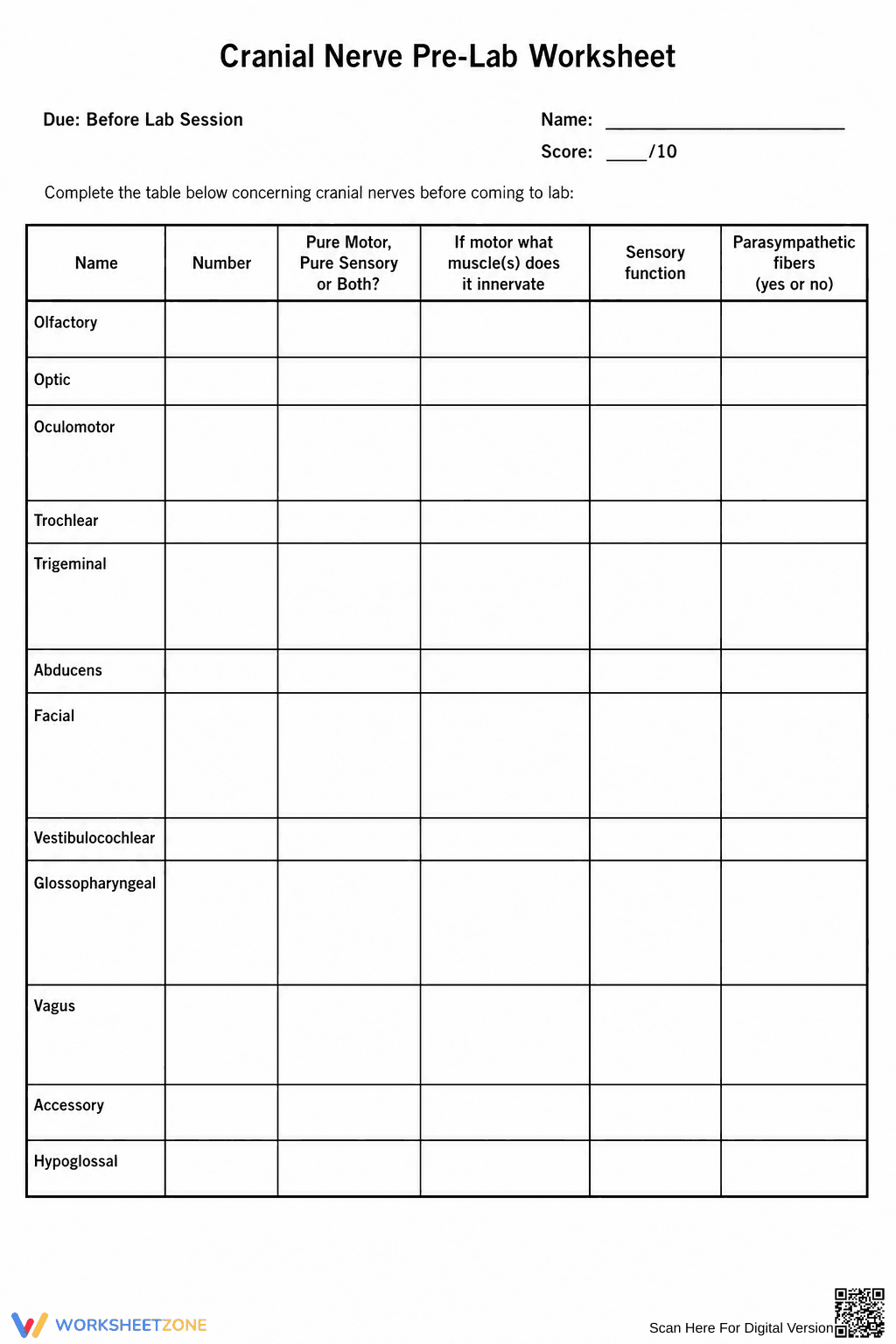
This high school biology pre-lab worksheet prepares students to identify and classify the 12 cranial nerves before hands-on laboratory activities. By completing structured tables, learners actively review nerve names, numbers, sensory and motor functions, and parasympathetic fiber presence, ensuring they are fully equipped for clinical evaluations and anatomical identification.
At a Glance
- Grade: 11-12 · Subject: Biology
- Standard:
HS-LS1-2— Illustrate interacting systems providing specific functions in organisms- Skill Focus: Cranial nerve identification and function
- Format: 2 pages · 16 problems · PDF
- Best For: Pre-lab preparation and review
- Time: 25–35 minutes
What's Inside
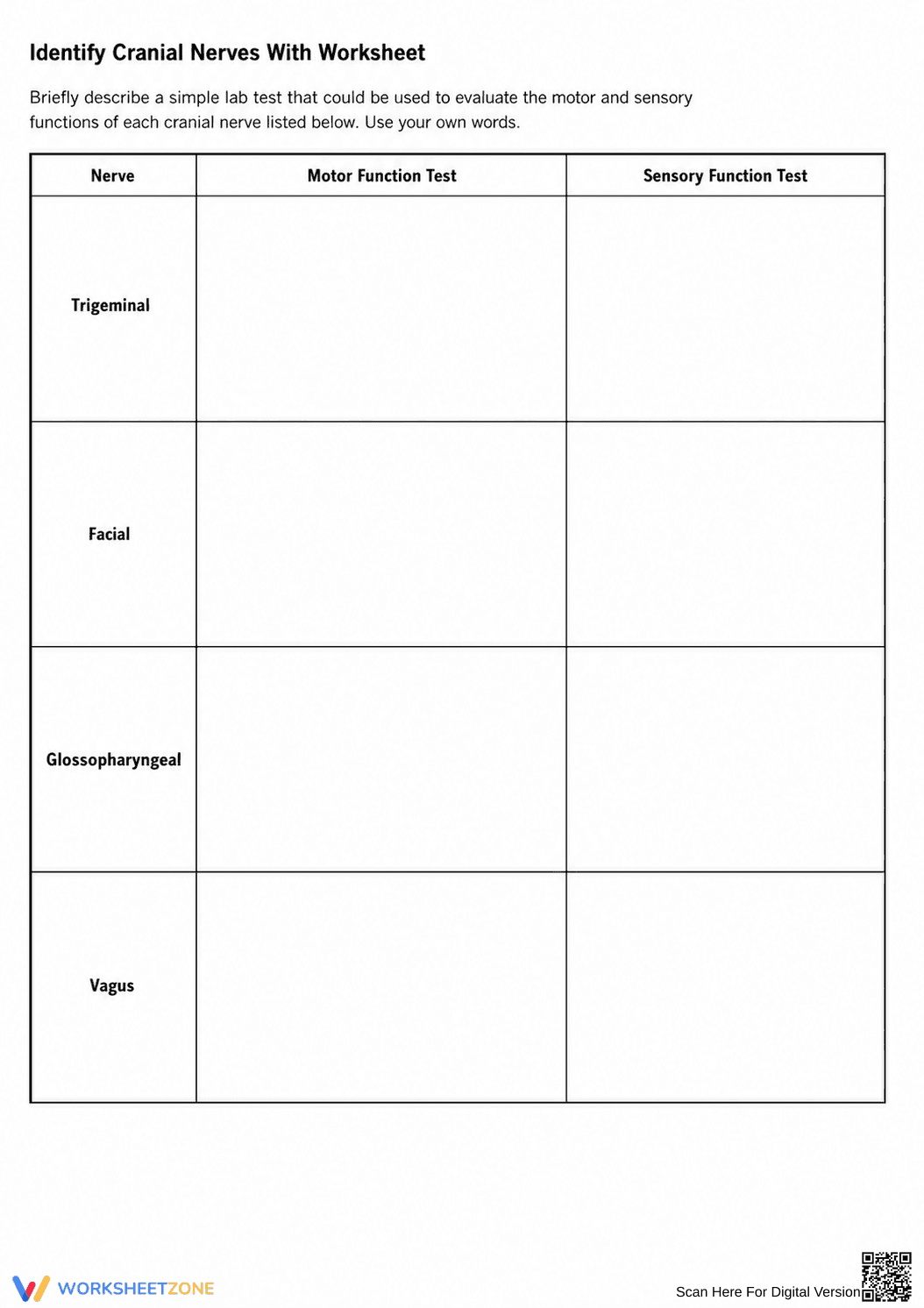
This two-page resource features a fill-in-the-blank matrix covering all 12 cranial nerves. The first page requires students to categorize each nerve by type, innervated muscles, and sensory functions. The second page challenges learners to describe clinical laboratory tests to evaluate the motor and sensory functions of four major mixed nerves: trigeminal, facial, glossopharyngeal, and vagus.
Zero-Prep Workflow
This resource is designed for immediate classroom implementation with a three-step workflow. First, print the PDF (under one minute). Next, distribute copies to students as they enter the lab (one minute). Finally, review the instructions and let students use textbooks to complete the tables independently. Total teacher preparation time is under two minutes, making this an excellent option for substitute plans or quick pre-lab assignments.
Standards Alignment
Aligned to HS-LS1-2, this worksheet requires students to illustrate the hierarchical organization of interacting systems that provide specific functions within multicellular organisms. By mapping motor and sensory pathways, students demonstrate how the peripheral nervous system interacts with muscular organs to maintain bodily functions. Both standard codes can be copied directly into lesson plans, IEP goals, or district curriculum mapping tools.
How to Use It
Deploy this worksheet as a pre-lab assignment completed before a nervous system dissection. Alternatively, use it during direct instruction as a guided graphic organizer where students fill in rows during a lecture. For a quick formative assessment, observe how easily students articulate the clinical tests on the second page; hesitation indicates a need to review sensory versus motor pathways. Expected completion time is 25 to 35 minutes.
Who It's For
This material is designed for high school juniors and seniors in advanced biology or anatomy courses. To support students needing accommodations, teachers can provide a word bank of innervated muscles or pre-fill the nerve numbers. This worksheet pairs perfectly with anatomical brain models, allowing students to visually trace the pathways they describe in the tables.
Aligning instructional materials with HS-LS1-2 to illustrate interacting systems providing specific functions in organisms is a critical component of advanced science education. According to a ScienceDirect TpT Analysis, structured graphic organizers and pre-lab matrices significantly improve student retention of complex anatomical vocabulary and physiological processes. When students actively categorize information—such as distinguishing between pure motor, pure sensory, and mixed cranial nerves—they build stronger cognitive frameworks for later clinical application. This targeted practice reduces cognitive overload during actual laboratory sessions, allowing learners to focus on hands-on skills rather than basic memorization. By requiring students to articulate specific clinical tests for nerve function, this resource bridges the gap between theoretical knowledge and practical scientific inquiry, ensuring a deeper, more resilient understanding of the human nervous system.


