


























Views
Downloads

Grade 7-12 Nervous System — Printable No-Prep Worksheet
Paste this activity's link or code into your existing LMS (Google Classroom, Canvas, Teams, Schoology, Moodle, etc.).
Students can open and work on the activity right away, with no student login required.
You'll still be able to track student progress and results from your teacher account.
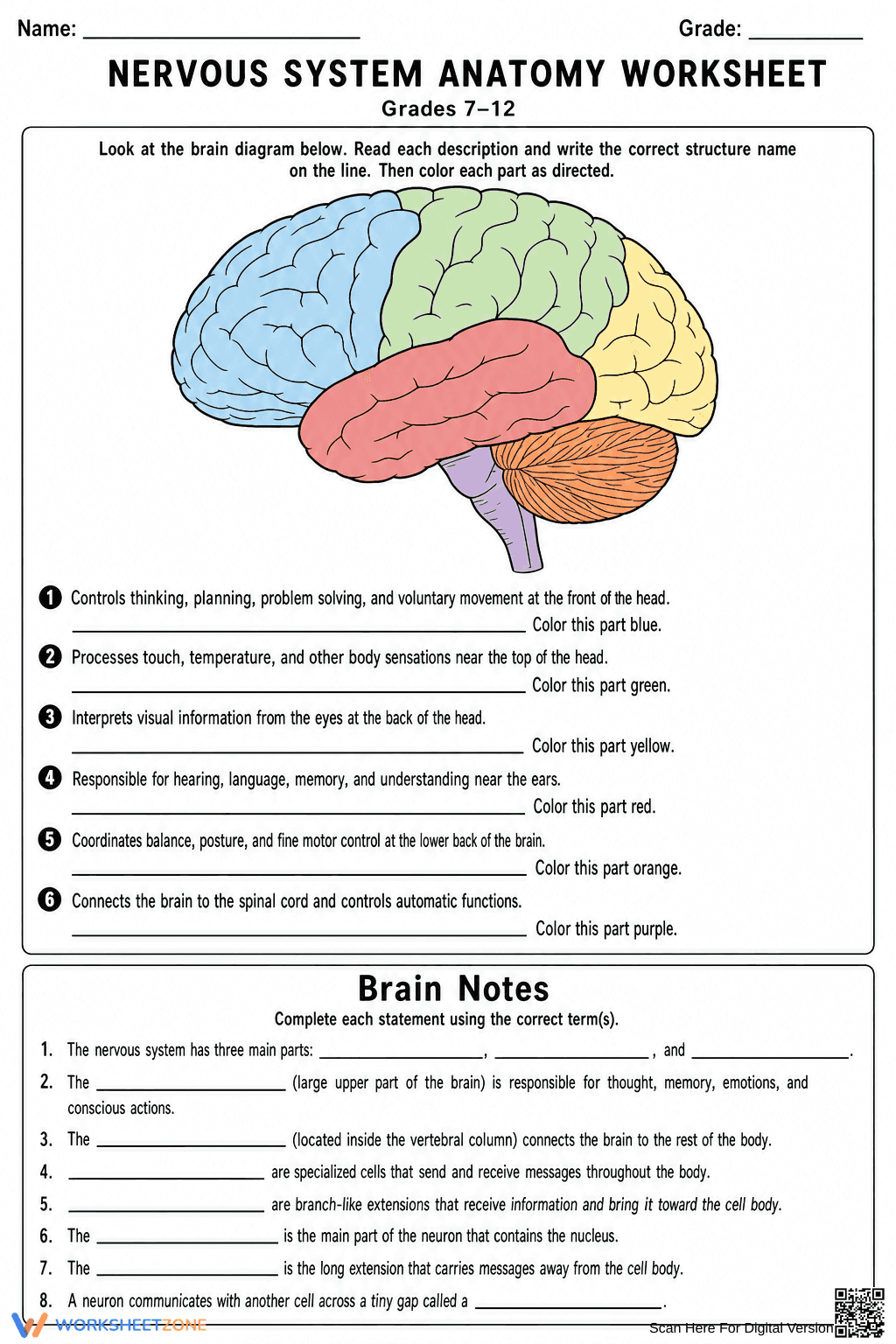
This comprehensive nervous system worksheet provides middle and high school students with a detailed exploration of brain anatomy and neurological functions. Students identify major lobes, neuron structures, and the functional differences between hemispheres to master complex physiological concepts and understand how sensory receptors process information.
At a Glance
- Grade: 7–12 · Subject: Science
- Standard:
MS-LS1-8— Gather and synthesize information on sensory receptors and the brain- Skill Focus: Brain anatomy and neuron function
- Format: 2 pages · 36 problems · Answer key included · PDF
- Best For: Sub plans and unit reviews
- Time: 30–45 minutes
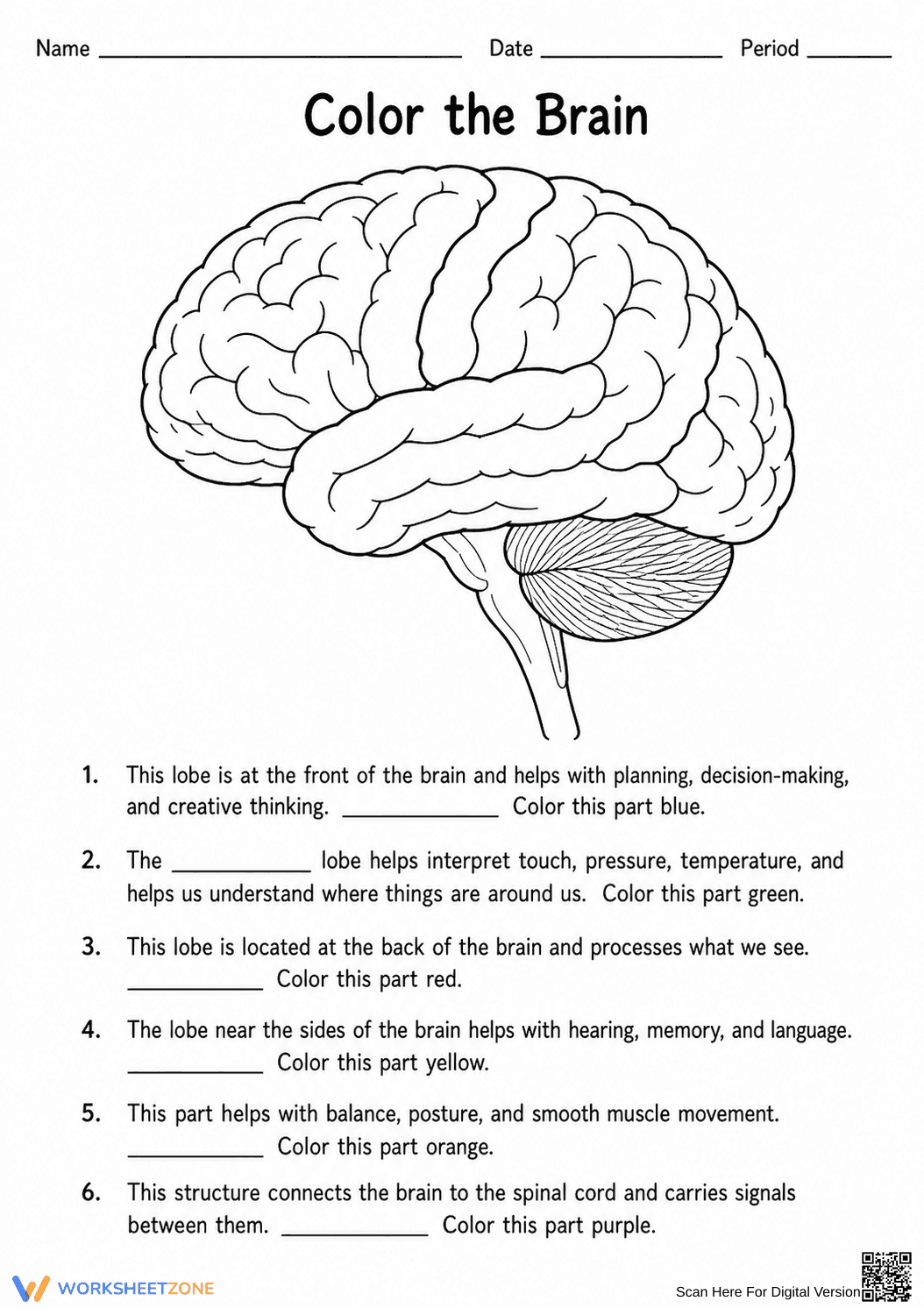
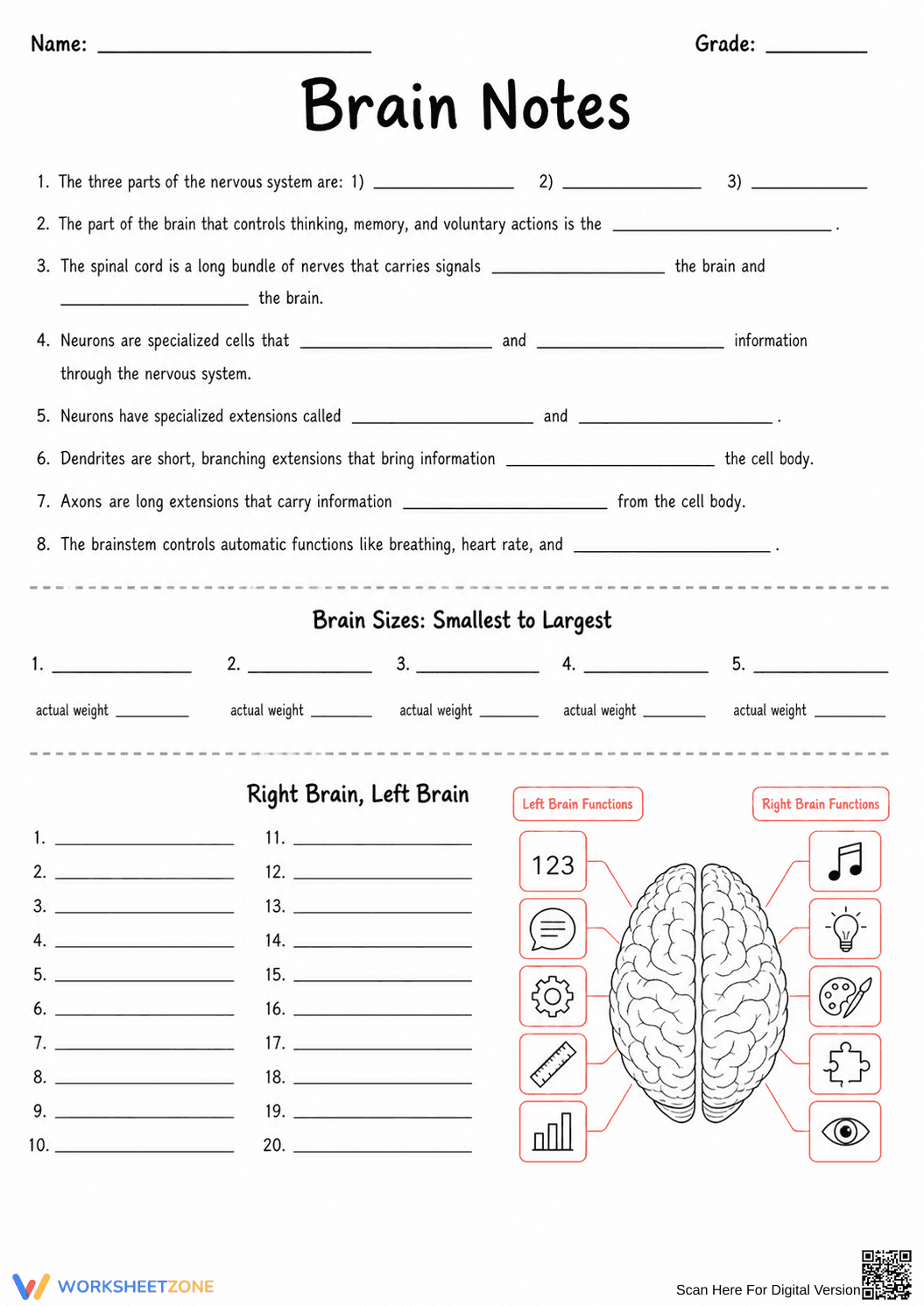
The resource consists of two distinct activity pages designed for maximum information density. The first page features a high-quality brain diagram where students color-code the frontal, parietal, occipital, and temporal lobes based on functional descriptions. The second page utilizes a structured fill-in-the-blank format to cover the three parts of the nervous system, neuron anatomy, and a detailed comparison of right-brain versus left-brain functions. A complete answer key is included for easy grading.
This worksheet is designed for immediate classroom implementation with a total teacher prep time of under two minutes. First, print the double-sided PDF (1 minute). Next, distribute it to students along with colored pencils (1 minute). Finally, use the included answer key for a quick whole-class review once students finish. Because the notes section is entirely self-contained, it requires no extensive teacher setup, making it an ideal, reliable option for emergency sub plans.
Aligned to primary standard MS-LS1-8, this resource requires students to gather and synthesize information that sensory receptors respond to stimuli by sending messages to the brain for immediate behavior or storage as memories. By identifying the specific lobes responsible for vision, hearing, and touch, students visualize the physical structures mentioned in the standard. Both standard codes can be copied directly into lesson plans, IEP goals, or district curriculum mapping tools.
Use this worksheet as a summative review after a direct instruction lesson on the central nervous system. It works effectively as an independent station where students use textbooks or digital resources to find the missing information in the notes section. For a quick formative assessment, observe students during the coloring phase; if they struggle to distinguish between the cerebellum and the brainstem, provide a targeted intervention. Expect completion within 30 to 45 minutes.
This resource is tailored for general biology and life science students in grades 7 through 12. The clear labeling tasks and integrated visual aids make it highly accessible for English Language Learners and students with IEPs who benefit from multimodal instruction. It pairs naturally with a 3D brain model demonstration or an introductory video on neurotransmission to solidify foundational concepts.
According to the RAND AIRS 2024 report on secondary science instruction, the use of integrated visual-verbal scaffolds—such as combining diagram coloring with structured note-taking—significantly improves long-term retention of complex anatomical terminology. This worksheet applies these evidence-based principles by requiring students to process the MS-LS1-8 standard through multiple modalities. By linking the physical location of brain lobes to their specific physiological functions, students move beyond rote memorization toward a conceptual understanding of how to gather and synthesize information on sensory receptors and the brain. Structured notes provide the necessary support for students to eventually explain neurological processes independently, reducing cognitive overload during complex biology units. This resource provides a high-density, research-backed summary that fits onto a single double-sided sheet, making it a highly practical tool for achieving mastery in middle and high school science classrooms.


