


























Views
Downloads

Nervous System Divisions Printable Worksheet | Grade 9
Paste this activity's link or code into your existing LMS (Google Classroom, Canvas, Teams, Schoology, Moodle, etc.).
Students can open and work on the activity right away, with no student login required.
You'll still be able to track student progress and results from your teacher account.
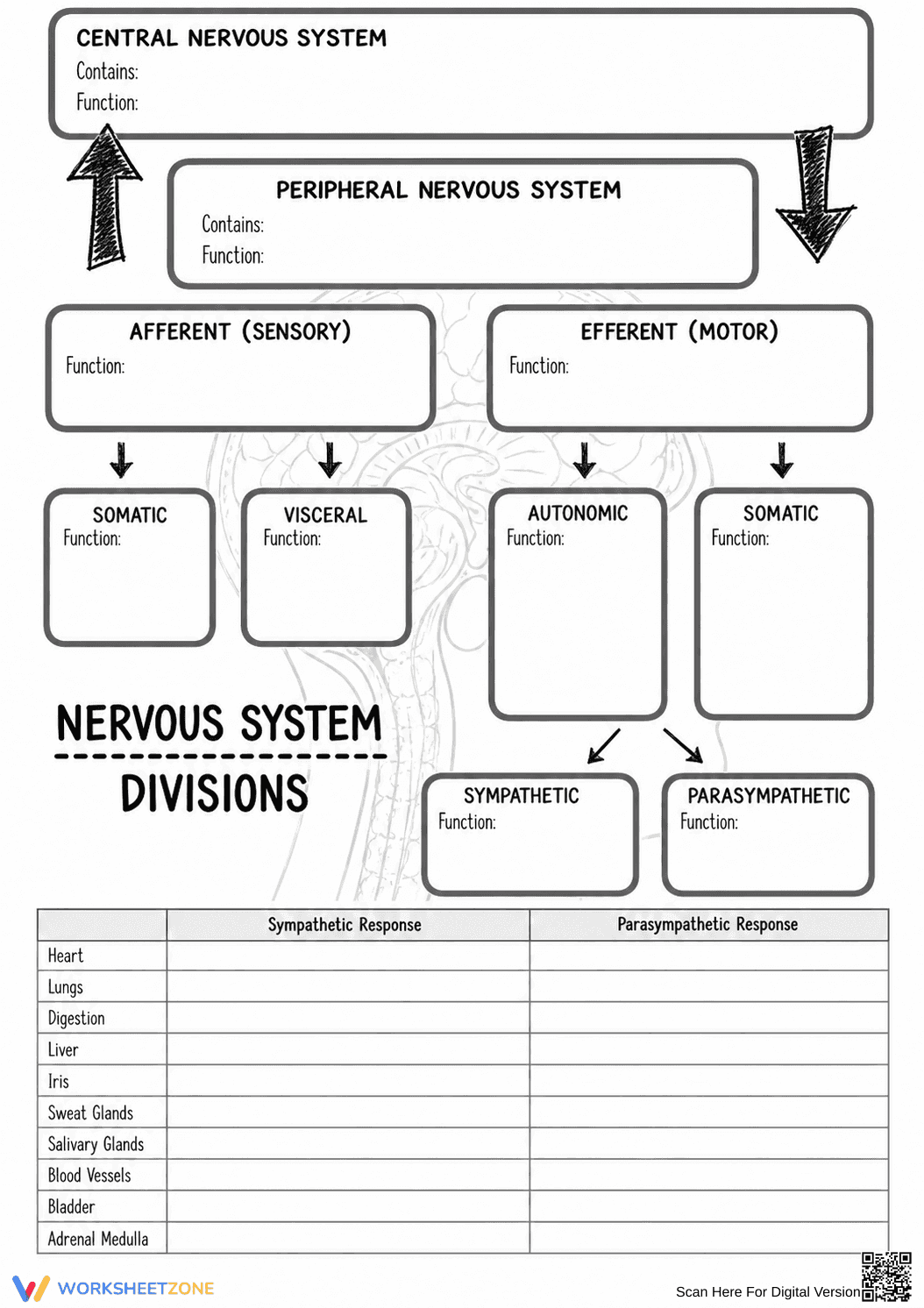
This Grade 9 biology worksheet helps students map the complex divisions of the human nervous system. By completing this visual graphic organizer, learners categorize the central and peripheral systems while identifying specific autonomic responses. Use this resource to solidify foundational anatomy concepts before advancing to action potentials.
At a Glance
- Grade: 9 · Subject: Biology
- Standard:
HS-LS1-2— Model interacting systems that provide specific functions- Skill Focus: Nervous System Divisions
- Format: 1 page · 30 tasks · Answer key included · PDF
- Best For: Independent practice or sub plans
- Time: 20–30 minutes
This single-page resource features a comprehensive flowchart mapping the central and peripheral nervous systems, including afferent, efferent, somatic, and autonomic pathways. Students fill in the functions for each major division. The bottom half includes a comparison table where learners contrast sympathetic and parasympathetic responses across ten organs, such as the heart and lungs. A complete answer key is provided for easy grading.
Zero-Prep Workflow
This resource is designed for immediate classroom implementation with minimal teacher setup.
- Print (1 minute): Generate copies of the single-page PDF for your entire roster.
- Distribute (1 minute): Hand out the graphic organizer as a bell-ringer or independent practice assignment.
- Review (3 minutes): Use the included answer key to quickly check student comprehension or project it for self-correction.
With a total teacher prep time of under two minutes, this worksheet is an excellent addition to any emergency sub plan or busy instructional week.
Standards Alignment
This activity aligns with HS-LS1-2: Develop and use a model to illustrate the hierarchical organization of interacting systems that provide specific functions within multicellular organisms. It also supports HS-LS1-3 by exploring how autonomic responses maintain homeostasis. Both standard codes can be copied directly into lesson plans, IEP goals, or district curriculum mapping tools.
How to Use It
Deploy this graphic organizer during direct instruction as a guided note-taking tool. As you introduce the peripheral and central nervous systems, students fill in the flowchart boxes in real-time. Alternatively, assign it as a post-lecture formative assessment to gauge retention. While students complete the sympathetic versus parasympathetic response table, observe whether they correctly associate the fight-or-flight mechanism with specific organ reactions, such as pupil dilation or increased heart rate. Expect students to complete the entire page in 20 to 30 minutes.
Who It's For
This worksheet is primarily designed for high school biology and anatomy students in grades 9 through 12. The structured visual format provides built-in scaffolding, making it highly accessible for visual learners and students requiring modified note-taking supports. Pair this graphic organizer with a detailed anatomical diagram of the brain and spinal cord to give students a complete picture of human neural pathways.
Understanding the hierarchical structure of the human body requires effective visual modeling and structured practice. This resource directly targets HS-LS1-2, helping students model interacting systems that provide specific functions. According to ScienceDirect TpT Analysis, utilizing structured graphic organizers significantly improves knowledge retention when teaching complex biological hierarchies in secondary education classrooms. By breaking down the nervous system into distinct, manageable categories, students can better conceptualize how these neural pathways interact to maintain homeostasis. The dual format of a flowchart combined with a comparative response table ensures that learners process the information both structurally and functionally. This targeted approach reinforces foundational anatomy concepts and builds the analytical skills necessary for advanced scientific inquiry. Integrating this practice into your curriculum supports long-term mastery of physiological systems.


