




























Views
Downloads

Nervous System Printable Worksheet | Grade 9-12 Biology

Paste this activity's link or code into your existing LMS (Google Classroom, Canvas, Teams, Schoology, Moodle, etc.).
Students can open and work on the activity right away, with no student login required.
You'll still be able to track student progress and results from your teacher account.
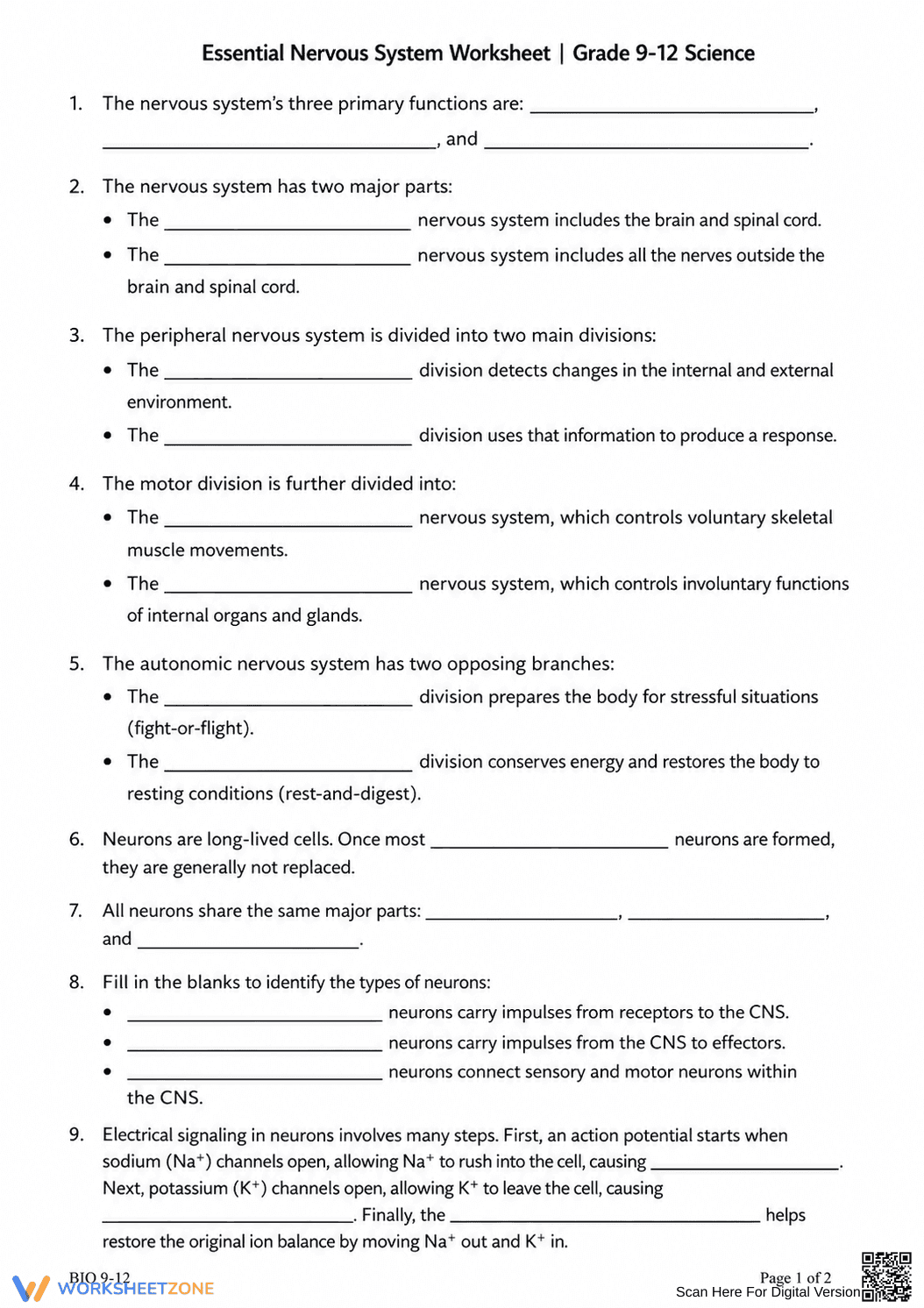
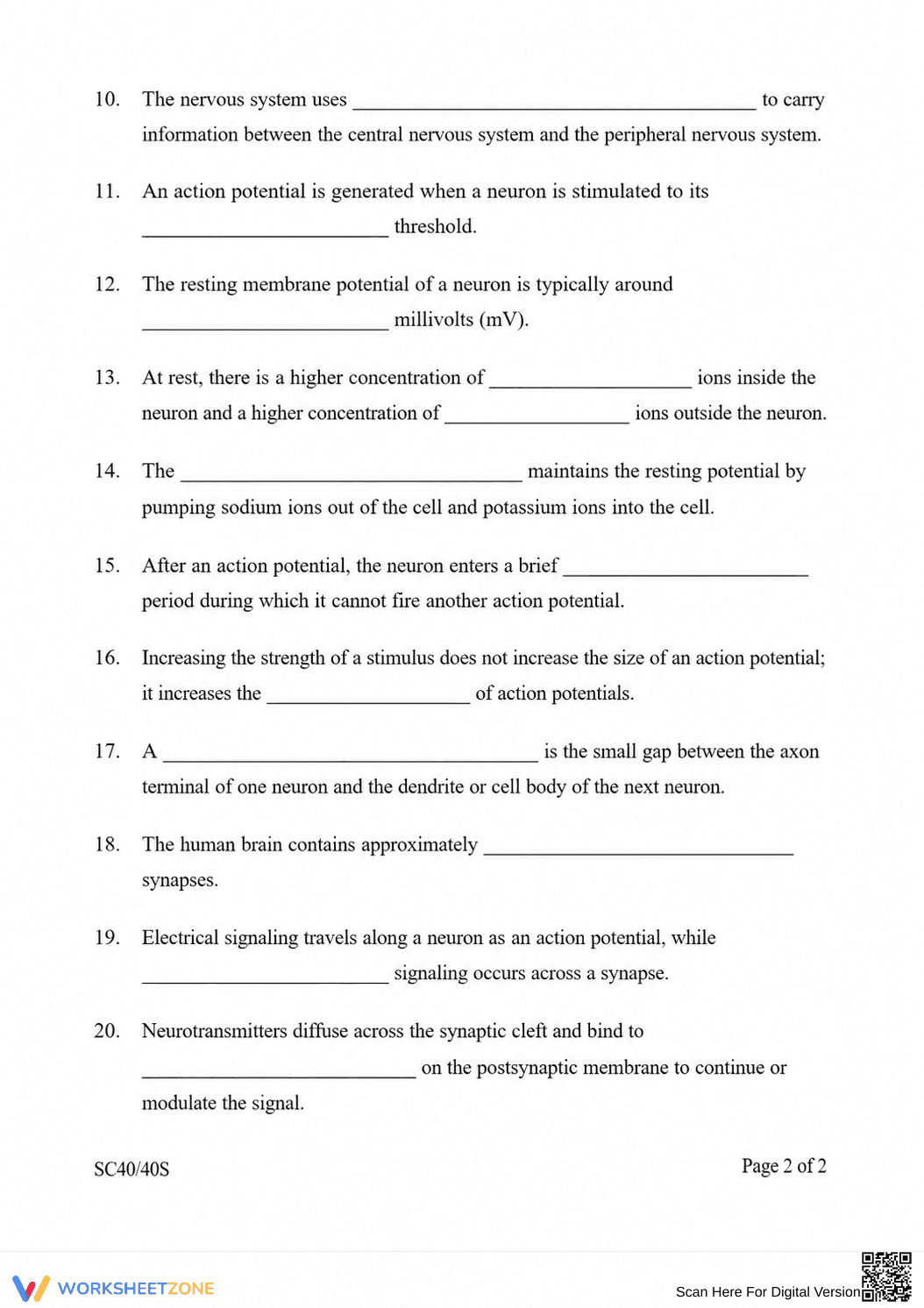
This high school biology worksheet provides students with targeted practice on the human nervous system, focusing on anatomical divisions and signal transmission. By completing these structured prompts, learners will solidify their understanding of neuron structures, action potentials, and synaptic communication to master complex physiological interactions.
At a Glance
- Grade: 9-12 · Subject: Biology
- Standard:
HS-LS1-2— Explain how the nervous system coordinates interactive organ functions- Skill Focus: Neuron anatomy and signal transmission
- Format: 2 pages · 20 problems · Answer key included · PDF
- Best For: Unit review or sub plans
- Time: 25–35 minutes
What's Inside
This two-page document features 20 fill-in-the-blank prompts designed to challenge student recall and reinforce critical academic vocabulary. The content progresses logically from broad system functions and anatomical divisions to specific cellular mechanics, including the sodium-potassium pump and synaptic transmission. The layout is clean and straightforward, providing ample space for student responses without visual distractions, and includes a comprehensive answer key for easy grading.
Zero-Prep Workflow
- Print: Generate copies of the two-page PDF for your class (1 minute).
- Distribute: Hand out the worksheets as a transition activity or bell-ringer (1 minute).
- Review: Go over the answers collectively to clarify misconceptions regarding ion movement (5 minutes).
Total teacher preparation time is under two minutes, making this an ideal resource for busy instructional days or emergency sub plans.
Standards Alignment
The primary focus is HS-LS1-2: Develop and use a model to illustrate the hierarchical organization of interacting systems that provide specific functions within multicellular organisms. This worksheet models the nervous system's hierarchy from the cellular level to the systemic level. Both standard codes can be copied directly into lesson plans, IEP goals, or district curriculum mapping tools.
How to Use It
Use this worksheet as a formative assessment after a direct instruction lecture to gauge retention of the sympathetic and parasympathetic divisions. Alternatively, assign it as an independent review activity to ensure instructional continuity when you are absent. Observe students during question 13; struggle here indicates a need for a re-teach on active transport and resting potential. Expected completion time ranges from 25 to 35 minutes.
Who It's For
This resource is tailored for high school biology students, including those in Honors tracks, and is also highly suitable for introductory anatomy and physiology courses. For students needing additional scaffolding, provide a word bank or allow open-note completion. Pair this worksheet with a labeled neuron diagram or a 3D video of a synapse to support visual learners and provide a multi-modal educational experience.
According to Fisher & Frey (2014), the use of structured fill-in-the-blank scaffolds supports the gradual release of responsibility by requiring students to retrieve specific academic vocabulary within a meaningful context. This worksheet aligns with these findings by targeting the HS-LS1-2 standard, which demands an understanding of how the nervous system maintains homeostasis through complex signaling. By focusing on 20 critical components of neural communication—from the initial stimulus to the chemical synapse—the resource ensures that students move beyond rote memorization toward a functional model of human biology. Explain how the nervous system coordinates interactive organ functions using this targeted practice. Research indicates that students who engage with technical scientific texts and structured retrieval practice show higher proficiency in explaining system interactions. This document provides that necessary bridge between direct instruction and independent mastery, making it a reliable tool for secondary science educators seeking to improve student outcomes in complex physiological topics.


