


























Views
Downloads

Printable Cranial Nerves Worksheet | Grade 9-11 Biology
Paste this activity's link or code into your existing LMS (Google Classroom, Canvas, Teams, Schoology, Moodle, etc.).
Students can open and work on the activity right away, with no student login required.
You'll still be able to track student progress and results from your teacher account.
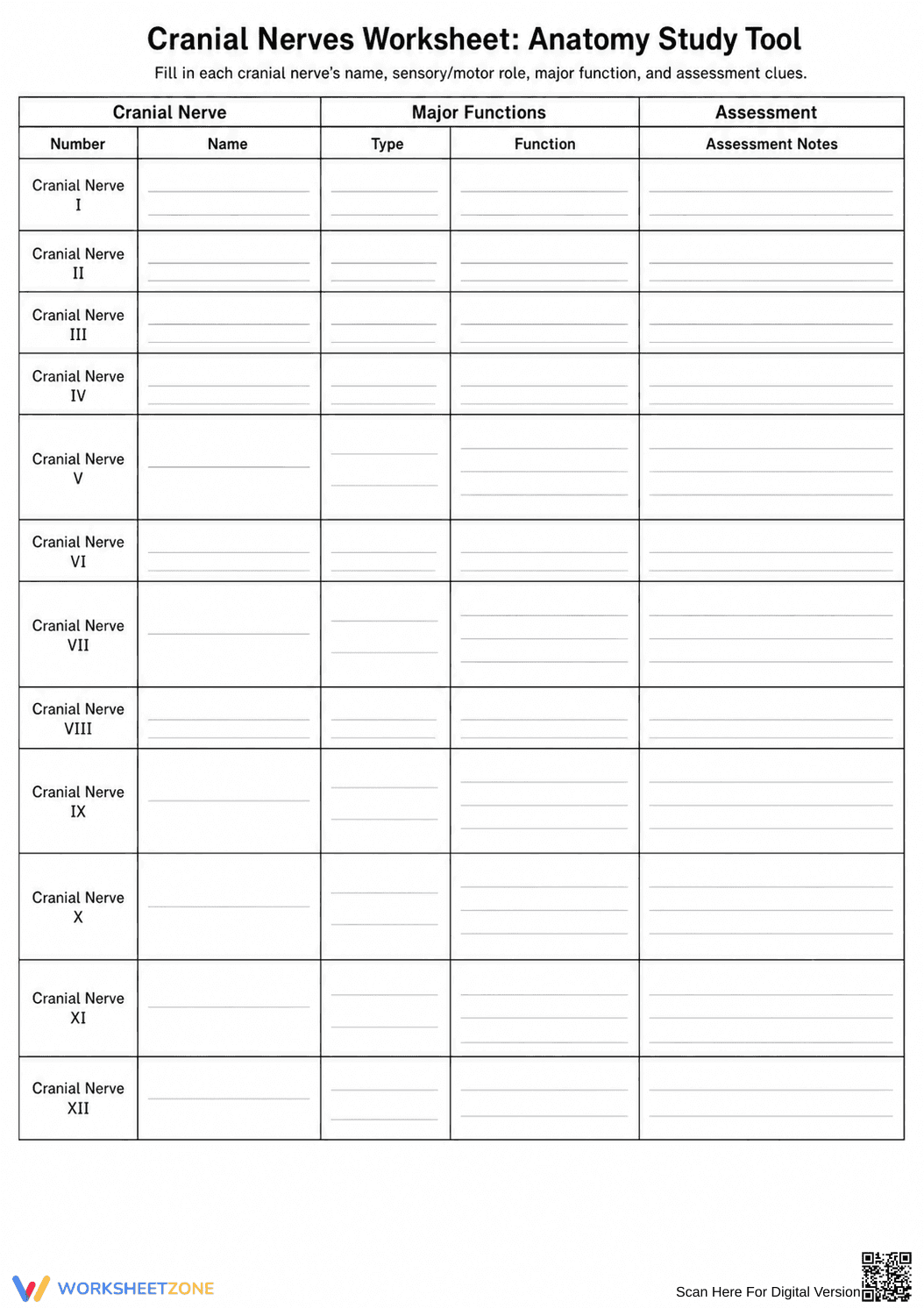
This high school biology worksheet helps students master the anatomy of the nervous system by detailing the twelve cranial nerves. Students identify each nerve's sensory or motor classification, major functions, and clinical assessment clues, building a strong foundation for advanced science studies.
At a Glance
- Grade: 9-11 · Subject: Biology
- Standard:
HS-LS1-2— Illustrate interacting systems providing specific functions in organisms- Skill Focus: Cranial Nerve Anatomy & Function
- Format: 1 page · 12 problems · Answer key included · PDF
- Best For: Independent study and review
- Time: 20–30 minutes
Inside this resource, educators will find a one-page graphic organizer formatted as a clean table. The worksheet requires students to fill in missing information for all twelve cranial nerves. For each nerve, learners document the specific name, determine if it is a sensory, motor, or mixed nerve, describe its primary physiological function, and list relevant clinical assessment notes. A complete answer key is provided to ensure accurate grading.
- Print (1 minute): Print the single-page PDF table for each student.
- Distribute (1 minute): Hand out the worksheet as a standalone assignment or study guide.
- Review (5 minutes): Use the included answer key to quickly verify student responses.
This resource requires under two minutes of total teacher prep time, making it an excellent option for emergency sub plans.
Aligned to HS-LS1-2: Develop and use a model to illustrate the hierarchical organization of interacting systems that provide specific functions within multicellular organisms. By mapping out the specific roles of the cranial nerves, students model how the nervous system interacts with other bodily systems. Both standard codes can be copied directly into lesson plans, IEP goals, or district curriculum mapping tools.
Use this worksheet during direct instruction as a guided notes template where students fill in the table as you lecture. Alternatively, assign it as an independent review activity before a unit exam. As a formative assessment tip, check student entries for the Vagus nerve, as its systemic functions often confuse learners. Expect students to complete this task in 20 to 30 minutes.
This resource is designed for high school biology and anatomy students in grades 9 through 11. It provides built-in structure for learners who benefit from organized data collection. Pair this worksheet with a detailed anatomical diagram of the brain to help students visualize the physical origin points of each nerve while they document the functions.
Mastering complex anatomical structures requires organized, systematic review methods that reduce cognitive load. This worksheet supports HS-LS1-2 by helping students illustrate interacting systems providing specific functions in organisms. According to Fisher & Frey (2014), utilizing structured graphic organizers and guided tables significantly improves student retention of dense informational text and complex scientific vocabulary. By breaking down the twelve cranial nerves into distinct, manageable categories—name, type, function, and assessment—this resource prevents learners from becoming overwhelmed by the sheer volume of neuroanatomy data. The clear format allows students to focus their cognitive energy on understanding physiological relationships rather than organizing the material themselves. This targeted approach ensures that high school biology students can confidently transition from basic memorization to clinical application, building a robust foundation for future healthcare or advanced science pathways.


