


























Views
Downloads

Essential Cranial Nerves Anatomy Practice | Grade 9-12
Paste this activity's link or code into your existing LMS (Google Classroom, Canvas, Teams, Schoology, Moodle, etc.).
Students can open and work on the activity right away, with no student login required.
You'll still be able to track student progress and results from your teacher account.
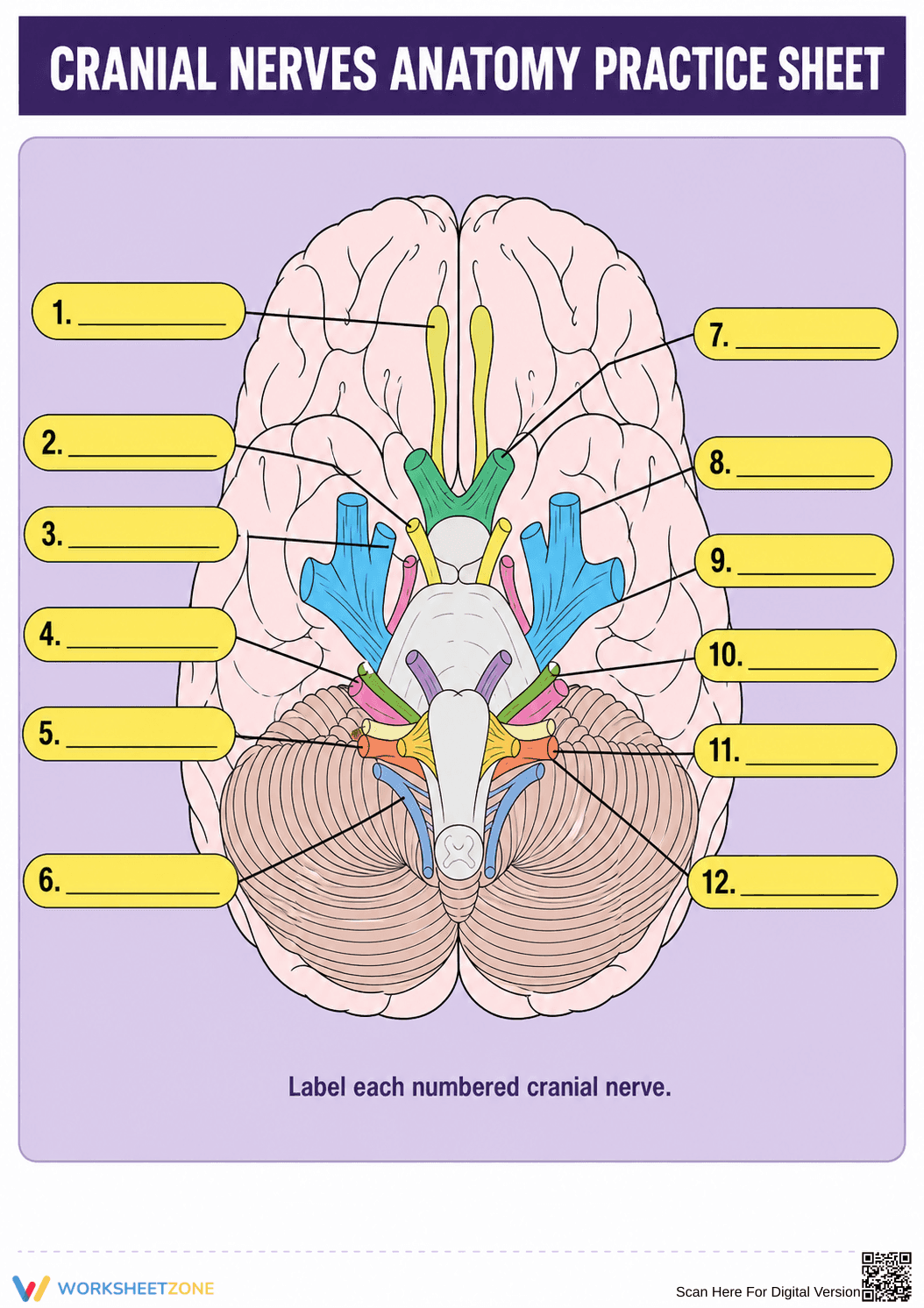
This Essential Cranial Nerves Anatomy Practice Sheet provides a comprehensive visual exercise for high school students to identify and locate the twelve cranial nerves. By engaging with this detailed ventral-view brain diagram, learners solidify their understanding of neuroanatomy and the spatial relationships between critical nervous system structures.
At a Glance
- Grade: 9-12 · Subject: Biology
- Standard:
HS-LS1-2— Develop and use a model to illustrate the organization of interacting systems- Skill Focus: Cranial Nerve Identification
- Format: 1 page · 12 problems · Answer key included · PDF
- Best For: Anatomy review and formative assessment
- Time: 15–20 minutes
This single-page PDF features a high-resolution anatomical illustration of the human brain's underside. It includes 12 distinct labeling fields corresponding to the olfactory, optic, and oculomotor nerves, among others. The clear, color-coded visual cues help students distinguish between various nerve origins, and a full answer key is provided for immediate feedback and self-grading.
Skill Progression
- Guided Practice: Students begin by observing the color-coded nerve structures to recognize distinct anatomical shapes and their relative positions on the brainstem.
- Supported Practice: Learners use the 12 numbered callouts to map specific nerves to their exit points, utilizing the visual diagram to bridge the gap between terminology and physical location.
- Independent Practice: Students complete the labeling without external aids to demonstrate mastery of the cranial nerve sequence and nomenclature.
This worksheet follows a gradual-release model, moving from visual recognition to independent recall of complex biological terminology.
Standards Alignment
This resource aligns with HS-LS1-2, which requires students to develop and use a model to illustrate the hierarchical organization of interacting systems that provide specific functions within multicellular organisms. By identifying the specific pathways of the cranial nerves, students visualize the organization of the human body. Both standard codes can be copied directly into lesson plans, IEP goals, or district curriculum mapping tools.
How to Use It
Use this worksheet as a formative assessment after a lecture on the peripheral nervous system. It is also effective as a "bell-ringer" activity to activate prior knowledge before a laboratory dissection or a detailed study of sensory organs. Teachers should observe if students can correctly sequence the nerves from anterior to posterior. The expected completion time range is 15 to 20 minutes.
Who It's For
This practice sheet is designed for high school biology students, AP Anatomy & Physiology learners, and introductory nursing students. It pairs naturally with a nervous system anchor chart or a 3D brain model to provide a multi-sensory learning experience for diverse student populations, including those requiring visual scaffolds.
The Essential Cranial Nerves Anatomy Practice Sheet is a targeted instructional tool designed to meet the rigorous demands of HS-LS1-2. By focusing on the identification of the twelve cranial nerves, the worksheet facilitates the mental mapping of the human nervous system, a foundational skill in biological sciences. According to Fisher & Frey (2014), the use of visual scaffolds and labeling tasks is critical for students to transition from surface-level recognition to deep conceptual understanding of complex anatomical systems. This resource provides 12 specific data points for students to master, ensuring they can accurately describe the organization of interacting systems within the human body. Research from the RAND AIRS 2024 report suggests that high-quality, focused practice sheets significantly improve retention rates in STEM subjects by reducing cognitive load during the initial phases of technical vocabulary acquisition and spatial reasoning.


