


























Views
Downloads

Printable Cranial Nerves Worksheet | Grades 10-12 Biology
Paste this activity's link or code into your existing LMS (Google Classroom, Canvas, Teams, Schoology, Moodle, etc.).
Students can open and work on the activity right away, with no student login required.
You'll still be able to track student progress and results from your teacher account.
This high school anatomy worksheet provides focused practice on the twelve cranial nerves, helping students master nervous system functions. By completing detailed tables and labeling anatomical diagrams, learners will solidify their understanding of nerve types, innervation locations, and clinical assessment tests to evaluate human body systems.
At a Glance
- Grade: 10–12 · Subject: Biology
- Standard:
HS-LS1-2— Illustrate interacting systems providing specific functions in organisms- Skill Focus: Identifying cranial nerve functions
- Format: 5 pages · 72 problems · PDF
- Best For: Independent study and review
- Time: 30–45 minutes
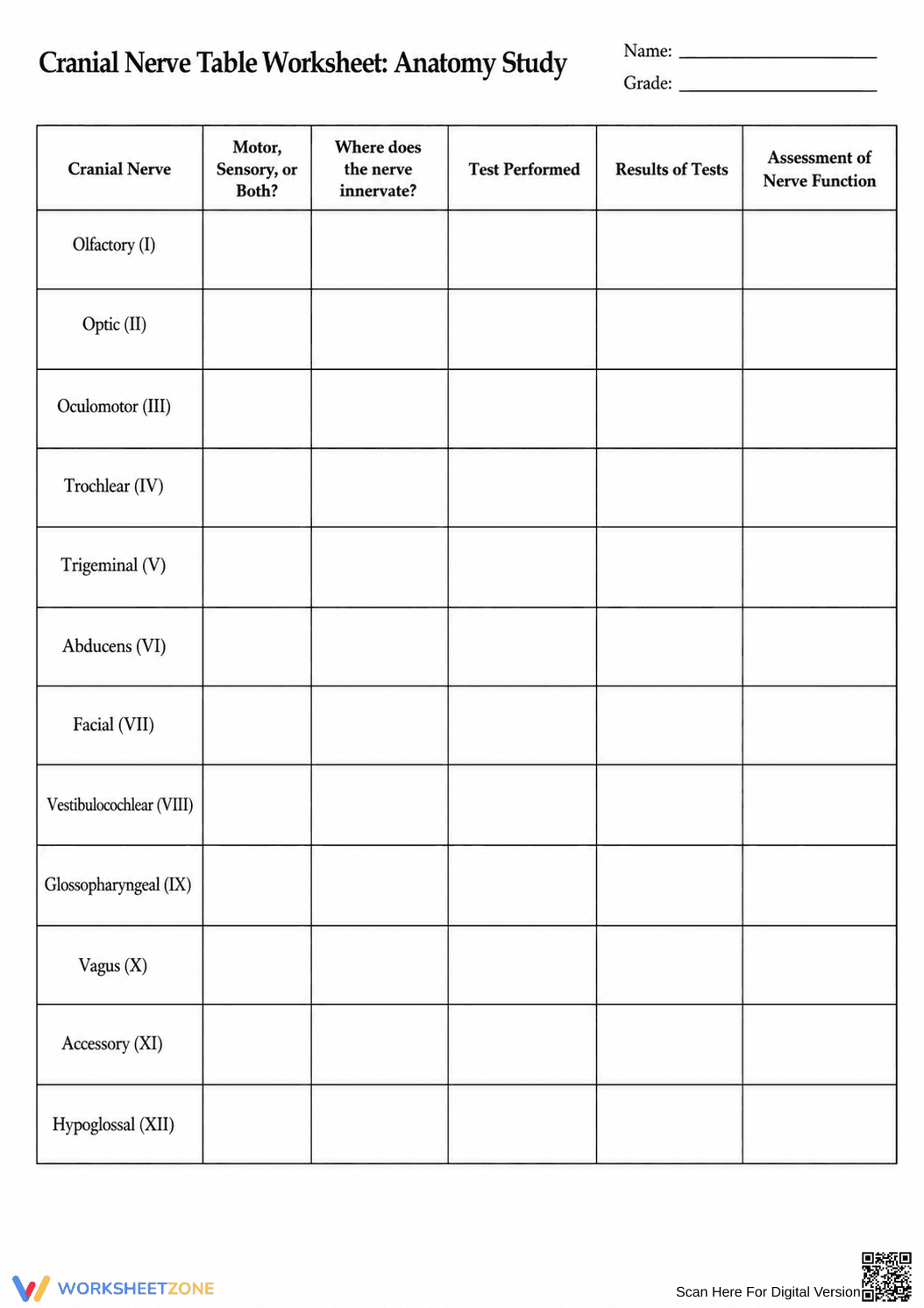
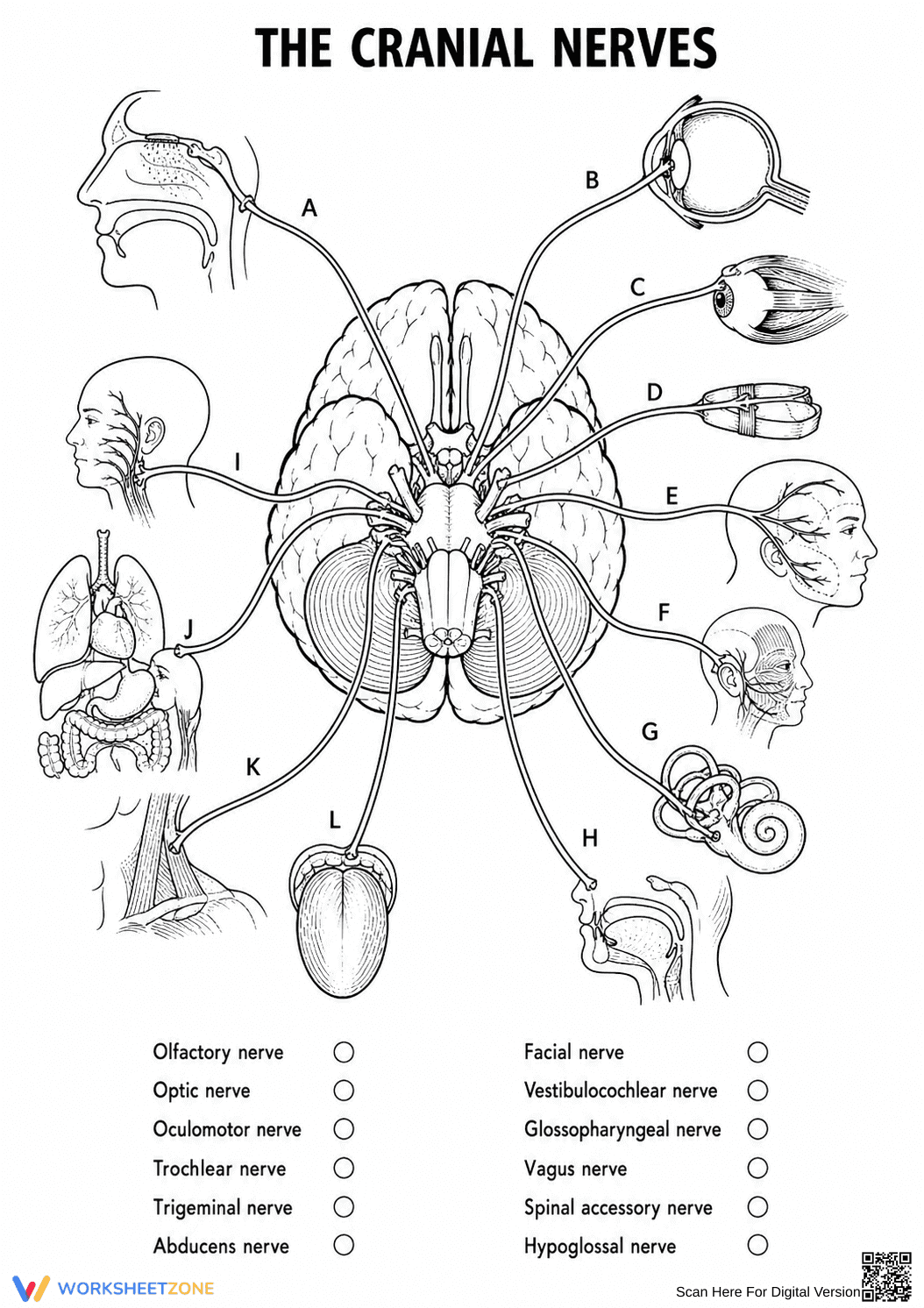
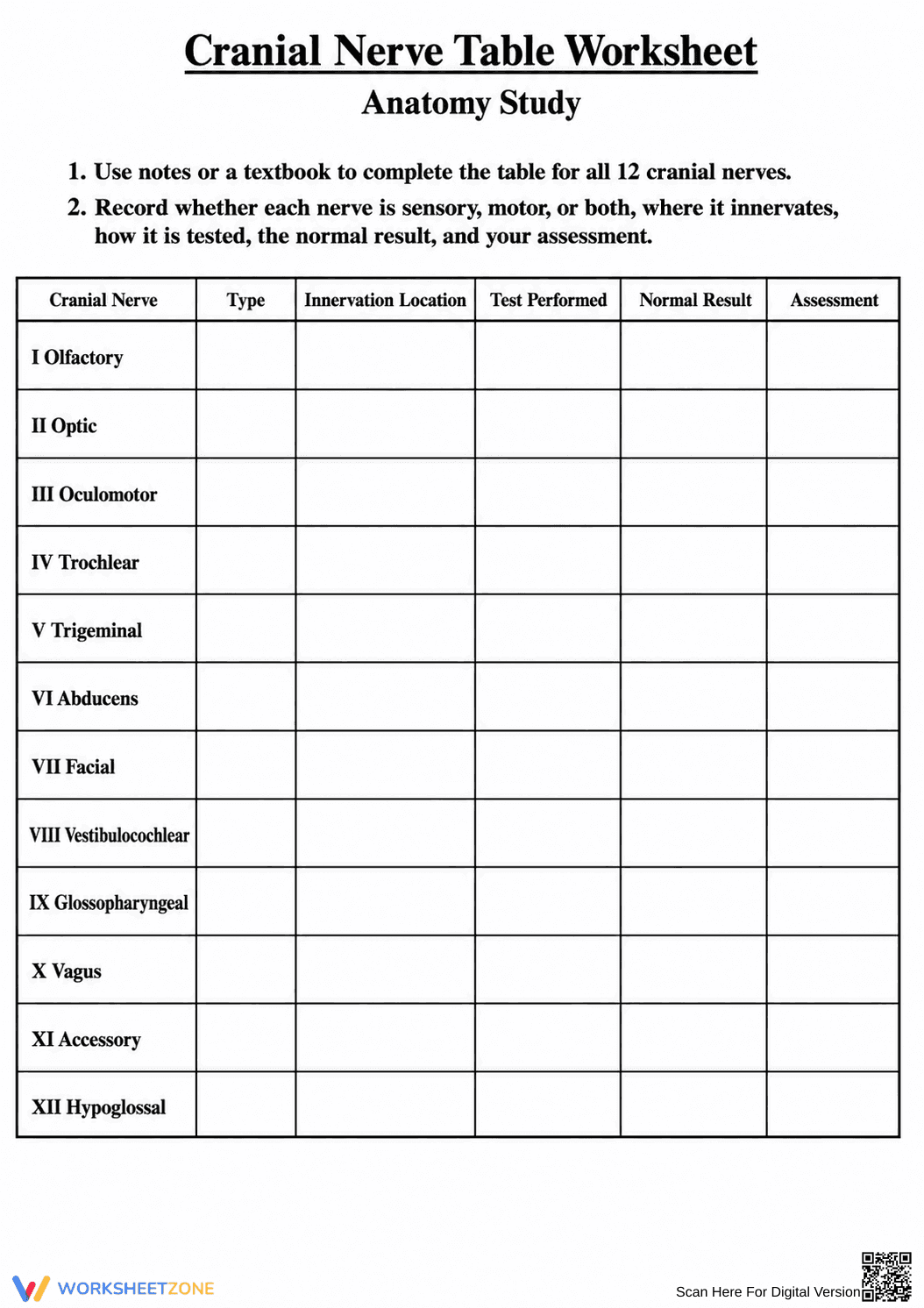
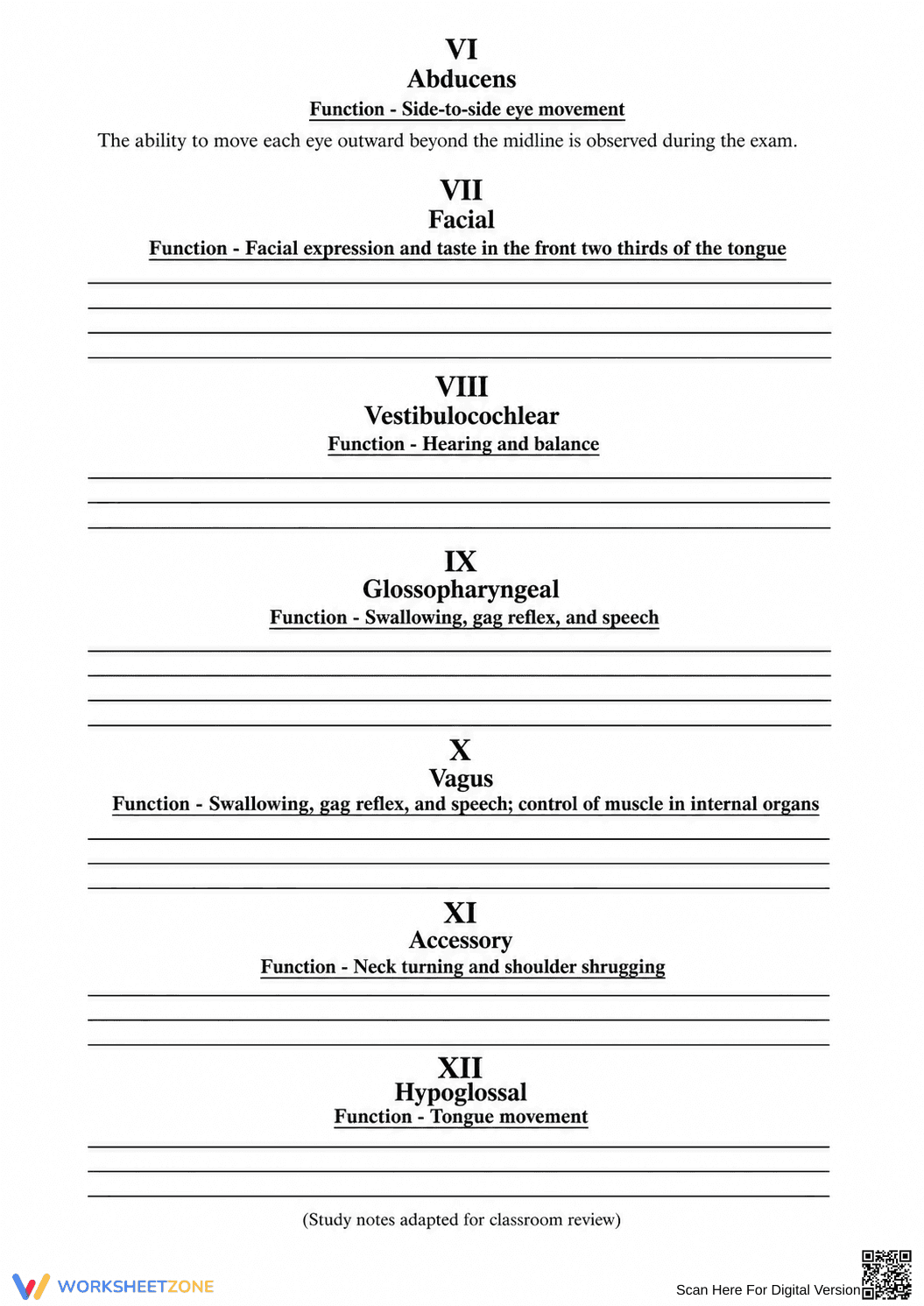
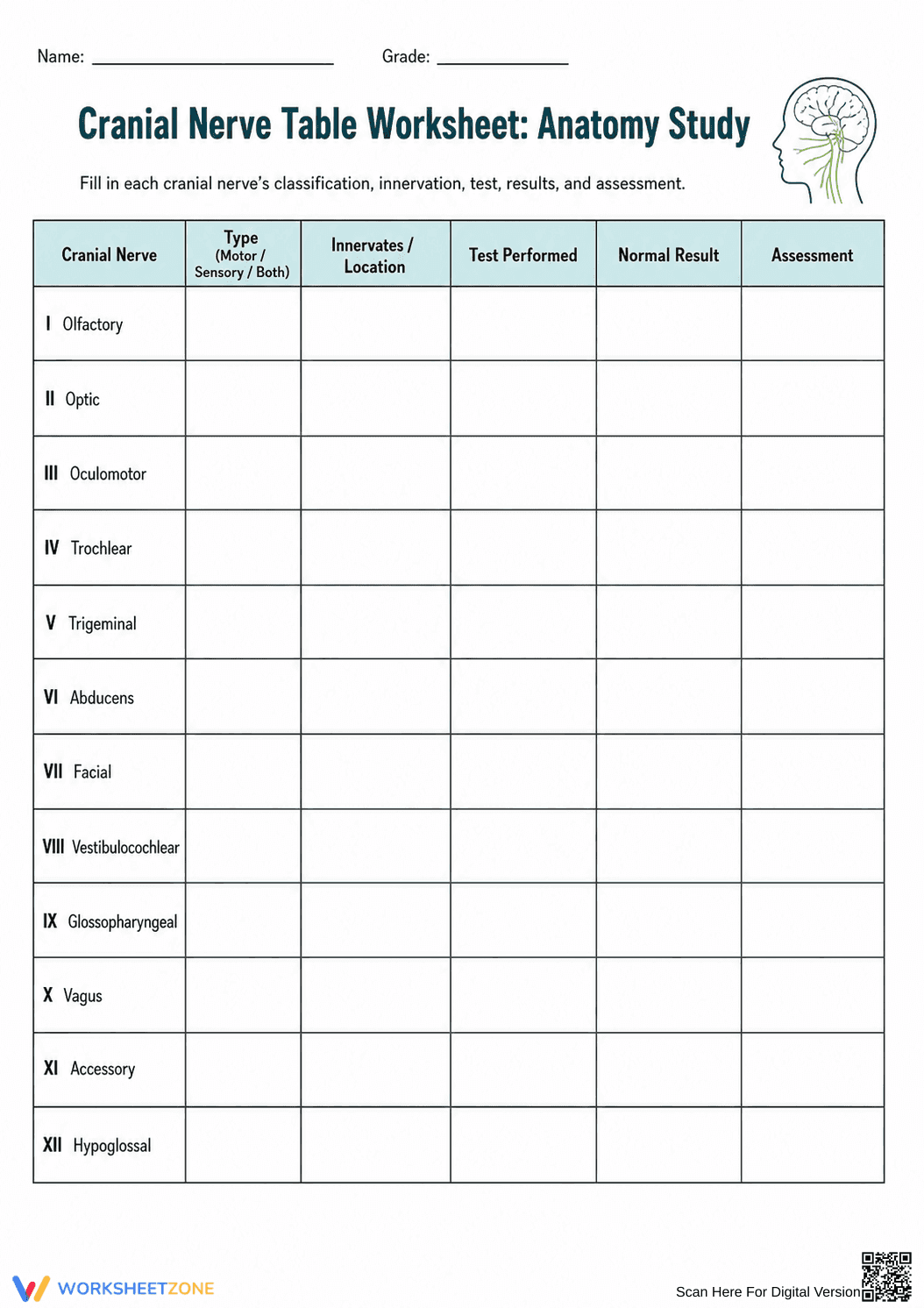
This comprehensive five-page resource features multiple formats to reinforce anatomical knowledge. It includes three variations of a detailed cranial nerve table requiring students to classify each nerve as motor, sensory, or both, alongside its innervation site and clinical testing methods. Additionally, the packet contains a visual diagram for labeling nerve pathways and a structured study guide outlining specific functions for nerves VI through XII.
- Guided practice: Students begin by reviewing the provided study notes detailing specific functions for the lower cranial nerves, establishing a baseline understanding.
- Supported practice: Learners transition to the visual diagram, matching the 12 cranial nerves to their corresponding anatomical pathways and target organs.
- Independent practice: Students complete the comprehensive blank tables from memory or textbook research, filling in 60 specific data points regarding nerve types and clinical tests.
This gradual-release approach ensures students build confidence before tackling the rigorous independent memorization tasks.
Aligned to HS-LS1-2, this resource supports students as they develop and use a model to illustrate the hierarchical organization of interacting systems that provide specific functions within multicellular organisms. By mapping the cranial nerves to their specific sensory and motor functions, learners connect microscopic nerve pathways to macroscopic bodily responses. Both standard codes can be copied directly into lesson plans, IEP goals, or district curriculum mapping tools.
Deploy this resource during a broader nervous system unit after initial direct instruction on brain anatomy. It serves as an excellent in-class collaborative activity where small groups research and fill out the tables together. As a formative assessment tip, observe students as they label the visual diagram to quickly identify misconceptions about nerve origins and target organs. Expect the full packet to take 30 to 45 minutes to complete.
This material is designed for high school biology, anatomy, and physiology students, as well as introductory college-level pre-med learners. To support students needing accommodations, teachers can provide a partially filled table or a word bank of clinical tests. It pairs perfectly with 3D brain models or interactive nervous system dissection labs.
Mastering complex anatomical structures requires repeated, structured retrieval practice. This resource targets HS-LS1-2 by having students illustrate interacting systems providing specific functions in organisms. According to ScienceDirect TpT Analysis, utilizing multimodal study tools—such as combining visual diagrams with analytical tables—significantly enhances long-term retention of complex biological systems. By requiring learners to categorize cranial nerves by type, innervation, and clinical assessment, this worksheet moves beyond rote memorization into applied clinical reasoning. The structured format reduces cognitive overload, allowing students to systematically process the intricate connections between the central nervous system and peripheral functions. This evidence-based approach ensures that high school and introductory college students build a durable foundation in human anatomy, preparing them for advanced coursework and practical clinical applications in future medical studies.


