


























Views
Downloads

Printable Cranial Nerves Anatomy Worksheet | Grades 9-12
Paste this activity's link or code into your existing LMS (Google Classroom, Canvas, Teams, Schoology, Moodle, etc.).
Students can open and work on the activity right away, with no student login required.
You'll still be able to track student progress and results from your teacher account.
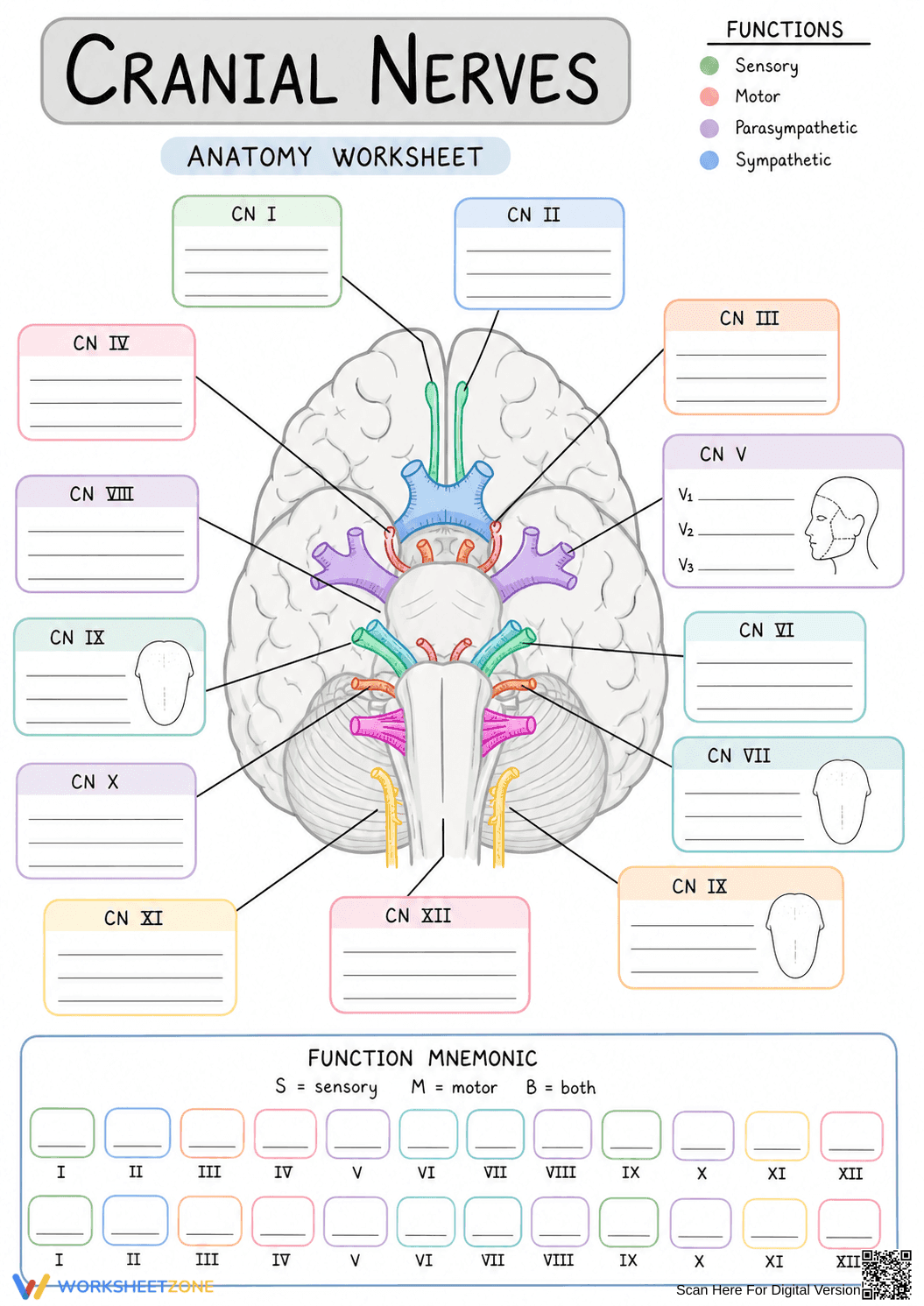
This high school biology worksheet helps students master the anatomy and function of the twelve cranial nerves. By labeling a detailed brain diagram and completing a function mnemonic, learners solidify their understanding of the nervous system. The visual format ensures complex anatomical structures are accessible and easy to memorize.
At a Glance
- Grade: 9-12 · Subject: Biology
- Standard:
HS-LS1-2— Illustrate interacting systems providing specific functions in organisms- Skill Focus: Identifying cranial nerves
- Format: 1 page · 12 problems · Answer key included · PDF
- Best For: Independent practice and review
- Time: 15–20 minutes
What's Inside
This single-page resource features a color-coded illustration of the human brain, highlighting the origins of cranial nerves I through XII. Students fill in the names and primary functions for each nerve in the designated boxes. The bottom section includes a structured mnemonic builder to help students retain the sequential order and functional classification of all twelve nerves.
Zero-Prep Workflow
- Print (1 minute): Generate enough copies of the PDF for your biology or anatomy class. The clear layout prints beautifully in both color and grayscale.
- Distribute (1 minute): Hand out the diagram after your initial lecture on the peripheral nervous system. No additional teacher setup or specialized materials are required.
- Review (3 minutes): Display the included answer key on your smartboard to allow students to self-correct their diagrams and mnemonic devices.
Standards Alignment
This activity is directly aligned with HS-LS1-2: Develop and use a model to illustrate the hierarchical organization of interacting systems that provide specific functions within multicellular organisms. By mapping the specific sensory and motor pathways of the cranial nerves, students demonstrate how the nervous system coordinates complex bodily functions. Both standard codes can be copied directly into lesson plans, IEP goals, or district curriculum mapping tools.
How to Use It
Deploy this diagram during direct instruction as a guided note-taking tool, allowing students to label each nerve as you discuss its role. Alternatively, assign it as a formative assessment at the end of your nervous system unit. As students work, observe whether they correctly distinguish between motor and sensory functions using the mnemonic section. Expect most high schoolers to complete the tasks within 15 to 20 minutes.
Who It's For
This resource is designed for high school biology, anatomy, and physiology students, as well as introductory college pre-med learners. To support students who need accommodations, provide a word bank of the twelve cranial nerve names on the board. This diagram pairs perfectly with a 3D brain model demonstration or a clinical case study lesson focusing on neurological deficits.
Mastering the intricate anatomical structures of the human nervous system requires active visual engagement and structured repetition. Aligning directly with HS-LS1-2, this resource requires students to illustrate interacting systems providing specific functions in organisms by accurately identifying the twelve cranial nerves. According to ScienceDirect TpT Analysis, integrating visual models with mnemonic devices significantly reduces cognitive load and improves long-term retention of complex biological vocabulary in secondary science classrooms. When students actively label diagrams rather than passively reading textbook descriptions, their spatial memory and functional recall increase dramatically. This targeted practice ensures learners can confidently map sensory, motor, and parasympathetic pathways across the brainstem. By combining spatial mapping with a functional mnemonic, educators provide a robust framework for anatomical literacy, building a critical foundation for advanced physiological studies and future clinical applications in healthcare fields.


