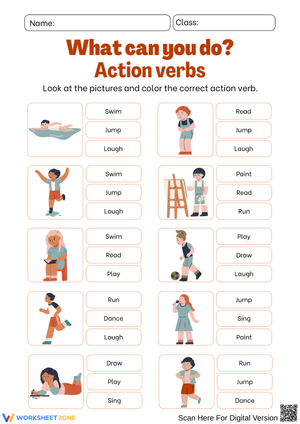
These 1st grade action verbs printable worksheets give teachers a focused set of resources for one of the year's most teachable grammar moments — the point when students stop reading sentences as a string of words and start noticing what those words actually do. Each worksheet targets a distinct skill: identifying the verb in a sentence, sorting doing words from naming words, matching illustrated actions to their written forms, and completing sentences from a word bank.
The Specific Skills These Worksheets Target
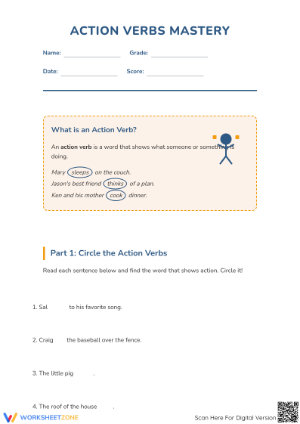
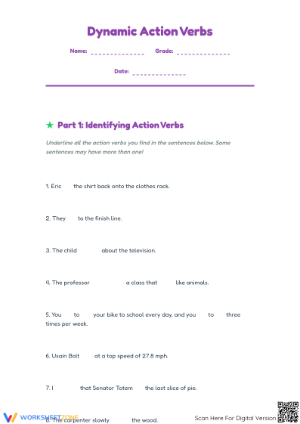
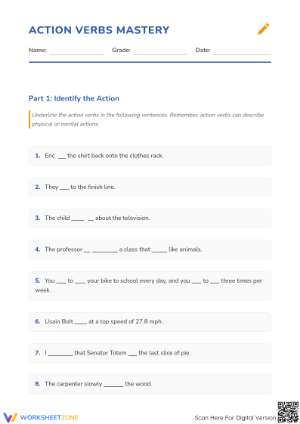
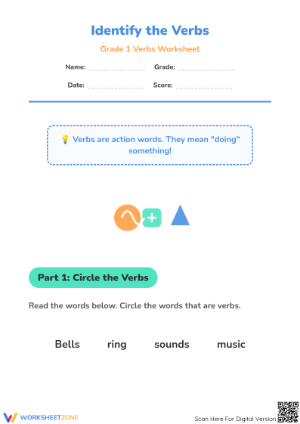
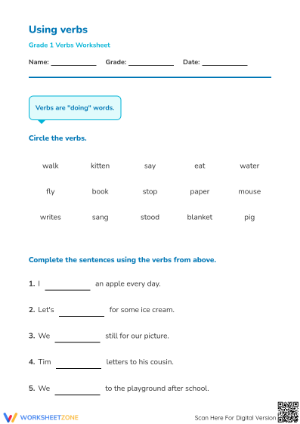
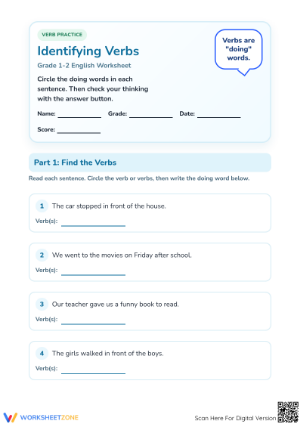
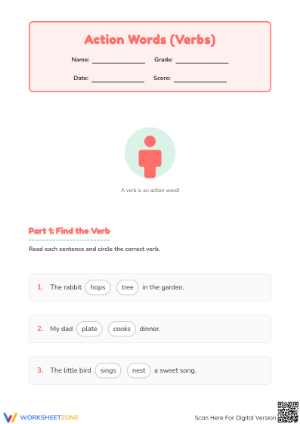
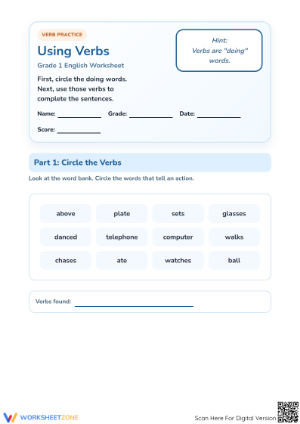
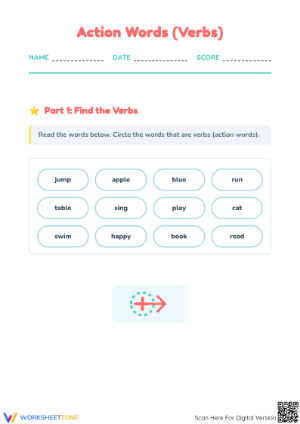
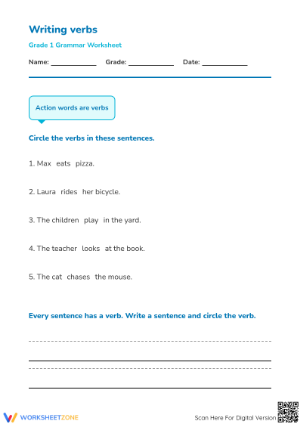
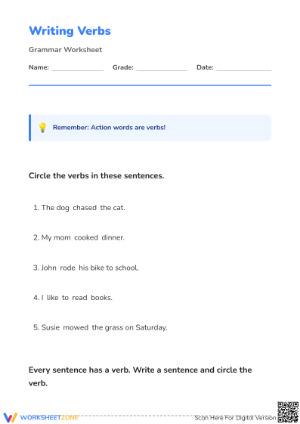
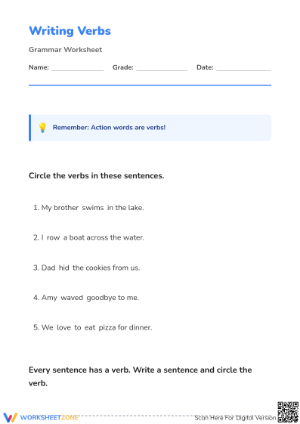
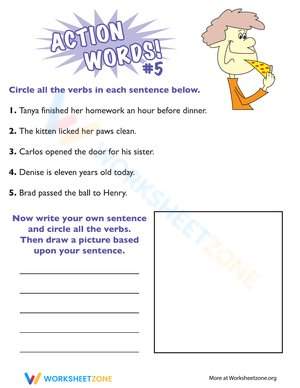
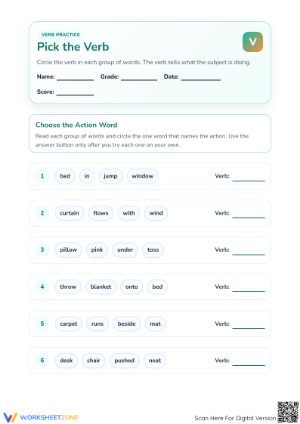
Verb identification exercises ask students to underline or circle the action word in a simple, decodable sentence — a task that sounds mechanical but requires real comprehension. A child who can decode "The frog jumps over the log" still has to determine which word names the doing. Students mark the verb, not the subject, not the object, not the adjective sitting between them. That precision is the whole point of the exercise.
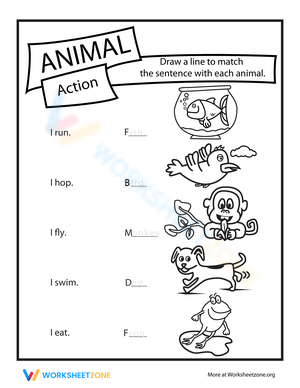
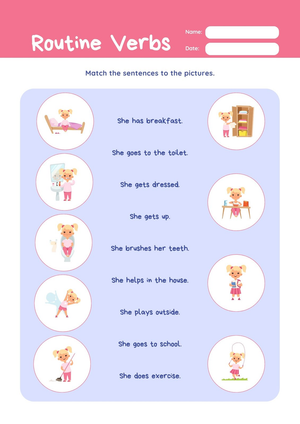
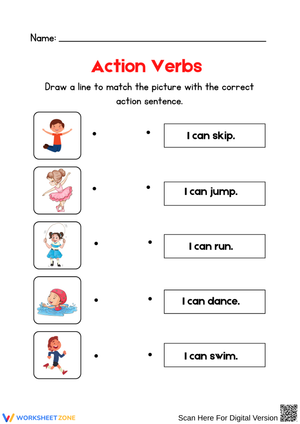
Picture-to-verb matching pairs illustrated scenes — a child running, a dog digging, a bird flying — with written verb cards. First graders still building their sight word inventory need that image as an anchor. The physical act of drawing a line or cutting and pasting also gives the skill a motor-memory component that helps the word stick past the end of the lesson.
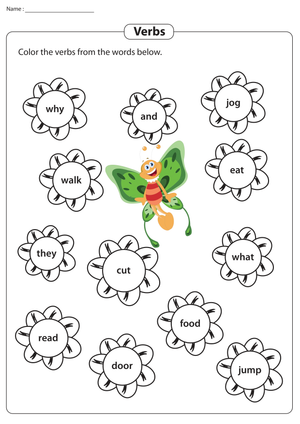
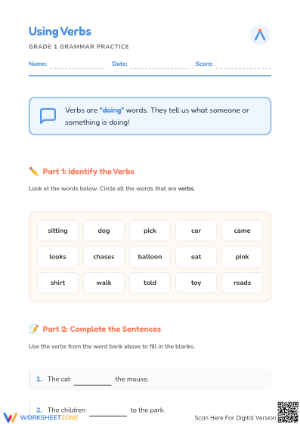
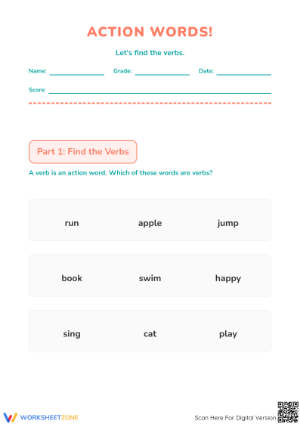
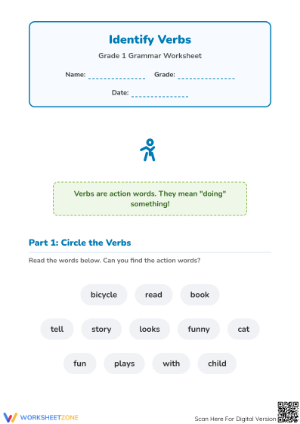
Noun-versus-verb sorting is where conceptual understanding gets tested. Students work with two-column organizers to categorize words as naming or doing. The harder version of this task uses words that can function as either part of speech — "run," "swim," "dance" shift roles depending on context — but the introductory worksheets here keep the vocabulary unambiguous, which is the right call for early in the unit.
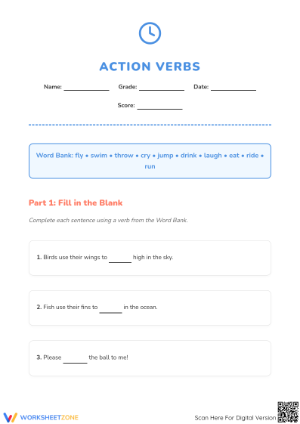
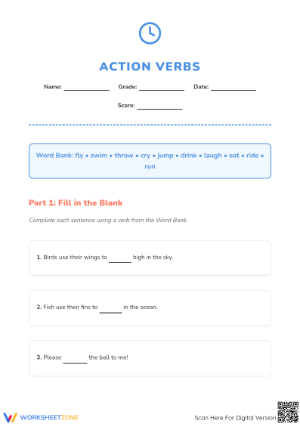
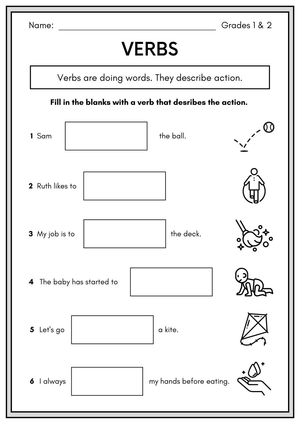
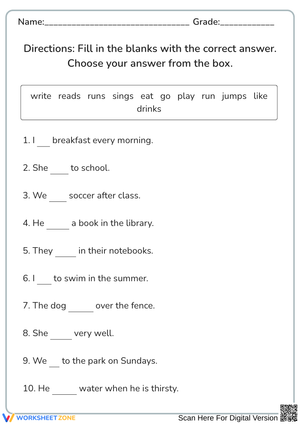
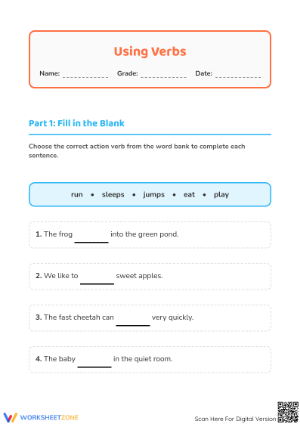
Sentence completion rounds out the set. Given a short sentence with the verb removed, students select from a word bank and write their choice on the line. This format rewards students who read the whole sentence for meaning before filling in the blank, which is exactly the reading habit worth reinforcing in first grade.
Student Errors Worth Anticipating Before You Hand These Out
The most consistent error in verb identification is adjective confusion. Students circle the most visually prominent content word, and in a sentence like "The big dog runs fast," a surprising number will mark "big" or "fast" rather than "runs." They are drawn to words that feel important — descriptive — without yet having the grammatical framework to see that "runs" is doing the structural work. Worth addressing directly before students begin: "The verb tells us what the subject does. Can you do 'big'? No. Can you do 'run'? Yes."
On sorting activities, watch for students who conflate words that sound active with words that are not verbs. "Ball," "race," and "slide" carry a sense of motion or energy, and students will sort them as verbs even when context makes clear they function as nouns. The fix is not another worksheet — it is a quick oral sentence-building check: "Is 'ball' a naming word or a doing word? Put it in a sentence. Does it tell what something does?"
Sentence completion reveals a different problem: students who pick the verb that matches a header illustration rather than reading the sentence. If the page shows a jumping frog at the top, some students write "jump" into every blank regardless of whether the sentence calls for it. Building the habit of rereading the full sentence after writing the answer corrects this pattern within a few practice rounds.
Why Action Verbs Come First in Grade 1 Grammar
The sequencing here is deliberate. Nouns arrive in kindergarten because they are concrete — students can point to a dog, a chair, a friend. Verbs require one additional cognitive step: seeing not a thing, but an action. First grade is where that abstraction becomes accessible because students' oral language production has expanded enough for them to talk about what characters and people do, not just what they are. Physical action verbs — visible, mimeable, easy to act out — are the entry point into the whole parts-of-speech system. Mental verbs like "wish" or "think" come later precisely because they cannot be demonstrated. This is also why every worksheet in this set draws from physical action vocabulary: run, jump, sit, write, eat, sleep. That concreteness is pedagogically intentional, not a simplification for the sake of ease.
Fitting These Worksheets Into Your Teaching Week
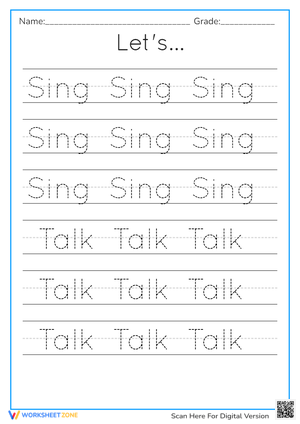
The verb identification worksheet works well as a Monday warm-up after morning meeting — short enough to finish in eight minutes, focused enough to reactivate whatever verb instruction happened the week before. The sorting task makes a natural literacy center activity mid-week: laminated, paired with dry-erase markers, placed at a station while small reading groups rotate through. The sentence completion worksheet holds up as a Friday exit task because it requires applying the full week's learning in one compact format. These 1st grade action verbs printable worksheets are also built to travel home — the instructions are clear, the vocabulary is decodable, and families can work through them without needing a grammar background.
Adjusting the Work for Students at Different Levels
For students not yet reading independently, the picture-to-verb matching worksheet is the right starting point. It does not require decoding the verb — students match the image to the word, building word recognition alongside the grammar concept. Pair this worksheet with verbal confirmation: ask the student to say the verb aloud before marking the answer, which separates reading fluency from grammatical understanding and tells you which skill needs attention.
On-grade-level students move through the identification and sorting worksheets at the standard pace. The word bank in the sentence completion task keeps cognitive load manageable — students are selecting and applying, not generating vocabulary from nothing, which is the appropriate level of independence at this point in the year.
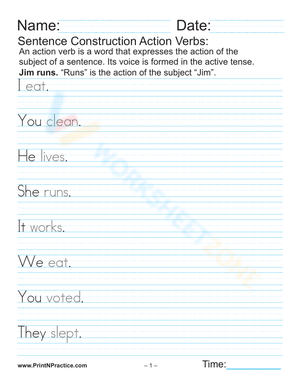
Students ready for extension can work with a version of the sentence completion worksheet where the word bank is removed. Writing a grammatically correct sentence using a given action verb — with no choices provided — pushes meaningfully toward the generative writing skill first grade is building all year. Some students will also be ready to notice tense shifts, a distinction that surfaces naturally when 1st grade action verbs printable worksheets are used in sequence across the unit rather than as isolated one-off tasks.
Standard Alignment
These 1st grade action verbs printable worksheets align to CCSS.ELA-LITERACY.L.1.1.E, which requires first-grade students to use verbs to convey a sense of past, present, and future. In classroom terms, that standard has a prerequisite: students must first be able to identify a verb before they can manipulate its tense. The identification and sorting worksheets address that prerequisite directly. The sentence completion tasks move one step closer to the standard's full expectation by asking students to select the semantically appropriate verb — a judgment that requires understanding what verbs do inside a sentence, not just what they are called.
Frequently Asked Questions
How do I explain the difference between a noun and a verb to a six-year-old?
The clearest method is the "can you do it?" test. Say a word aloud and ask whether the student can perform it. "Table?" They laugh and say no. "Jump?" They demonstrate immediately. The logic transfers without further explanation: doing words are verbs, naming words are nouns. This also gives students a self-correction tool they can use during the sorting worksheet without raising their hand every thirty seconds.
When should I introduce mental verbs like "think" or "wish"?
Hold those until students can consistently identify physical action verbs in sentences without prompting — for most first-grade classes, that means late in the unit, not at the start. Mental verbs fail the "can you do it?" test in the obvious way, which undercuts a tool students just learned to rely on. When you do introduce them, frame it explicitly as a separate category: "Some verbs happen inside. You can't see them, but they're still doing words." A brief class discussion about this distinction sticks better than a worksheet would.
Can English language learners use these worksheets without additional support?
The picture-to-verb matching worksheet is the strongest entry point for ELL students because the image removes the language barrier on the input side — students are recognizing an action they already know how to perform, then connecting it to its English label. Pairing that worksheet with a brief verbal rehearsal (saying the verb aloud, acting it out, tracing the written word) gives multiple access points to the same vocabulary before asking students to work with verbs inside full sentences. The sentence completion task with a word bank is accessible once that vocabulary base is in place.












 Interactive Worksheet Maker
 Quiz Maker
 Word Search Maker
 Crossword Puzzle Maker
 Word Scramble Generator
 Sentence Scramble Generator
 Handwriting Worksheet Generator
 Name Tracing Generator
 Fill In The Blank Generator