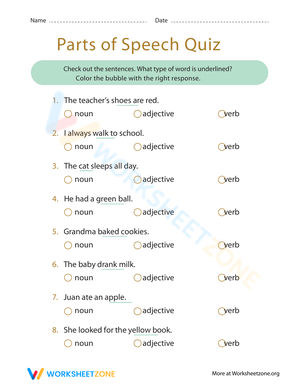
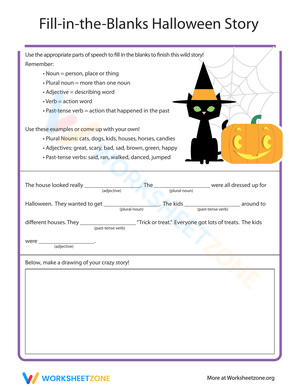
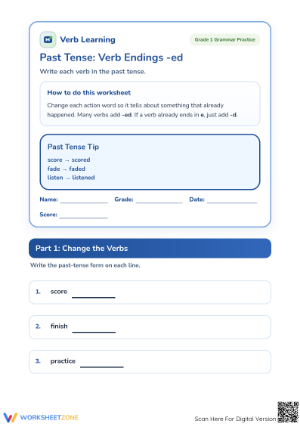
These past tense verbs printable worksheets for 1st grade give teachers a focused set of exercises for one of the trickiest early grammar transitions: helping students connect what they already say in conversation—"I went," "she jumped," "we played"—to what they write on the page. The set covers regular -ed verbs, the three phonological forms -ed takes, high-frequency irregular forms, and time-signal words that cue students toward the correct verb form. Each worksheet stands alone, so any one of them drops cleanly into a warm-up, a small-group rotation, or an independent practice block without setup.
The Specific Skills Each Worksheet Targets
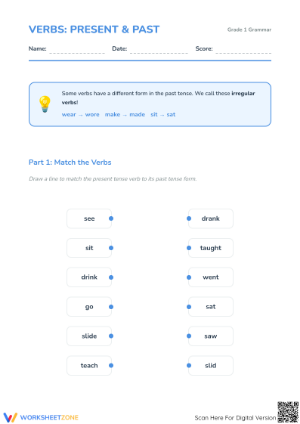
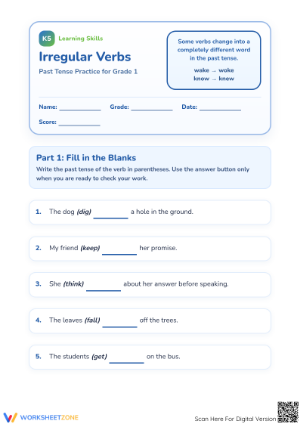
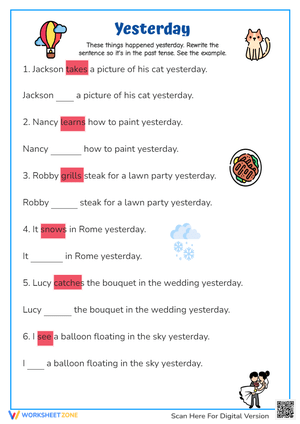
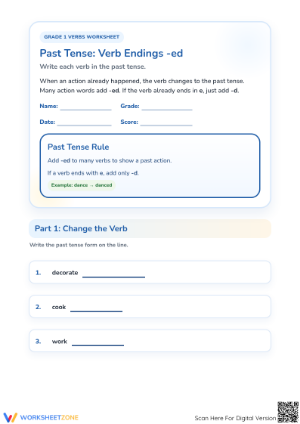
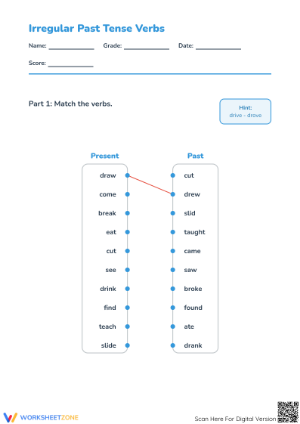
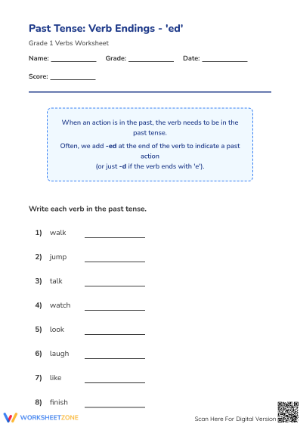
The exercises build from the most predictable pattern outward. Students start by converting base verbs to their -ed form—walk to walked, look to looked—then move to sentences where they underline the past-tense verb or rewrite a present-tense sentence in the past. A separate cluster of exercises addresses the phonological reality of -ed, which produces three distinct sounds: /t/ in jumped and kicked, /d/ in played and opened, and /id/ in landed and planted. Most 1st-grade programs skip this distinction; these worksheets don't, because those three sounds are the reason students write "jumpd" or "playid" when they're trying to spell phonetically. High-frequency irregular verbs—went, saw, ran, had, did, was, were—get their own matching and sentence-completion tasks. A final group introduces time-signal words (yesterday, last night, this morning) as context clues that tell students which verb form a sentence requires.
Why First Grade Is the Right Moment for This Instruction
First graders already produce past tense correctly in speech. A child who says "I went to my grandma's house" is not confused about what past tense means—the conceptual understanding is already there. What's missing is the ability to encode that spoken knowledge into written form. This is why 1st-grade past-tense instruction is less about teaching a new idea and more about formalizing an existing one. Exercises that ask students to convert "I play" to "I played" succeed partly because students can test the written sentence against what they already know sounds right when spoken aloud. That oral anchor reduces the cognitive burden of the written task, which is why reading completed sentences aloud after writing should be built into every lesson that uses these materials.
The -ed suffix work also intersects with phonics instruction happening at the same time. When students recognize that jumped is jump plus a suffix, they're applying morphological awareness that transfers directly to decoding multi-syllable words across all their reading. The grammar worksheet and the phonics lesson aren't competing for time—they're reinforcing the same underlying skill from two different angles.
Mistakes Students Make That These Worksheets Help You Catch
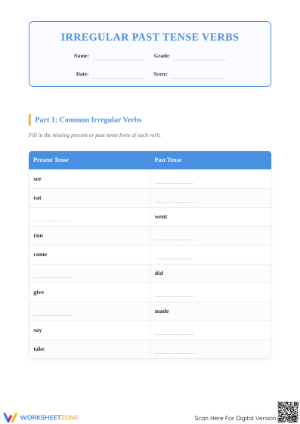
Over-regularization is the most common error and, developmentally, the most reassuring one to see. A student who writes "goed," "runned," or "sawed" has clearly internalized the -ed rule—she's just applied it everywhere. It signals progress, not confusion, but teachers still need a systematic way to address irregular verbs before that habit calcifies. The worksheets surface this error quickly because irregular forms appear in context, which makes the wrong choice visible in a way an isolated drill might not.
The double-consonant rule creates a second category of errors that teachers often attribute to carelessness when it's actually a knowledge gap. "Hop" becomes "hopped," but "help" becomes "helped." Students who don't know the doubling rule write "hoped" for "hopped" every time—and spell-check won't flag it because "hoped" is a real word. The worksheets include verbs that require consonant doubling alongside those that don't, so teachers can see exactly which students are applying the rule and which are guessing.
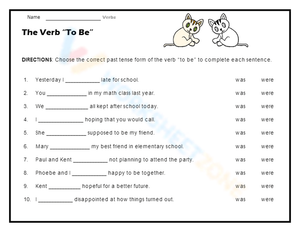
A quieter error involves "was." Most 1st graders use it correctly in speech but don't connect it to "is" as its past-tense partner. In writing tasks, they omit it, substitute "is," or leave the verb slot blank. Sentence-completion exercises that ask students to choose between "is" and "was" surface this gap in a format that makes the contrast explicit rather than leaving it buried in a paragraph.
Standard Alignment
CCSS.ELA-LITERACY.L.1.1.E requires students to use verbs to convey a sense of past, present, and future. In instructional terms, this standard typically becomes the focus in the second half of 1st grade, once students can write stable present-tense sentences and are ready to contrast them with a different time reference. Each worksheet in this set works directly toward that standard by asking students to identify, form, and apply past-tense verbs at the sentence level—not in isolated word lists, but in the kind of short sentences that appear in early reader texts and personal narrative writing.
Fitting These Worksheets Into Your Weekly Literacy Block
Monday morning is one of the most productive moments for past-tense practice in 1st grade. Students walk in after a weekend full of events they want to talk about, and channeling that oral energy into a short written exercise—"Write two things you did this weekend"—then using a worksheet to examine the verb forms they chose creates an immediate, authentic context. The exercises are short enough to complete in the 8–10 minutes before a morning meeting transitions into the reading block.
For initial instruction, a document camera and a single worksheet make an effective whole-class launch. Read one sentence aloud, think aloud about the time-signal word, then choose the verb form and explain why. Students work through a second sentence with a partner, discussing before they write. Independent completion follows. That three-stage sequence—model, partner, independent—moves students from guided practice to solo performance within a single session, and the completed worksheet becomes the formative data you review at the end of the day to see exactly where students are breaking down.
Adjusting the Work for a Range of Learners
For students still consolidating the -ed rule, pull worksheets that use only the most phonetically regular verbs: walk, play, look, talk. Remove any irregular items until the regular pattern is stable. For students who've mastered regular verbs, pair a worksheet with irregular verb sorting cards—present form in one column, past form in another—so the written task has a physical, manipulative component alongside it.
The past tense verbs printable worksheets for 1st grade also serve students who are ready to move beyond sentence-level tasks. Advanced writers can use completed worksheet sentences as the opening clause of a two-sentence personal narrative, turning the grammar exercise into a writing launch. On the other end, students who need more processing time benefit from completing a worksheet orally with a partner before writing—saying each sentence aloud first activates the grammatical intuition they already carry in speech, so the pencil-and-paper work that follows is confirmation rather than discovery.
Frequently Asked Questions
How do you explain past tense to a 1st grader who keeps defaulting to present-tense verbs in writing?
Start with the student's own words. Ask her to tell you one thing she did at recess, then write her exact words on a whiteboard. Most students will use past tense naturally in speech—"I played on the swings"—and seeing those spoken words written down with the -ed ending makes the written rule feel less arbitrary. From there, connect it to time-signal words: when we see "yesterday" in a sentence, we look for an -ed verb or a known irregular form.
Which irregular verbs should come first in 1st grade?
Start with went, saw, was, were, had, and did. These appear constantly in the early reader texts students are already decoding, so exposure is already high. Connecting a word they recognize in print to its present-tense partner—go/went, see/saw, is/was—builds the association more durably than memorizing a list in isolation.
Do these worksheets address the three sounds of the -ed suffix?
The past tense verbs printable worksheets for 1st grade include a sorting exercise where students categorize -ed words by their ending sound: /t/ as in kicked, /d/ as in played, and /id/ as in landed. This exercise pairs well with a pocket-chart sort before students move to pencil-and-paper work, giving auditory learners a chance to hear the pattern before they're asked to produce it in writing.
Can I assign these worksheets out of order, or do they depend on each other?
Each worksheet is a standalone exercise, not part of a sequence that requires prior worksheets to make sense. Teachers regularly pull individual worksheets based on what a specific student or small group needs on a given day. The past tense verbs printable worksheets for 1st grade in this set are organized by skill type—regular verbs, irregular verbs, time-signal words, error correction—so teachers can target the exact gap a student has without working through unrelated exercises first.












 Interactive Worksheet Maker
 Quiz Maker
 Word Search Maker
 Crossword Puzzle Maker
 Word Scramble Generator
 Sentence Scramble Generator
 Handwriting Worksheet Generator
 Name Tracing Generator
 Fill In The Blank Generator