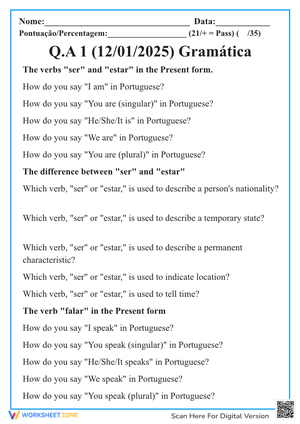
These 1st grade present tense verbs worksheets give teachers a focused set of practice tasks for the grammar concept that first graders underestimate until they try to write it: making the verb match the subject. The set includes five worksheet types — verb identification, subject-verb agreement, noun-verb sorting, sentence completion, and verb-illustration matching — each targeting a distinct move students need to make before present tense use becomes automatic.
What's Inside the Set
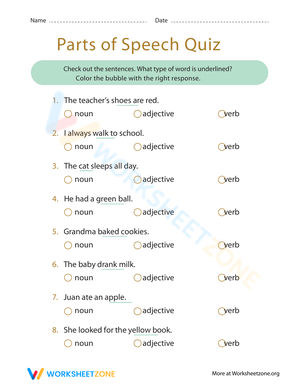
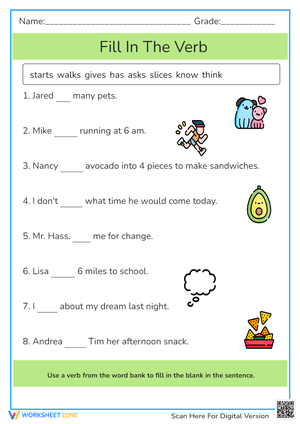
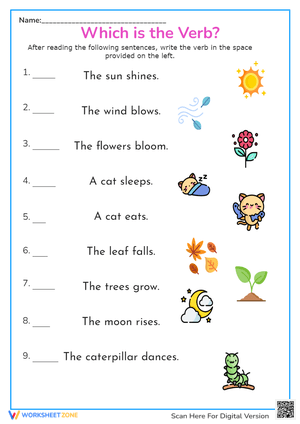
Identification worksheets ask students to underline or circle the action word in short, decodable sentences. The sentences stay at a controlled reading level so phonics load doesn't compete with grammar focus — a distinction that matters at this grade because cognitive demand splits when students are simultaneously decoding unfamiliar words and trying to label parts of speech. Subject-verb agreement worksheets present pairs like "The cat sleeps / The cats sleep" and ask students to choose the correct form for a given subject, building the connection between a singular subject and the "-s" ending. Sorting worksheets provide mixed lists of nouns and verbs for students to categorize — a task that only works if students can articulate the difference, not just recognize it. Sentence-completion worksheets supply a word bank of high-frequency action words and a set of incomplete sentences; students select the correct verb for each context. The visual-matching worksheets pair illustrated actions with written verb forms, giving students a non-textual referent — particularly useful when word-reading is still developing.
Mistakes Students Make That These Worksheets Help Surface
The most consistent error in first-grade verb writing is not confusion about what a verb is — it's the disconnect between speech and print. A student who says "he runs" naturally in conversation will write "he run" on the page without noticing the mismatch, because the spoken "-s" is nearly inaudible in rapid speech and has no parallel in the student's listening experience. These worksheets make the agreement error visible and correctable in a way that oral practice alone does not.
A second pattern worth flagging: students treat high-frequency linking verbs like "is" as non-verbs during sorting tasks. Because "is" was introduced as a sight word before it was ever labeled a part of speech, first graders frequently place it in the Noun column. Sorting worksheets surface this early, so teachers can address it before it compounds in writing. One more specific error appears in sentence-completion work: when a word bank includes both "run" and "runs," students who haven't internalized subject-verb agreement choose based on spelling familiarity rather than subject number — they pick "run" more often simply because it matches the base word they already know. Circling the subject before selecting the verb is a quick procedural fix that significantly reduces this type of error.
Building These Worksheets Into Your Instructional Week
The identification and circling worksheets fit the five to eight minutes between morning meeting and the start of the literacy block. Students settle into academic mode, and you get a quick scan of who is operating automatically and who is still hesitating — genuinely useful information before instruction begins. These 1st grade present tense verbs worksheets also run well in a grammar center rotation, where the sorting and visual-matching tasks sustain independent or partner work while the teacher pulls a small guided-reading group.
Subject-verb agreement worksheets land better after at least one physical demonstration of the concept. Having the class stand and say "We jump" in unison, then pointing to one student and saying "She jumps" while both the teacher and student perform the action, gives the written practice a kinesthetic anchor. The worksheet follows the activity; the activity does not follow the worksheet. Sentence-completion worksheets are the strongest option for homework in this unit — the word bank reduces retrieval demand, the sentences are short, and a caregiver can read the prompts aloud without needing to explain grammatical terminology. They also work well in a substitute folder: low setup, clear instructions, no prior knowledge of the unit required.
Why Present Tense Comes First at This Grade
First graders understand present tense most readily because it maps directly onto observable, immediate action. When a teacher says "The frog jumps," students can watch or mime that action right now. Past tense requires temporal displacement — imagining something that already happened — and future tense requires hypothetical thinking about something that hasn't occurred yet. Both are harder cognitive moves for six- and seven-year-olds. Present tense appears first in first-grade pacing not because curriculum writers arranged it arbitrarily but because it aligns with where children's conceptual thinking actually sits at this stage. The worksheets in this set stay within that window deliberately, building confidence with one tense before the timeline grows more complex.
Standard Alignment
CCSS.ELA-LITERACY.L.1.1.E requires first graders to use verbs to convey a sense of past, present, and future. Most pacing guides position present tense in the first trimester — after high-frequency word work is established but before past-tense "-ed" endings are introduced. The 1st grade present tense verbs worksheets in this set address the present-tense portion of that standard directly and build the foundation that later tense instruction will extend. Teachers in standards-aligned programs use the identification and agreement worksheets as core instructional materials for this standard, then return to the sorting and completion worksheets when introducing past tense to give students a concrete contrast point.
Adapting the Worksheets Across Ability Levels
Students who are still building reading fluency get the most from the visual-matching and sorting worksheets, where text demand is lightest. On identification worksheets, reading the sentences aloud while students circle removes decoding as a barrier without altering the grammar task itself. For students who have already internalized basic subject-verb agreement, sentence-completion worksheets extend naturally beyond the page: after finishing the word bank sentences, they write two additional sentences using a different subject — taking the task from structured practice into open production without any additional materials.
English language learners benefit most from worksheets where an illustration provides a referent outside of text. Action words that can be pictured — jump, eat, sleep, write — give ELL students a grounding point the text alone cannot offer. The "-s" ending rule is genuinely difficult for students whose home language does not mark subject-verb agreement morphologically; treat that error as expected through most of first grade rather than as a signal that instruction has failed.
Frequently Asked Questions
How do I explain the "-s" rule without confusing students who are still learning plural nouns?
Plural nouns add "-s" to the noun; singular subjects add "-s" to the verb. That parallel confuses students at first because the surface pattern looks identical. A move that helps: cover the subject, read just the verb aloud, and ask students, "Does this action have one owner or more than one?" Returning to the subject to verify always beats asking students to memorize a rule in the abstract.
When in the year do these worksheets work best?
Most pacing guides place present tense verb instruction in the first trimester, after high-frequency word work is established but before formal past-tense instruction begins. Starting the identification worksheets once students have a working definition of "action word" — even an informal one from a whole-class discussion — produces better results than introducing them without that prior framing.
Can I use these with students who are below grade level in reading?
Yes, with adjustment. The visual-matching and sorting worksheets carry the least text demand and work well as entry points. For identification worksheets, read the sentences aloud and have students circle the verb they hear rather than decode independently. The grammar concept remains intact; the reading barrier is removed.
Do the worksheets address "is," "am," and "are"?
The set focuses on regular action verbs — the first tier of present tense instruction. Linking verbs like "is," "am," and "are" appear as challenge items in the sorting worksheets but are not the primary focus. Teaching them separately, after students are solid on action verbs, prevents the two categories from blurring before students have a clear grip on either. The 1st grade present tense verbs worksheets in this set are sequenced with that order in mind: action verbs build the foundation, and linking verbs follow.












 Interactive Worksheet Maker
 Quiz Maker
 Word Search Maker
 Crossword Puzzle Maker
 Word Scramble Generator
 Sentence Scramble Generator
 Handwriting Worksheet Generator
 Name Tracing Generator
 Fill In The Blank Generator