


























Views
Downloads

Identifying Verbs Printable Worksheet | Grade 1-2 ELA
Paste this activity's link or code into your existing LMS (Google Classroom, Canvas, Teams, Schoology, Moodle, etc.).
Students can open and work on the activity right away, with no student login required.
You'll still be able to track student progress and results from your teacher account.
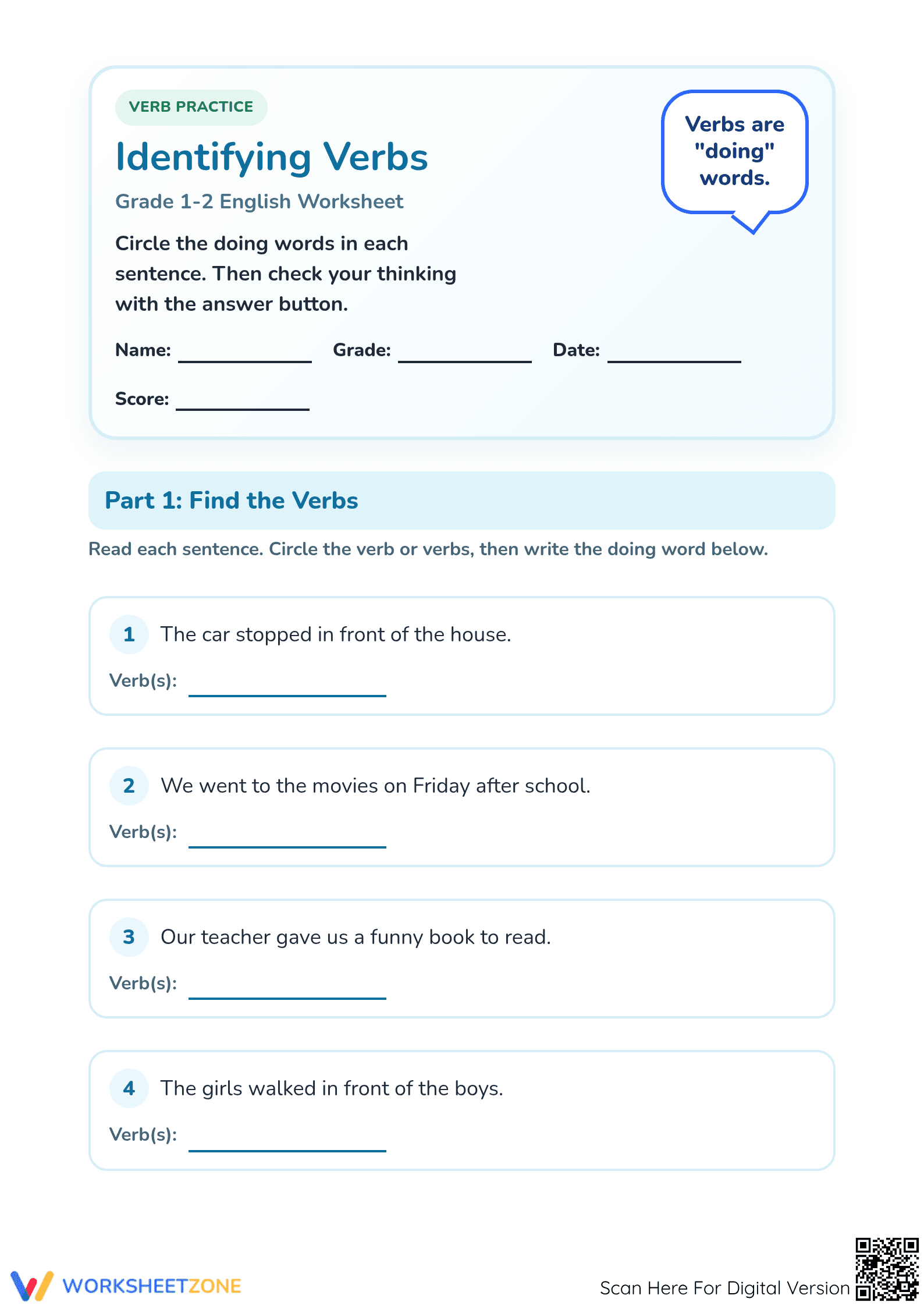
This Grade 1-2 ELA worksheet helps students identify and use verbs as "doing words" within various sentence contexts. By isolating action words and applying them in original writing, learners build a foundational understanding of sentence structure and grammar. This resource ensures students can distinguish verbs from other parts of speech with confidence and accuracy.
At a Glance
- Grade: 1-2 · Subject: ELA
- Standard:
CCSS.ELA-LITERACY.L.1.1— Demonstrate command of grammar conventions and identify verbs in sentences- Skill Focus: Verb Identification & Usage
- Format: 3 pages · 11 problems · Answer key included · PDF
- Best For: Independent grammar practice and formative assessment
- Time: 15–20 minutes
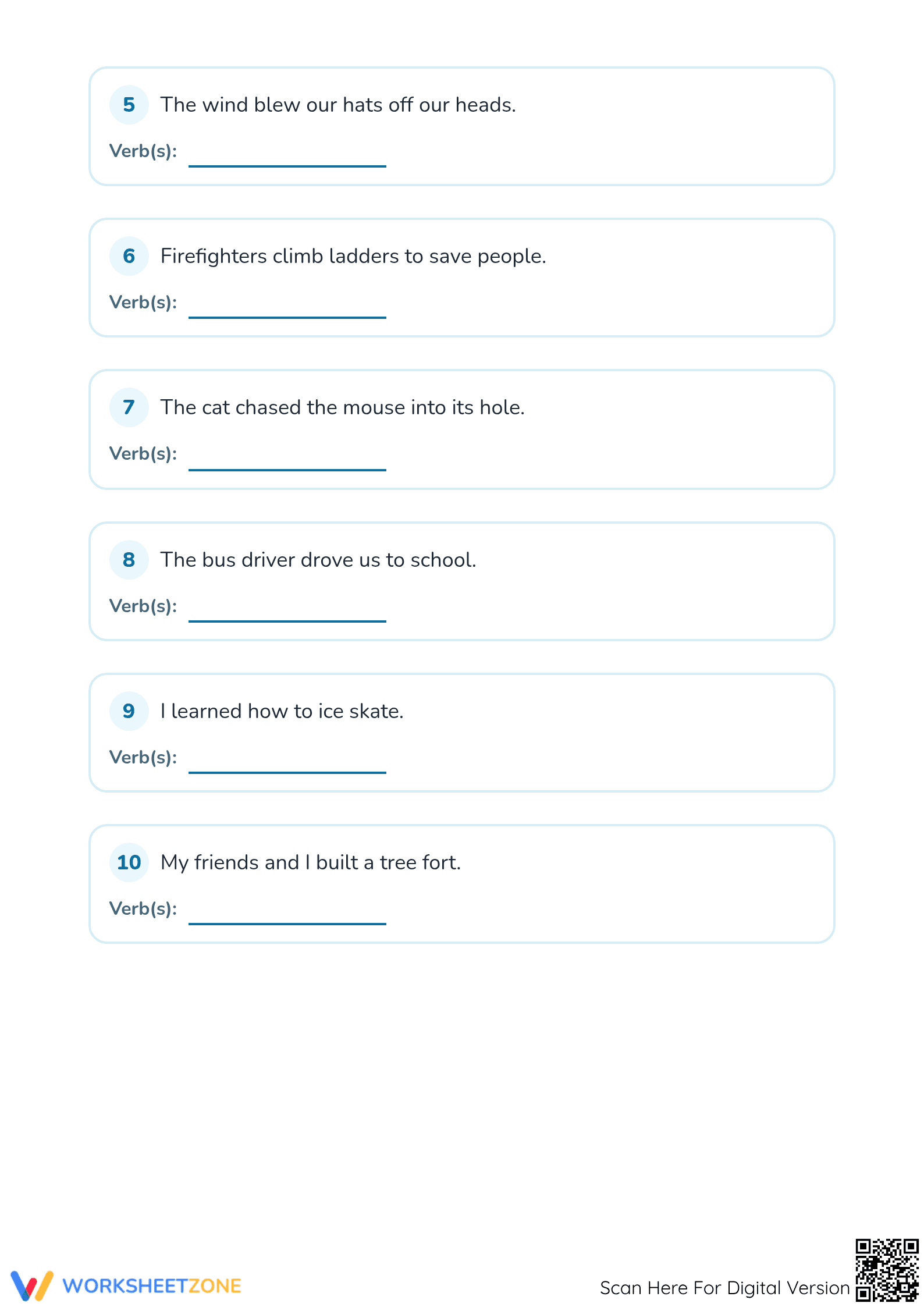
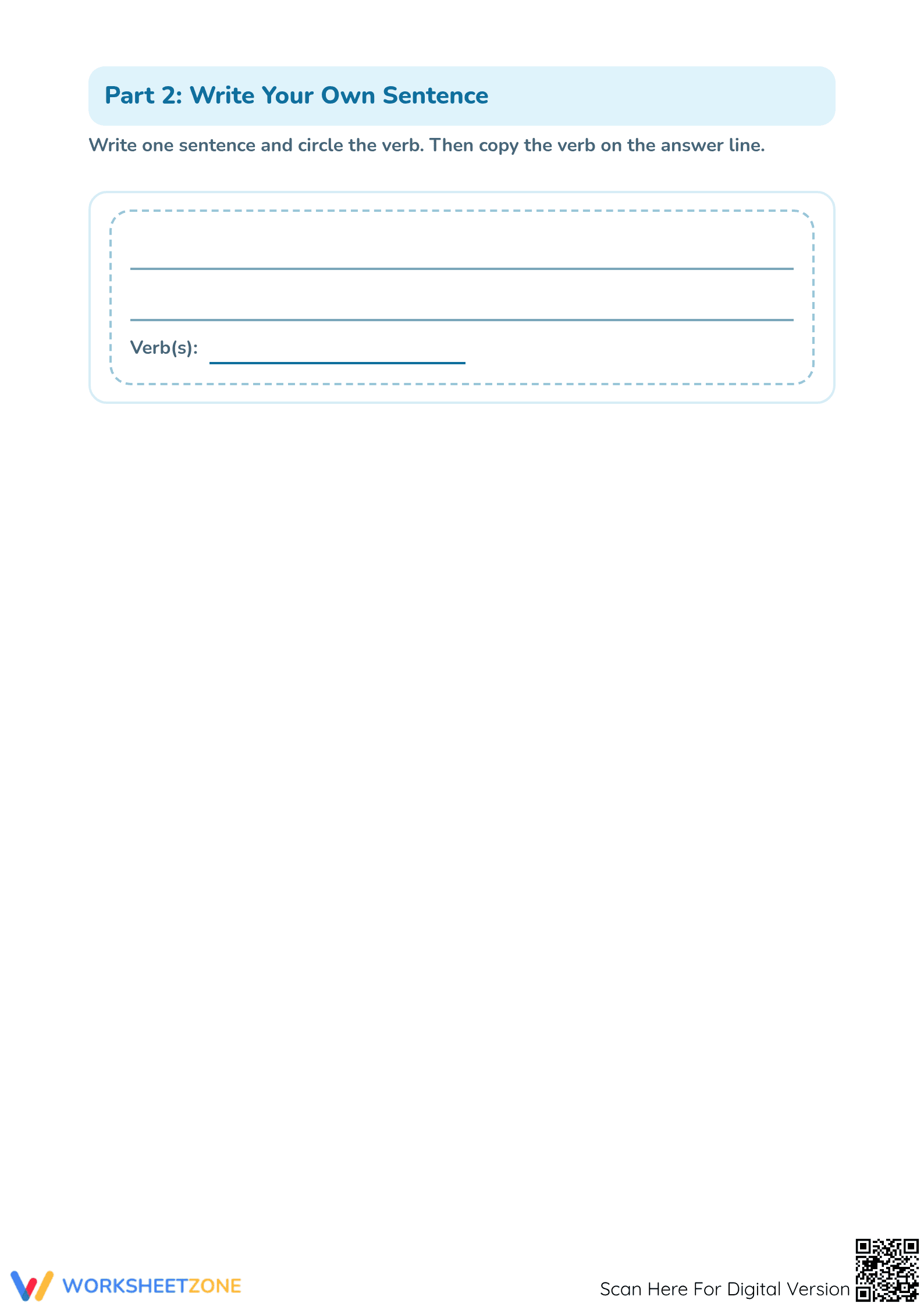
The packet contains three comprehensive pages designed for early elementary learners. Part 1 features 10 sentence-based identification tasks where students circle the verb and transcribe it onto a dedicated line. Part 2 transitions to application, requiring students to compose an original sentence, identify their own verb, and rewrite it. A full answer key is provided for immediate feedback.
The zero-prep workflow is designed for maximum efficiency in busy classrooms. First, print the three-page PDF for your roster, which takes about one minute. Second, distribute the worksheets as a bell-ringer or literacy center activity. Finally, use the included answer key for rapid grading or student self-correction. This resource is an ideal solution for emergency sub plans or unexpected schedule shifts.
This resource aligns primarily with `CCSS.ELA-LITERACY.L.1.1`, which requires students to demonstrate command of the conventions of standard English grammar, specifically identifying and using verbs. It also supports `CCSS.ELA-LITERACY.L.2.1` by reinforcing the role of action words in more complex sentence structures. Both standard codes can be copied directly into lesson plans, IEP goals, or district curriculum mapping tools.
Use this worksheet during the independent practice phase of a gradual release lesson on parts of speech. It serves as an excellent formative assessment after a direct instruction session on action words. Teachers should observe if students can identify verbs that aren't physical actions, such as "learned" or "gave." Completion typically takes 15 to 20 minutes depending on student writing speed.
This resource is tailored for first and second-grade students beginning their journey into lexical word classes. It is also suitable for English Language Learners (ELL) who need clear, visual sentence structures to practice vocabulary. Pair this with a verb anchor chart or a short reading passage to reinforce the concept across different instructional media.
Effective grammar instruction in the early grades relies on the explicit identification of word functions within a sentence. According to Fisher & Frey (2014), the gradual release of responsibility—moving from identifying verbs in provided text to generating them in original writing—is essential for long-term retention of linguistic conventions. This worksheet facilitates that transition through its two-part structure, moving from 10 identification tasks to a creative application prompt. By focusing on CCSS.ELA-LITERACY.L.1.1, the resource addresses a core requirement for Grade 1 and 2 literacy development. Research from the NAEP suggests that students who master basic parts of speech early demonstrate higher proficiency in complex sentence construction in later elementary years. This 3-page PDF provides the structured repetition necessary for students to internalize the concept of "doing words" as the engine of the English sentence, supported by a clear answer key for instructional accuracy.


