


























Views
Downloads
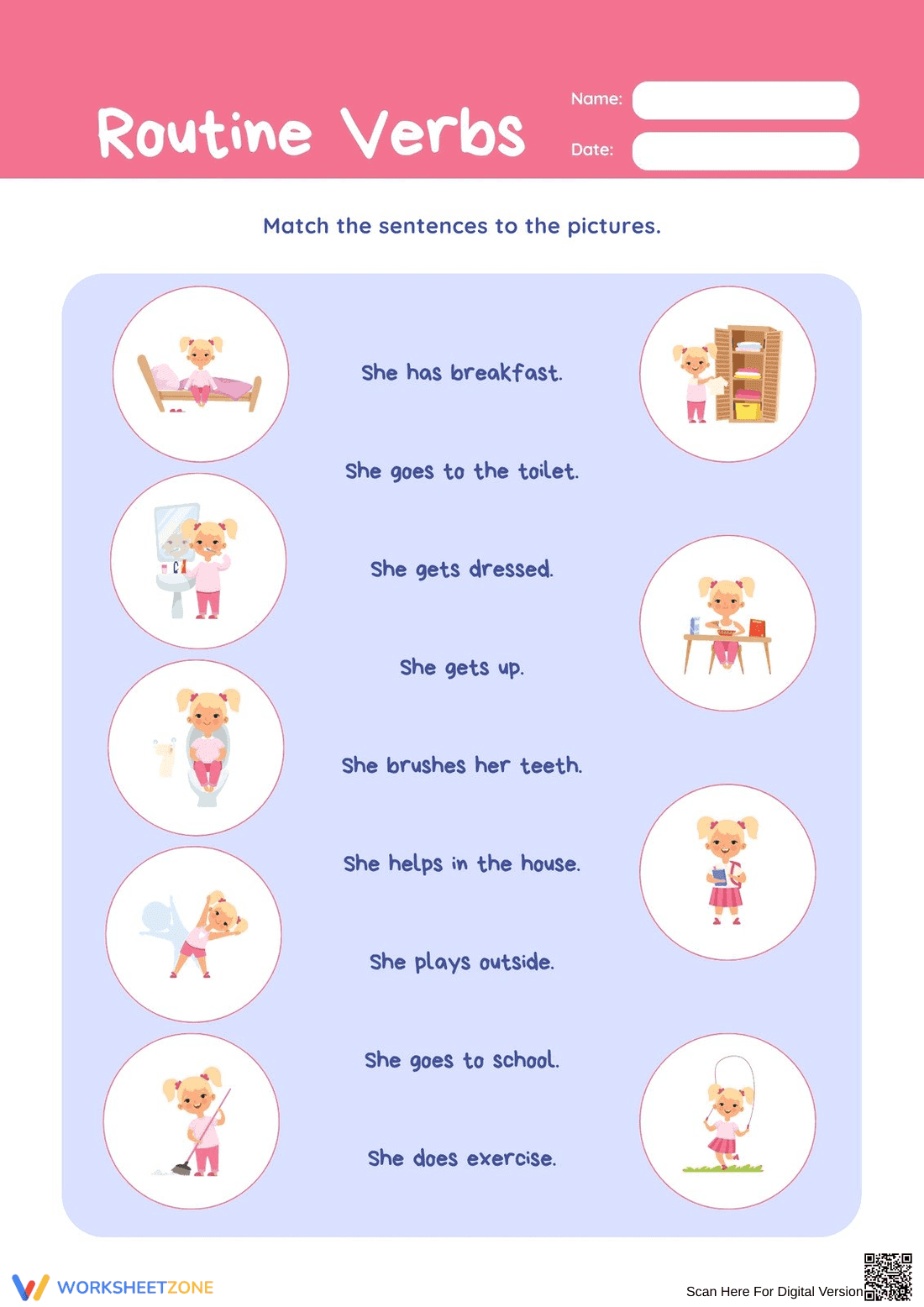

Grade 1 Routine Verbs Printable Worksheet
Paste this activity's link or code into your existing LMS (Google Classroom, Canvas, Teams, Schoology, Moodle, etc.).
Students can open and work on the activity right away, with no student login required.
You'll still be able to track student progress and results from your teacher account.
This Grade 1 reading comprehension worksheet helps students connect simple sentences with visual context. By matching daily routine verbs to clear illustrations, early readers build vocabulary and demonstrate text comprehension. The straightforward layout ensures young learners can focus entirely on reading accuracy and meaning.
At a Glance
- Grade: 1 · Subject: ELA
- Standard:
CCSS.ELA-LITERACY.RF.1.4— Read text with purpose and understanding- Skill Focus: Routine verbs and reading comprehension
- Format: 1 page · 9 problems · Answer key included · PDF
- Best For: Independent practice and morning work
- Time: 10–15 minutes
Inside this resource, educators will find a single-page matching activity featuring nine distinct daily routine sentences, such as "She gets dressed" and "She plays outside." Students draw lines connecting each sentence to the corresponding illustration of a girl performing the action. The clear, uncluttered design minimizes distractions, while the included answer key allows for rapid grading or self-correction by students.
This resource is designed for immediate classroom implementation with a highly efficient workflow:
- Print (1 minute): The single-page PDF format requires no special formatting or color ink, making it easy to batch-print for the whole class.
- Distribute (1 minute): Hand out the worksheets as students arrive or transition between subjects. The instructions are self-explanatory, requiring minimal teacher setup.
- Review (3 minutes): Use the provided answer key to quickly check student work or project it on the board for a whole-class review session.
With under two minutes of total teacher prep time, this activity is an excellent addition to any emergency sub plan or last-minute schedule change.
This worksheet is aligned to primary standard CCSS.ELA-LITERACY.RF.1.4, requiring students to read with sufficient accuracy and fluency to support comprehension. By matching text to images, students actively demonstrate their understanding of the written words. Both standard codes can be copied directly into lesson plans, IEP goals, or district curriculum mapping tools.
Teachers can utilize this worksheet during morning work to establish a calm, focused routine right at the start of the day. It also serves as an effective independent literacy center activity while the teacher conducts small group guided reading sessions. As a formative assessment tip, observe whether students are reading the entire sentence or simply guessing based on isolated sight words. Expected completion time ranges from 10 to 15 minutes depending on the student's reading fluency.
This activity is ideal for Grade 1 students, ESL learners, and kindergarteners who are reading at an advanced level. The visual scaffolds provide essential support for students who struggle with decoding, allowing them to use context clues to determine meaning. It pairs perfectly with a direct instruction lesson on action verbs or a read-aloud book focused on daily morning routines.
Developing early reading comprehension requires consistent opportunities for students to connect written text with visual representations. Aligned with CCSS.ELA-LITERACY.RF.1.4, this resource prompts learners to read text with purpose and understanding by matching routine verbs to corresponding images. According to Fisher & Frey (2014), integrating visual scaffolds with foundational reading tasks significantly improves vocabulary retention and overall text comprehension in early elementary students. When young learners actively engage in matching exercises, they reinforce their decoding skills while simultaneously building a robust sight word vocabulary. This targeted practice ensures that students do not merely call out words, but actually grasp the underlying meaning of the sentences they read. By providing clear, relatable illustrations of daily routines, this worksheet supports cognitive mapping and helps solidify essential literacy foundations for future academic success.


