


























Views
Downloads
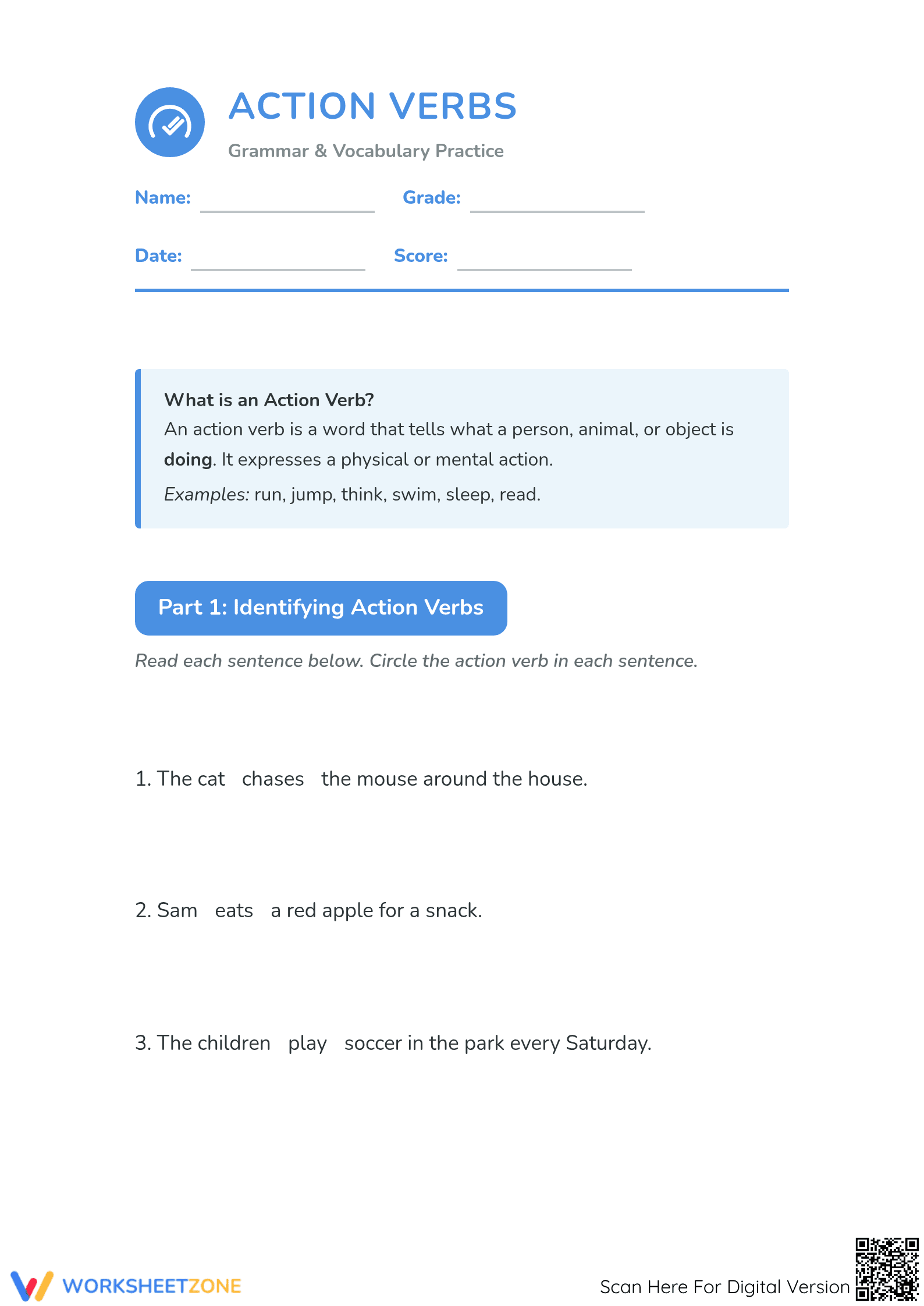


Action Verbs Practice Worksheet | Grade 2 Essential
Paste this activity's link or code into your existing LMS (Google Classroom, Canvas, Teams, Schoology, Moodle, etc.).
Students can open and work on the activity right away, with no student login required.
You'll still be able to track student progress and results from your teacher account.
This Grade 2 action verbs worksheet provides a comprehensive 5-page toolkit for mastering parts of speech. Students progress from identifying verbs in sentences to applying them in original writing. By connecting physical actions to written words, learners build a concrete understanding of how verbs drive sentence meaning and structure.
At a Glance
- Grade: 2 · Subject: ELA
- Standard:
CCSS.ELA-LITERACY.L.1.1— Use frequently occurring nouns, verbs, and prepositions in sentences- Skill Focus: Action Verb Application
- Format: 5 pages · 34 problems · Answer key included · PDF
- Best For: Independent practice or sub plans
- Time: 30–45 minutes
This extensive 5-page PDF includes a clear definition block, 10 sentence-based identification tasks, 8 visual matching exercises, 10 word-bank fill-in-the-blanks, and 6 creative writing prompts. The layout uses high-quality icons to support visual learners and includes a full answer key for rapid grading and immediate feedback.
Zero-Prep Workflow
- Print: Select the 5-page student packet and the answer key (under 1 minute).
- Distribute: Hand out the packet for a quiet independent work block, literacy center, or homework assignment (30 seconds).
- Review: Use the included answer key to grade or have students self-correct their work to identify misconceptions (under 1 minute).
This resource requires zero teacher setup and is ideal for emergency sub plans or morning work routines.
Standards Alignment
This resource aligns with `CCSS.ELA-LITERACY.L.1.1`, focusing on the correct use of verbs to convey action. It also supports `CCSS.ELA-LITERACY.L.3.1.A` by requiring students to explain the function of verbs through context-rich application. Both standard codes can be copied directly into lesson plans, IEP goals, or district curriculum mapping tools.
How to Use It
Use this worksheet during the "You Do" phase of a gradual release lesson on parts of speech. It serves as an excellent formative assessment; observe students during the matching section to see if they can connect abstract verbs to concrete visual actions. The expected completion time for all five pages is approximately 35 minutes.
Who It's For
Designed for Grade 1-3 students, this packet is particularly effective for English Language Learners (ELL) who benefit from the visual icons in the matching and writing sections. Pair this with a "Verb Charades" classroom activity or a direct instruction lesson on sentence structure for a multi-sensory learning experience.
According to Fisher & Frey (2014), the gradual release of responsibility is most effective when students move from scaffolded identification to independent generative writing. This worksheet mirrors that research-backed progression across its 34 tasks. By starting with a clear definition and moving through four distinct levels of cognitive demand—identifying, matching, selecting, and finally creating—students solidify their grasp of CCSS.ELA-LITERACY.L.1.1. The inclusion of visual cues reduces cognitive load for early readers, allowing them to focus specifically on the grammatical function of the action verb. This structured approach ensures that learners do not just memorize definitions but can actively deploy verbs to improve their descriptive writing. Such systematic practice is essential for meeting national literacy benchmarks and preparing students for more complex sentence structures in upper elementary grades.


