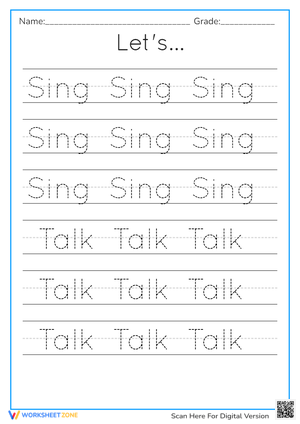
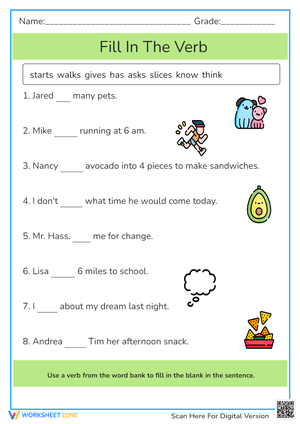
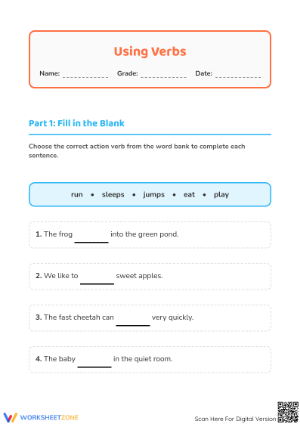
These 1st grade verbs printable worksheets give teachers a focused set of standalone practice activities covering action word identification, present and past tense recognition, and basic subject-verb agreement — the three areas where first graders most visibly struggle to move from word-level reading into sentence-level writing. Each worksheet targets a single skill and works independently during literacy centers, warm-up blocks, and small-group sessions, so students are not managing multiple new demands at once.
What Students Practice in Each Worksheet
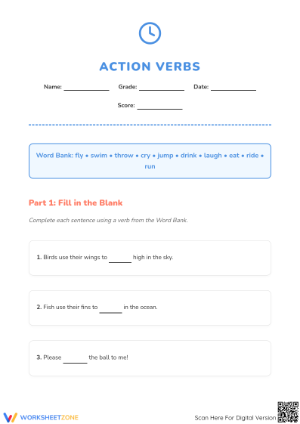
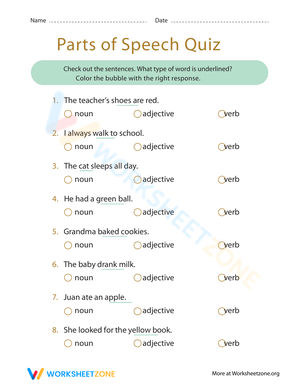
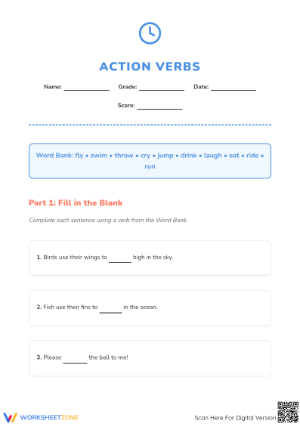
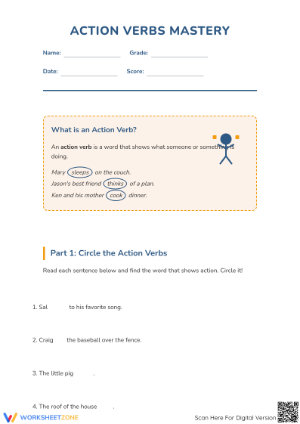
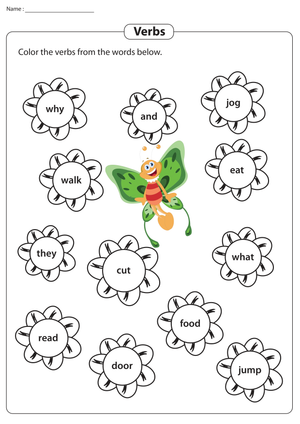
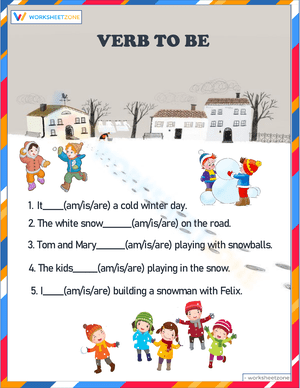
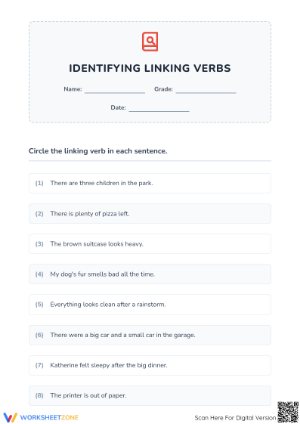
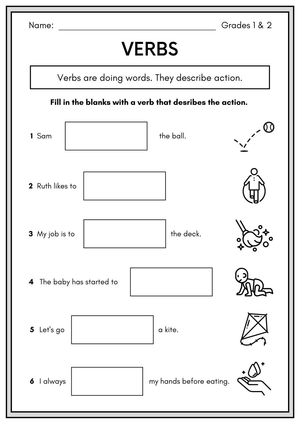
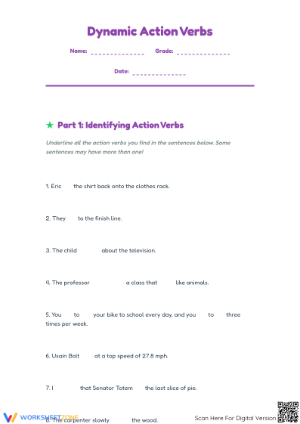
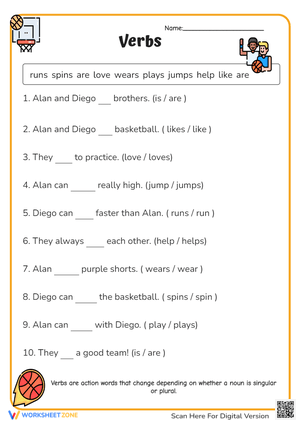
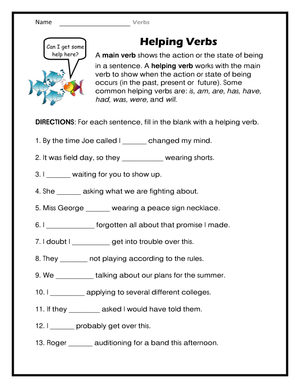
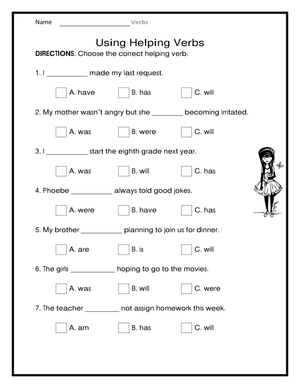
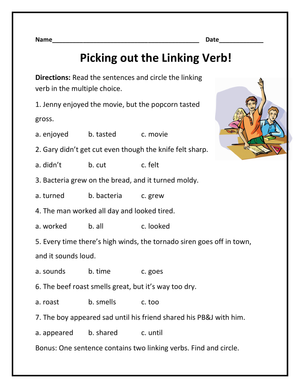
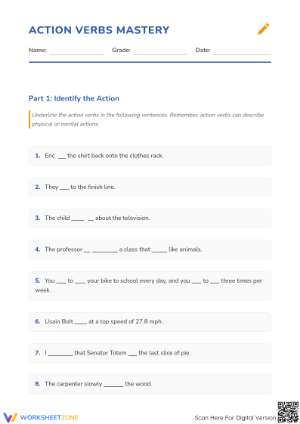
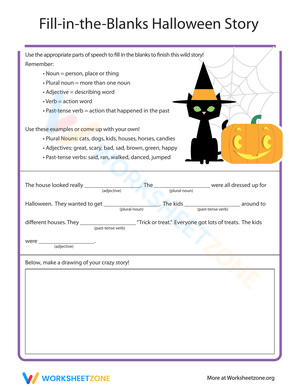
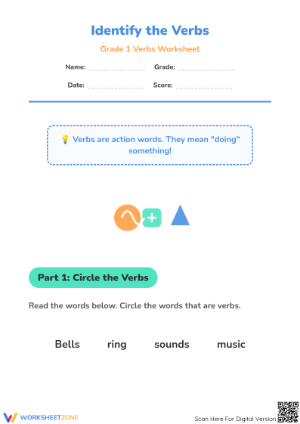
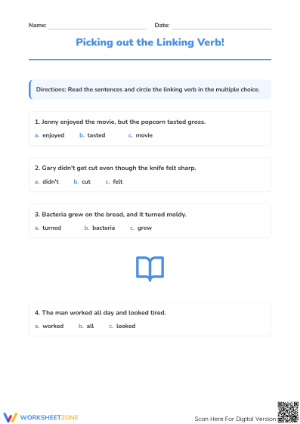
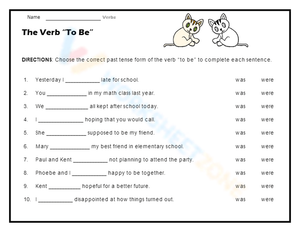
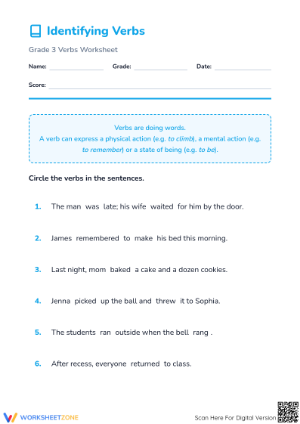
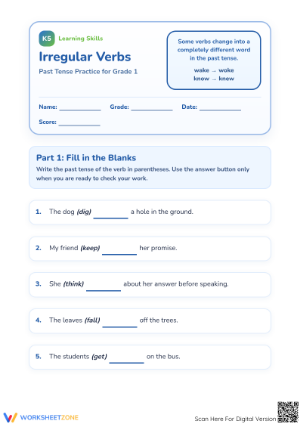
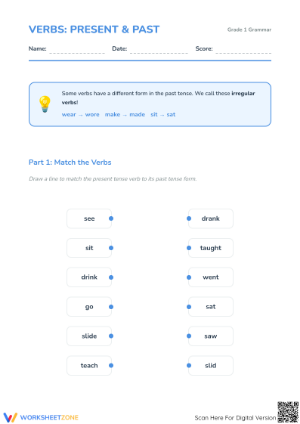
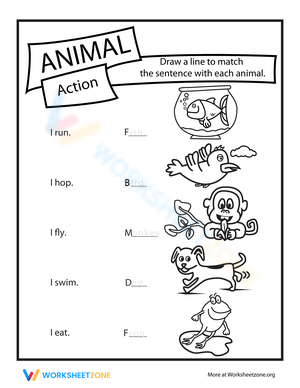
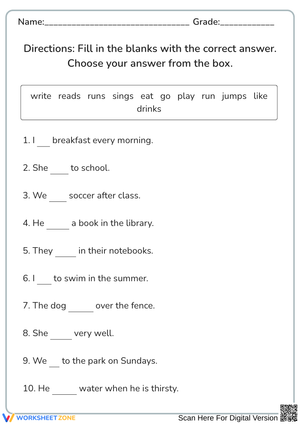
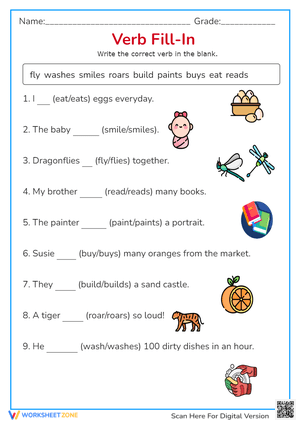
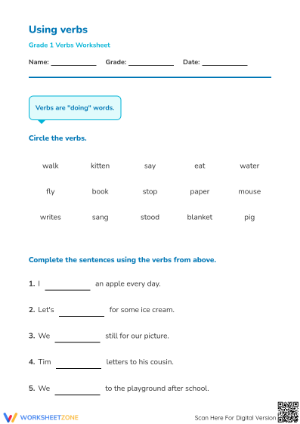
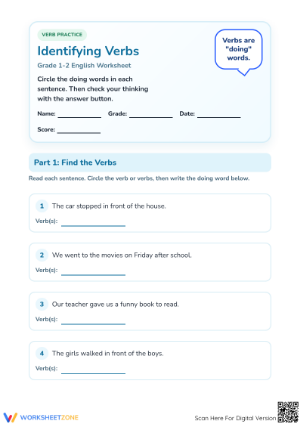
The set moves through a clear progression of verb-related tasks. Identification worksheets present mixed lists of nouns, adjectives, and verbs; students underline or circle only the action words. Matching worksheets pair written verbs — words like pour, leap, or fold — with small pictures of those actions, and students draw a line between them. Fill-in-the-blank worksheets place students inside sentences, asking them to select the correct verb from a word bank of three or four choices to complete a thought. Tense recognition worksheets introduce the -ed ending as a past-action marker: students read a sentence and mark whether the action is happening now or already finished. The most demanding worksheets in the set ask students to rewrite a sentence so the verb matches the subject — choosing between "he run" and "he runs," for example. Each worksheet isolates one of these tasks rather than layering them, which keeps the grammar work manageable for six- and seven-year-olds working independently.
Why Action Verbs Make Sense as the Entry Point at Grade 1
First graders arrive already using action verbs fluently in speech. The instructional work is not teaching them new words — it is teaching them that a word class exists and operates by rules. That metacognitive shift is significant for six-year-olds, and action verbs ease into it because they are concrete and embodied. A student can physically demonstrate clap or spin; they cannot demonstrate the or happy. Beginning verb instruction with words children can act out reduces the abstraction before subject-verb agreement and tense are introduced. This also explains why the identification worksheets precede the sentence-level work: students need to isolate the concept before they can manipulate it inside a grammatical structure.
Error Patterns Worth Knowing Before You Distribute
The most consistent error in verb identification is category confusion between action verbs and action-adjacent adjectives. A student who correctly circles run will often circle fast in the next sentence because the picture shows quick movement and fast seems to describe what is happening. These 1st grade verbs printable worksheets surface that confusion reliably — the identification tasks deliberately place high-frequency adjectives alongside verbs in a shared visual context, making the error visible rather than hidden. Naming this pattern before the lesson ("some words describe how something happens, but that is not the same as the word that tells us what happened") gives students language to catch their own mistakes mid-task.
A second pattern involves past tense recognition. Students who have jump memorized as a sight word frequently stall on jumped, treating it as an entirely unfamiliar word rather than a familiar root with a suffix. The tense worksheets expose this quickly. A brief before-you-start move — writing jump and jumped side by side and asking students to read both aloud — takes thirty seconds and sharply reduces confusion once the worksheet is in hand.
Standard Alignment
Two Language standards from the Common Core State Standards apply directly here. CCSS L.1.1c requires students to use singular and plural nouns with matching verbs in basic sentences — what teachers commonly call subject-verb agreement. The rewriting worksheets address this standard at the production level, not just recognition. CCSS L.1.1e requires students to use verbs to convey a sense of past, present, and future; the tense identification and sentence-rewriting worksheets address this standard directly. Both standards expect written output, which is why the worksheets that have students write or rewrite a sentence carry more instructional weight than the circling-and-matching activities — even though those simpler tasks are the right starting point in the sequence.
Building These Worksheets Into Your Teaching Week
The standalone design of 1st grade verbs printable worksheets means any individual worksheet fits into a lesson without requiring commitment to a fixed sequence. Identification and matching worksheets work well as morning warm-ups — the five to eight minutes before morning meeting transitions into academic work is enough time for a recognition task. Fill-in-the-blank and rewriting worksheets belong in literacy centers or guided small-group time, where you can hear students talk through their choices. That talk matters: a student who selects the wrong answer but articulates correct reasoning needs a different response than one who is guessing. For homework, the picture-matching worksheets travel reliably because decoding difficulty does not become a barrier to completing the grammar task. At the end of a unit, two or three subject-verb agreement items serve as a quick formative checkpoint — enough data to see who is ready to move on and who needs the concept revisited.
Matching Each Worksheet to Where a Student Actually Is
For students who are still working through early decoding, the visual matching and picture-circle worksheets let grammar practice continue without demanding fluent reading. If a student freezes on a sentence-level task, swap in the matching worksheet for now and return to sentences in a few weeks — the concept lands more cleanly once decoding is less effortful. For students who move through identification quickly, the generative end of the set provides the right level of demand: writing a verb from memory to complete a sentence, or listing six verbs that describe their morning before school. One honest limitation worth naming: the fill-in-the-blank format frustrates students who are strong readers and see plausible meaning in every word bank option. For those students, covering the word bank and asking them to supply the verb independently gives you more accurate information about what they actually know.
Frequently Asked Questions
Which verb concepts should first graders know solidly by the end of the year?
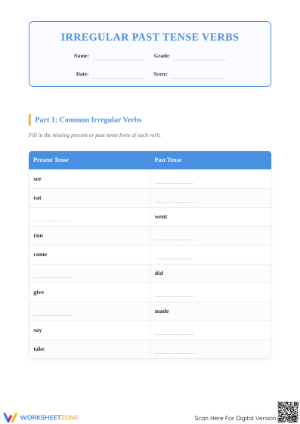
By the end of Grade 1, students should reliably identify common action verbs in isolation and in sentences, select a verb that agrees with a singular or plural subject, and recognize that -ed signals a completed action. Irregular past tense forms — ran, sang, ate — appear in 1st grade verbs printable worksheets as exposure items, not mastery targets; that work belongs to Grade 2.
Do these worksheets work as the introduction to verbs, or do they require prior instruction first?
They require prior instruction. Handing a cold identification worksheet to a student who has not had a lesson on what a verb does produces guessing, not learning. These worksheets function as the practice and consolidation layer after teacher modeling and shared work — not as the first time a student encounters the concept. Even five minutes of whole-class modeling before independent practice changes what students do with the task.
How many worksheets per week is a reasonable pace during a verb unit?
Two to three worksheets across a week works well. One identification or matching worksheet early in the week, one fill-in-the-blank or tense worksheet mid-week during centers, and an optional rewriting worksheet at the end for a formative read gives students enough distributed practice without turning grammar into a paper-completion exercise. Spacing the practice across several days outperforms assigning the same total number of items in a single sitting — retrieval across time strengthens retention more than massed repetition does.












 Interactive Worksheet Maker
 Quiz Maker
 Word Search Maker
 Crossword Puzzle Maker
 Word Scramble Generator
 Sentence Scramble Generator
 Handwriting Worksheet Generator
 Name Tracing Generator
 Fill In The Blank Generator