


























Views
Downloads


Grade 1 Action Verbs — Printable No-Prep Worksheet
Paste this activity's link or code into your existing LMS (Google Classroom, Canvas, Teams, Schoology, Moodle, etc.).
Students can open and work on the activity right away, with no student login required.
You'll still be able to track student progress and results from your teacher account.
This Grade 1 action verbs worksheet provides students with 18 structured opportunities to identify and apply "doing words" in context. By transitioning from simple word recognition to sentence-level application, learners build the foundational grammar skills necessary for clear writing. The activities ensure students understand that verbs represent actions.
At a Glance
- Grade: 1 · Subject: ELA
- Standard:
CCSS.ELA-LITERACY.L.1.1— Use common, proper, and possessive nouns and verbs correctly- Skill Focus: Action Verb Identification
- Format: 2 pages · 18 problems · Answer key included · PDF
- Best For: Independent grammar practice and review
- Time: 15–20 minutes
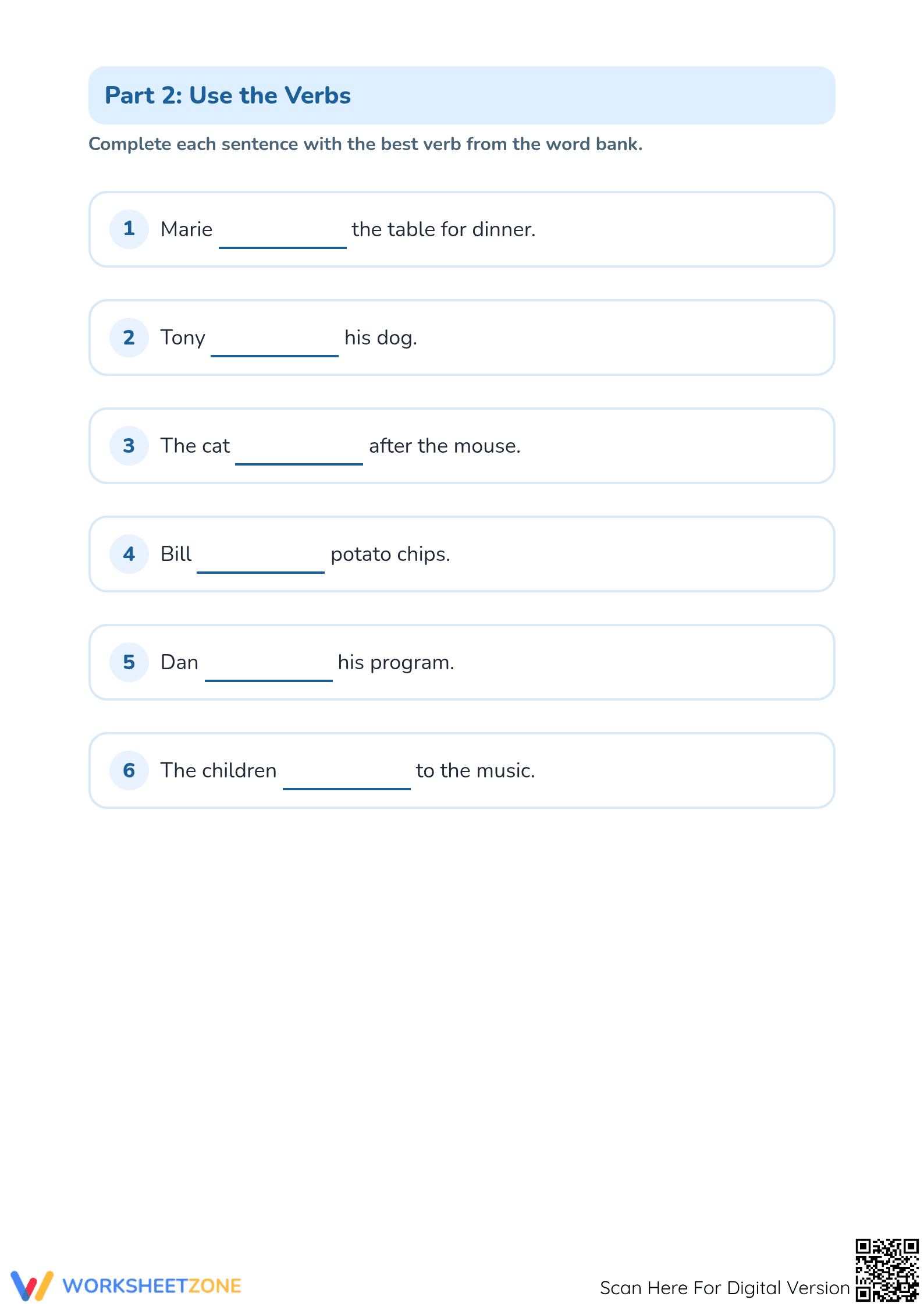
What's Inside: This two-page resource features a clean, distraction-free layout designed for young learners. Page one contains a 12-word bank where students must distinguish between nouns, prepositions, and verbs. Page two challenges students to apply their findings by completing six cloze-style sentences. A comprehensive answer key is provided to facilitate quick grading or student self-correction.
The zero-prep workflow is designed for maximum efficiency in busy classrooms. First, print the two-page PDF (30 seconds). Next, distribute the sheets to students as a morning warm-up or literacy center activity (1 minute). Finally, use the included answer key to review the "doing words" as a whole group to reinforce the concept (5 minutes). Total teacher preparation time is under two minutes, making this an ideal resource for sub plans.
Standards Alignment: This resource is aligned with `CCSS.ELA-LITERACY.L.1.1`, which requires students to demonstrate command of the conventions of standard English grammar and usage when writing or speaking. Specifically, it targets the identification of verbs as a core component of sentence structure. This standard code can be copied directly into lesson plans, IEP goals, or district curriculum mapping tools.
How to Use It: Use this worksheet during the "You Do" phase of a gradual release lesson on parts of speech. It serves as an excellent formative assessment tool; observe if students can correctly identify "watches" or "chases" as actions versus "computer" as a noun. Expected completion time ranges from 15 to 20 minutes depending on reading fluency and prior knowledge.
Who It's For: This resource is tailored for first-grade students but is also highly effective for second-grade review or English Language Learners (ELL) who need visual support for vocabulary acquisition. It pairs naturally with a classroom anchor chart displaying common action verbs or a shared reading passage where students hunt for "doing words" in a narrative text.
Research by Fisher & Frey (2014) emphasizes the importance of the gradual release of responsibility, moving from teacher modeling to independent application. This worksheet follows that pedagogical arc by first asking students to recognize verbs in isolation before requiring them to integrate those words into meaningful sentences. By isolating the "doing word" concept, the resource reduces cognitive load for Grade 1 learners, allowing them to focus specifically on the lexical category of verbs. According to the CCSS.ELA-LITERACY.L.1.1 framework, early mastery of verb usage is a significant predictor of later syntactic complexity in student writing. This printable resource provides the high-repetition practice necessary for students to internalize these grammar rules. The inclusion of an answer key supports immediate feedback, a critical factor in preventing the fossilization of grammatical errors during the early stages of language development. This ensures students are ready for more complex sentence construction.


