


























Views
Downloads

Identify Verbs Worksheet | Grade 1 Essential ELA
Paste this activity's link or code into your existing LMS (Google Classroom, Canvas, Teams, Schoology, Moodle, etc.).
Students can open and work on the activity right away, with no student login required.
You'll still be able to track student progress and results from your teacher account.
Students learn to recognize and use action words effectively with this comprehensive grammar resource. This worksheet focuses on the fundamental concept that verbs represent "doing" something, providing a clear path toward mastery of basic sentence parts. By the end of these activities, learners will be able to distinguish verbs from other word classes with high accuracy.
At a Glance
- Grade: 1 · Subject: ELA
- Standard:
CCSS.ELA-LITERACY.L.1.1— Demonstrate command of the conventions of standard English grammar and usage- Skill Focus: Identifying action verbs
- Format: 3 pages · 39 problems · Answer key included · PDF
- Best For: Introduction to parts of speech
- Time: 15–25 minutes
What's Inside
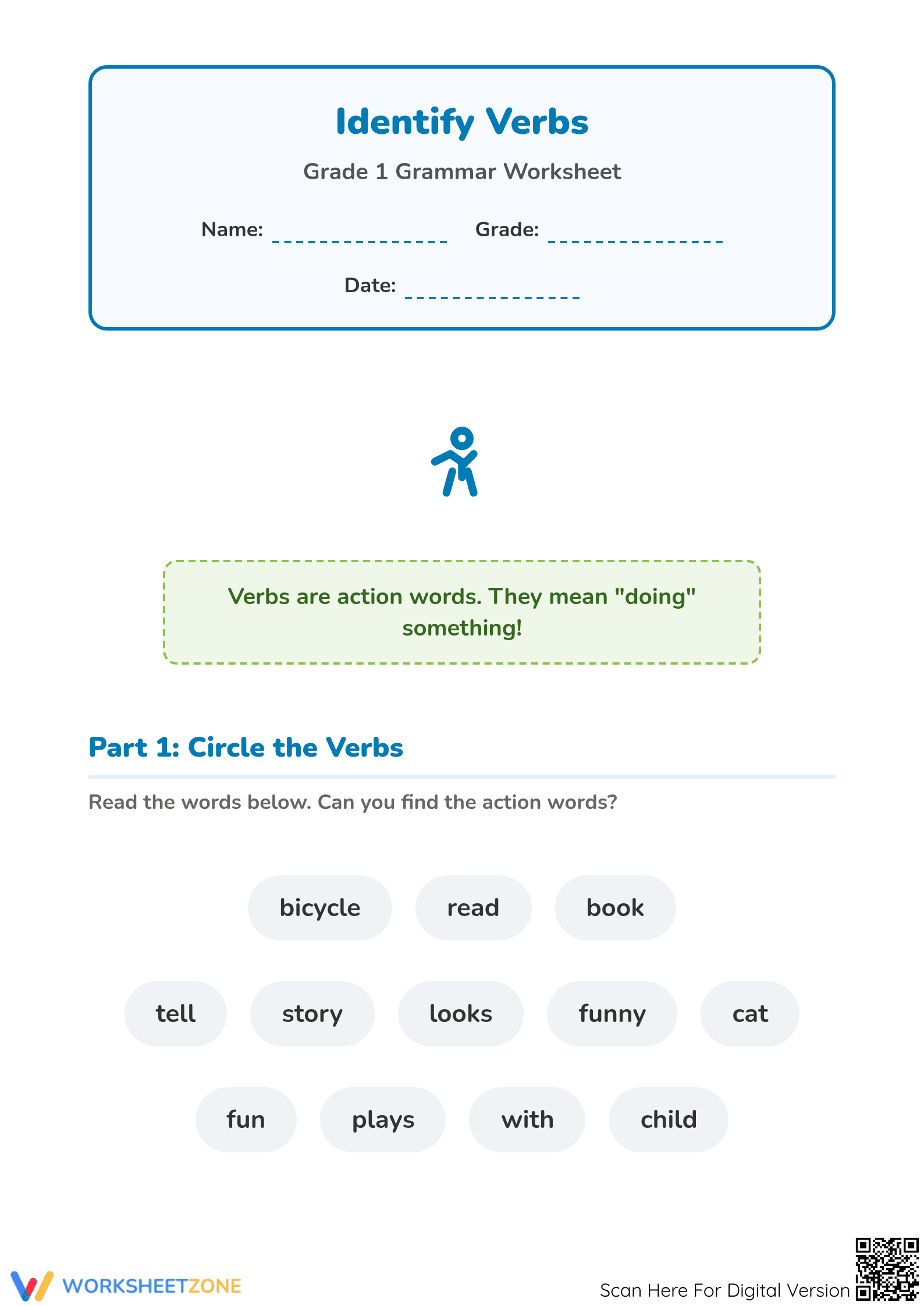
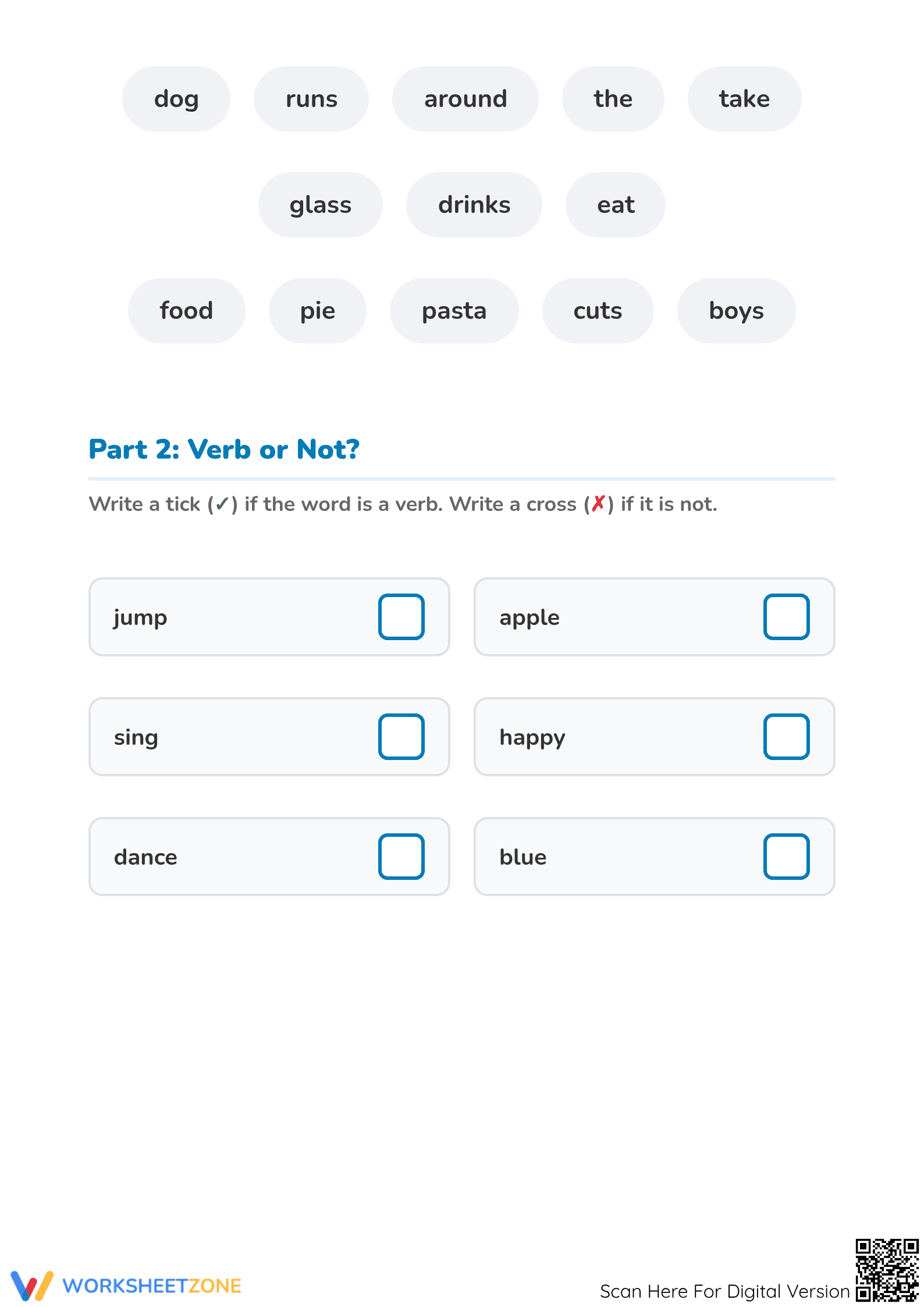
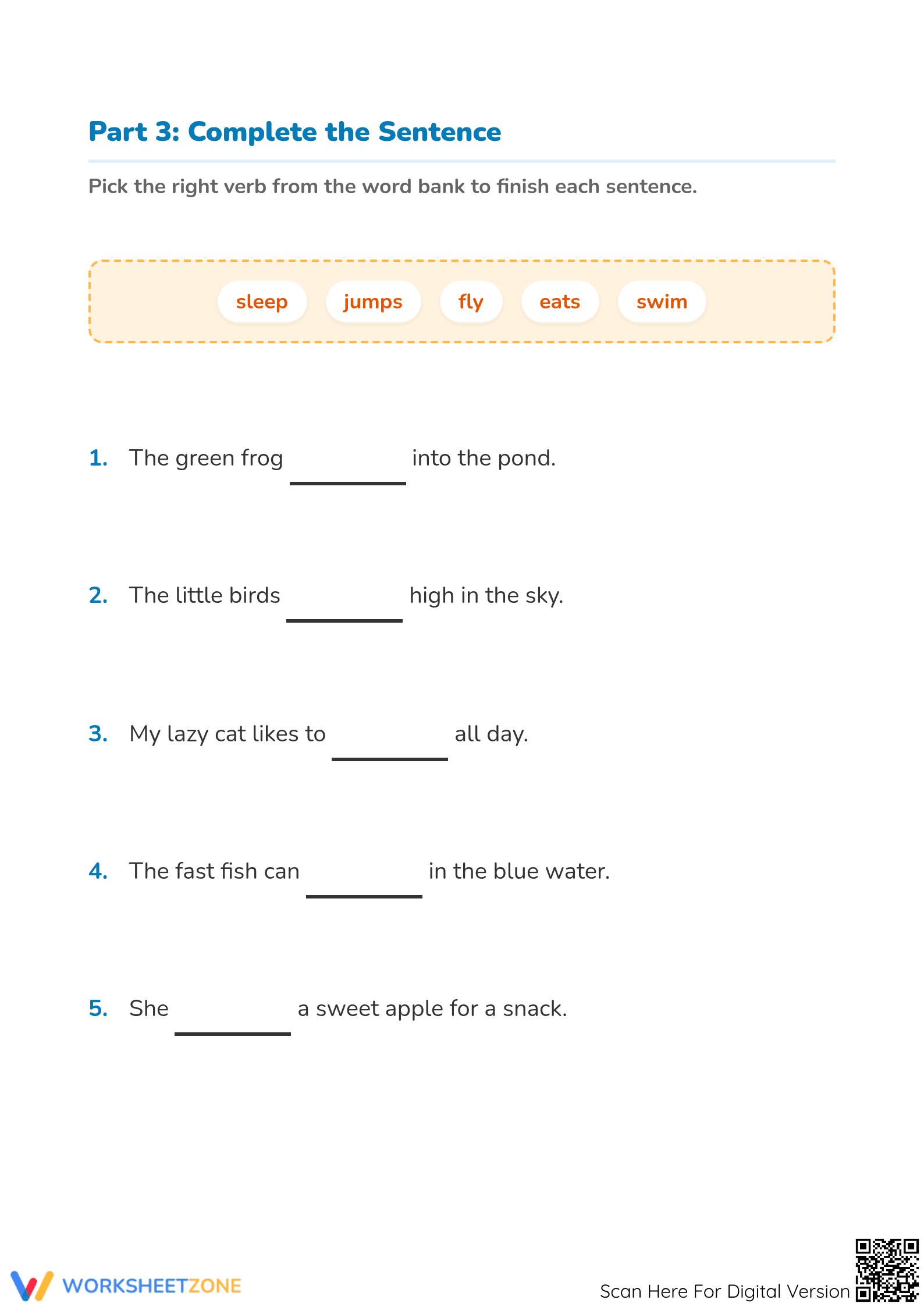
This three-page PDF contains a structured sequence of 39 tasks designed for first-grade learners. It begins with a clear definition of verbs as action words, followed by two extensive word lists for circling practice. The second page introduces a classification challenge where students must tick or cross words based on their function. Finally, the third page features five sentence-completion problems supported by a word bank. A full answer key is provided.
Skill Progression
- Guided Practice: The first 28 tasks focus on recognition within a controlled list, allowing students to apply the "action word" definition to familiar vocabulary like "read," "plays," and "eats."
- Supported Practice: Six classification items require students to evaluate words against non-verbs, such as "apple" or "blue," reinforcing the boundaries of the verb category through contrast.
- Independent Practice: Five sentence-completion tasks require students to select the most logical verb from a word bank to finish a thought, moving from word-level to sentence-level application.
This sequence follows the gradual release of responsibility, ensuring students build confidence before working independently.
Standards Alignment
This resource is primarily aligned with CCSS.ELA-LITERACY.L.1.1, which requires students to demonstrate command of the conventions of standard English grammar. Specifically, it supports sub-standard L.1.1.E by building the prerequisite skill of identifying verbs. This standard code can be copied directly into lesson plans, IEP goals, or district curriculum mapping tools.
How to Use It
Use this worksheet during the guided practice portion of a grammar lesson after introducing action words with an anchor chart. It works well as a formative assessment tool; teachers can scan the "Verb or Not?" section to see which students are confusing verbs with adjectives. Expect students to spend 20 minutes completing all three pages, though it can be broken into three daily warm-ups.
Who It's For
This resource is designed for first-grade students but is also effective for second-grade review or English Language Learners (ELLs) who need explicit vocabulary categorization. It pairs naturally with a classroom "Action Word" wall or a direct instruction lesson on simple sentence structures.
According to the RAND AIRS 2024 report on foundational literacy, explicit instruction in word classes like verbs is a critical predictor of early reading comprehension and syntactic development. This worksheet applies these findings by isolating the concept of "action words" through a multi-modal approach that includes visual identification, binary classification, and contextual application. By engaging with 39 distinct tasks, students move beyond rote memorization toward a functional understanding of how verbs operate within a sentence structure. Research from Fisher & Frey (2014) emphasizes the importance of the gradual release of responsibility, which is mirrored here as students transition from circling isolated words to selecting appropriate verbs for complete sentences. This structured repetition ensures that the standard CCSS.ELA-LITERACY.L.1.1 is not just introduced but reinforced through varied cognitive demands. Educators can utilize these results to identify specific gaps in lexical acquisition, making it a robust tool for both initial instruction and targeted intervention in the primary classroom.


