


























Views
Downloads
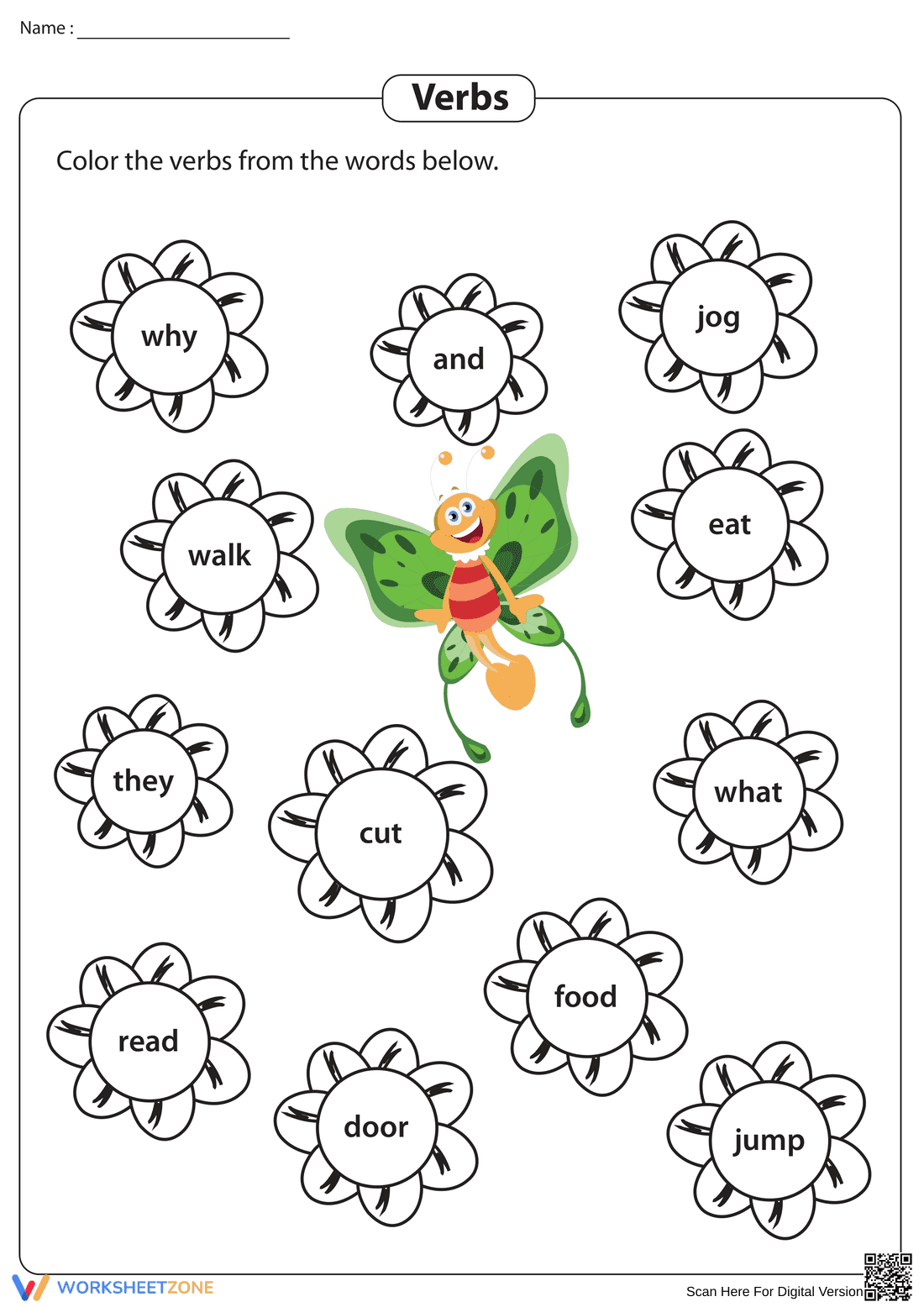

Grade 1 Verb Identification — Printable No-Prep Worksheet
Paste this activity's link or code into your existing LMS (Google Classroom, Canvas, Teams, Schoology, Moodle, etc.).
Students can open and work on the activity right away, with no student login required.
You'll still be able to track student progress and results from your teacher account.
Start by helping young learners distinguish action words from other parts of speech. This printable worksheet uses an engaging flower-and-butterfly theme to turn grammar practice into a creative coloring activity. Students learn to spot verbs like "jump" and "read" among common sight words, building the foundation for strong sentence construction and literacy.
At a Glance
- Grade: 1 · Subject: English Language Arts
- Standard:
CCSS.ELA-LITERACY.L.K.1.B— Use frequently occurring nouns and verbs in speech and writing- Skill Focus: Identifying and distinguishing verbs (action words)
- Format: 1 page · 12 tasks · Answer key included · PDF
- Best For: Early finishers and morning work
- Time: 10–15 minutes
This single-page PDF features 12 illustrated flower petals, each containing a unique word. Six of these words are high-frequency verbs, while the others include nouns, pronouns, and conjunctions. The layout is clean and child-friendly, providing ample space for coloring. A comprehensive answer key is included to facilitate quick grading or student self-correction during independent work stations.
Teachers can implement this resource in three simple steps. First, print the single-page PDF (less than 30 seconds). Second, distribute the sheets to students with a brief reminder that verbs are "doing words" (1 minute). Third, review the completed coloring during a transition period or through peer-checking (under 1 minute). Total teacher preparation time is less than two minutes, making it an ideal sub-plan addition.
This activity is primarily aligned with CCSS.ELA-LITERACY.L.K.1.B, which focuses on the use and identification of frequently occurring nouns and verbs. It also supports introductory Grade 1 grammar by reinforcing the concept of action words in a simple, visual format. Both standard codes can be copied directly into lesson plans, IEP goals, or district curriculum mapping tools.
Deploy this worksheet as a "hook" during the introduction of parts of speech to gauge prior knowledge. Alternatively, use it as a formative assessment after a direct instruction lesson on action words; as students color, circulate the room to observe if they can verbally explain why "jog" is an action while "door" is not. The expected completion time is approximately 12 minutes.
Designed specifically for Kindergarten and first-grade students, this resource is excellent for Tier 1 instruction or Tier 2 intervention for students struggling with basic grammar concepts. It pairs naturally with a short reading passage or an anchor chart that lists common action words, providing the necessary visual support for English Language Learners (ELL) and emerging readers.
This instructional resource addresses the foundational literacy requirement of identifying parts of speech, a critical precursor to syntactic development. By focusing on frequently occurring verbs within a thematic visual framework, the worksheet reduces cognitive load and increases student engagement during repetitive practice. Research from Fisher & Frey (2014) emphasizes the importance of guided practice and visual scaffolds in the gradual release of responsibility model. Identifying verbs like those featured here helps students transition from recognizing isolated words to constructing coherent sentences. According to the RAND AIRS 2024 report on elementary ELA materials, high-quality supplemental resources must provide clear alignment to CCSS.ELA-LITERACY.L.K.1.B while maintaining accessible readability for early learners. This worksheet fulfills those criteria by offering a focused 12-task set that builds mastery through active participation. It serves as a reliable tool for both traditional classroom settings and home-schooling environments.


