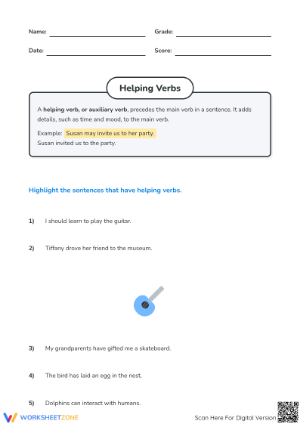
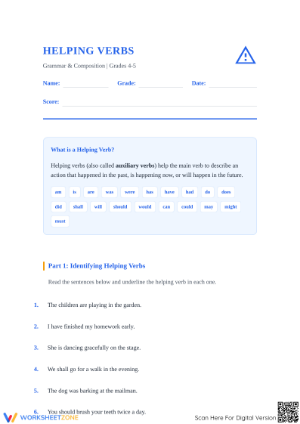
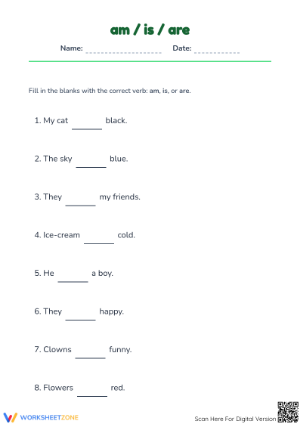
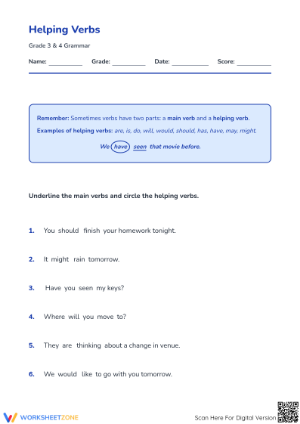
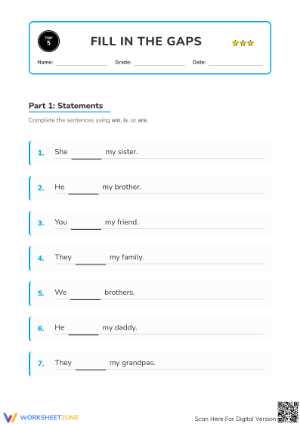
Helping verbs, also called auxiliary verbs, sit alongside a main verb to build a complete verb phrase. Forms of be, do, and have do this job constantly in student writing, showing up in phrases like is running, has finished, or does not know. For grade 3-5 teachers, helping verbs worksheets give students repeated, low-stakes practice spotting these small but essential words before they move into more complex verb tense and mood work. When students can name the helping verb and the main verb separately, they read sentences more accurately and write with clearer control over timing and certainty.
Helping Verbs vs Main Verbs: Teaching the Core Distinction
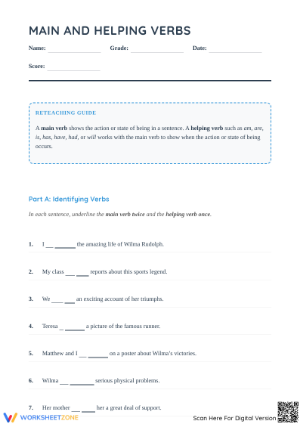
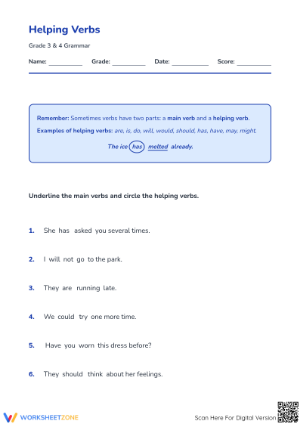
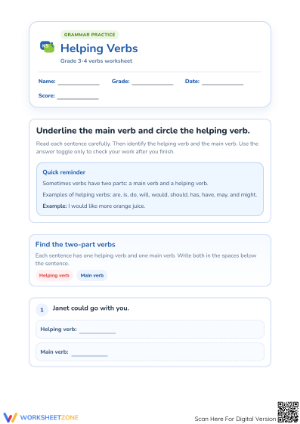
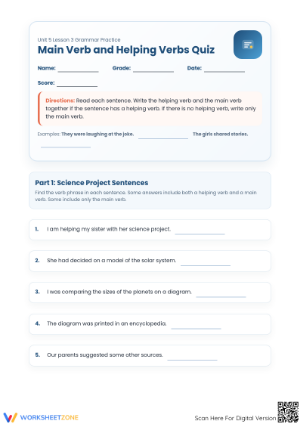
Start instruction with sentence pairs that isolate one helping verb and one main verb, such as she is walking or they have arrived. Ask students to underline the helping verb once and the main verb twice, then explain what each word contributes. The helping verb signals tense or mood, while the main verb carries the core action or state. This two-step routine works well as a warm-up before students tackle a full helping verbs worksheet independently.
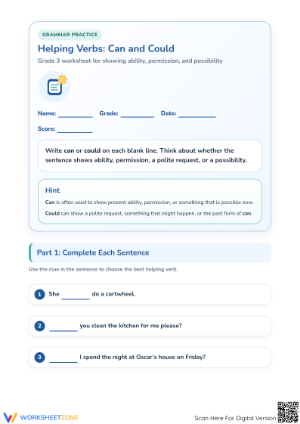
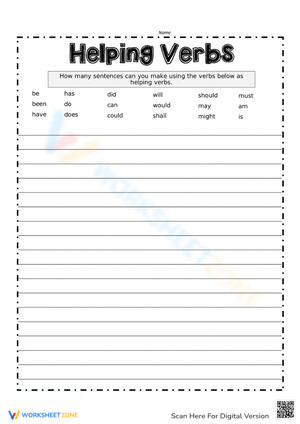
A close look at the auxiliary system shows students are not memorizing an open-ended list. English uses only a small, fixed set of helping verbs: forms of be, do, and have, plus nine modal auxiliaries, can, could, may, might, must, shall, should, will, and would. Framing the list as finite and countable, rather than an endless grammar rule, tends to lower student anxiety and makes flashcard or sorting activities far more manageable during a single class period.
Modal Auxiliaries and CCSS L.4.1.c: Possibility, Obligation, and Permission
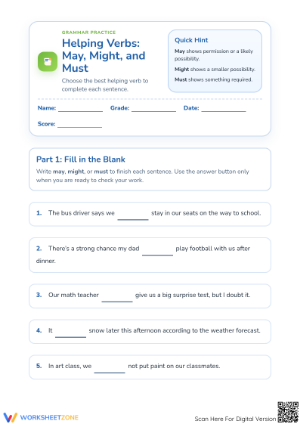
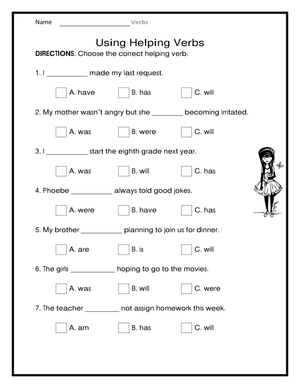
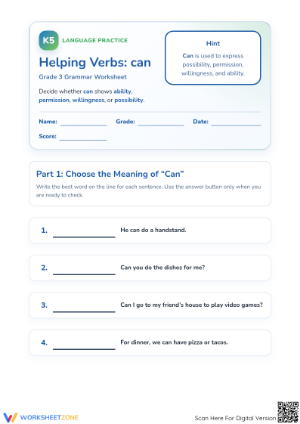
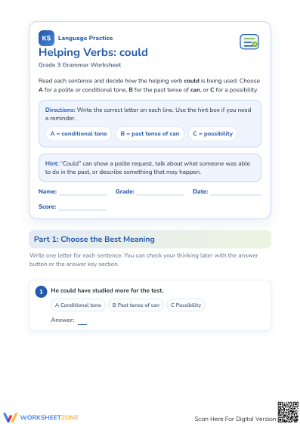
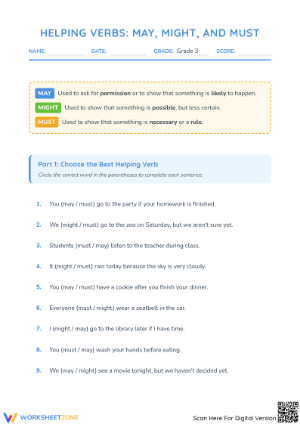
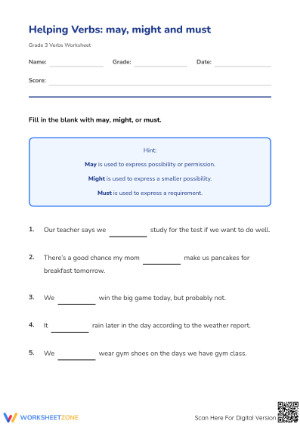
CCSS L.4.1.c asks fourth-grade students to use modal auxiliaries to convey specific shades of meaning, including possibility, likelihood, obligation, and permission. This is a step beyond simply identifying a helping verb; students must reason about what each modal implies. A sentence using might signals uncertainty, while one using must signals obligation. Worksheets built around this standard typically ask students to choose the modal that best fits a given context, or to rewrite a sentence so its meaning shifts from permission to obligation.
Workybooks fourth-grade modal auxiliaries verbs worksheets structure practice around this exact skill, pairing short context sentences with a bank of modal choices so students select the auxiliary that matches the intended meaning, giving teachers a reliable formative tool for tracking whether students grasp possibility, obligation, and permission distinctions under CCSS L.4.1.c.
Building Helping Verbs Worksheets Practice Into Daily Instruction
Helping verbs worksheets work best when they are not a one-time unit but a recurring five to ten minute routine. Many grade 3-5 teachers open a grammar block with a quick identify-the-helping-verb task, then close the same lesson with a modal auxiliary sentence completion task. This bookend structure keeps the skill active in short-term memory while students apply it to that day's reading or writing content, rather than treating grammar as an isolated worksheet exercise disconnected from the rest of the lesson.
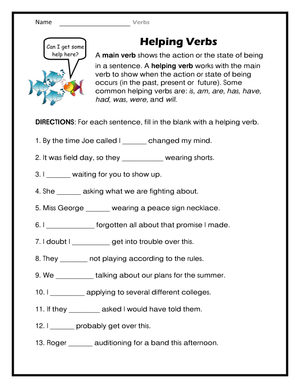
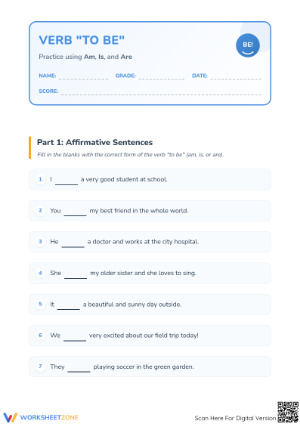
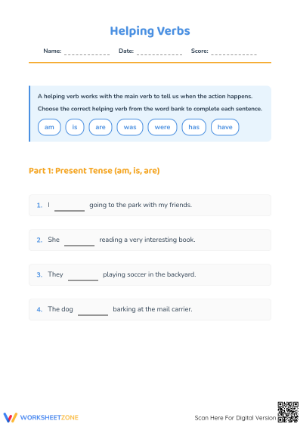
K5 Learnings fourth-grade auxiliary verbs worksheets model how helping verbs like is, has, and will combine with a main verb to build multiple verb-phrase patterns students meet in narrative and informational texts, giving teachers a concrete bank of practice items for grade 3-5 grammar instruction and quick formative checks.
Supporting ELL and Intervention Students with Helping Verbs
Students learning English as a new language often come from home languages that mark tense differently, so the concept of a separate helping verb can feel unfamiliar rather than intuitive. Slow the pace for these learners by starting with just one helping verb family at a time, such as forms of be, before introducing have and do. Sentence frames with a fixed helping verb and a changeable main verb, like she is (reading, singing, jumping), let ELL students practice the pattern without juggling multiple variables at once.
For intervention groups, a short diagnostic helping verbs worksheet can quickly show whether a student is missing the concept entirely or simply confusing it with subject-verb agreement. Group students by error type rather than by overall reading level, since a student who reverses helping and main verbs needs different practice than one who omits the helping verb altogether.
Frequently Asked Questions
1. What grade level typically learns helping verbs?
Helping verbs are commonly introduced in grade 3 and reinforced through grades 4 and 5, with modal auxiliary meaning work tied to fourth-grade standards like CCSS L.4.1.c.
2. What is the difference between a helping verb and a main verb?
The helping verb pairs with a main verb to show tense, mood, or voice, such as is in is running, while the main verb carries the core action or state, such as running.
3. Which standards cover helping verbs and modal auxiliaries?
CCSS L.4.1.c addresses using modal auxiliaries such as can, may, and must to convey possibility, likelihood, obligation, or permission.
4. How can teachers use helping verbs worksheets for intervention groups?
Group students by specific error type, such as dropping the helping verb or confusing it with the main verb, and assign short diagnostic worksheets to target that exact gap.
5. What are common student errors with helping verbs?
Students often omit the helping verb, misidentify it as the main verb, or choose a modal auxiliary that does not match the intended shade of meaning.












 Interactive Worksheet Maker
 Quiz Maker
 Word Search Maker
 Crossword Puzzle Maker
 Word Scramble Generator
 Sentence Scramble Generator
 Handwriting Worksheet Generator
 Name Tracing Generator
 Fill In The Blank Generator