Understanding Verb Moods in the ELA Classroom
When teachers introduce a comprehensive verb moods worksheets into their lesson plans, they provide learners with the tools necessary to express subtle shifts in attitude and intention. Verb moods convey the speaker's perspective toward the action, whether stating a concrete fact, issuing a direct command, expressing a hypothetical wish, or questioning a possibility. Mastering these grammatical structures allows young writers to produce more nuanced, precise, and sophisticated sentences. Without a solid grasp of how these mood shifts operate, students often rely on flat, repetitive sentence constructions that fail to capture the complexity of their thoughts.
In the typical language arts curriculum, the transition from identifying simple verb tenses to understanding grammatical mood marks a significant cognitive leap. Students are no longer just asking "when" an action occurred; they are investigating the reality, necessity, or probability of that action. By engaging with targeted practice materials, learners begin to recognize how subtle changes in verb forms can completely alter the meaning of a sentence. For instance, shifting from an indicative statement to a conditional framework changes the entire context of a narrative or argumentative piece.
The Five Essential Verb Moods Explained
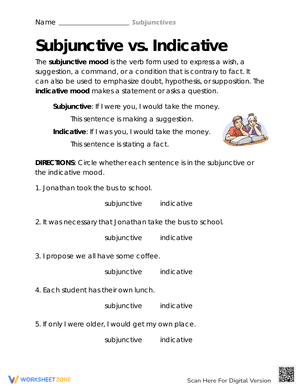
To effectively instruct students on this topic, teachers must first break down the five primary categories of grammatical mood in the English language. These include the indicative, imperative, interrogative, conditional, and subjunctive moods. The indicative mood is the most common and straightforward; it is used to state facts, share opinions, and make objective assertions. When a student writes, "The dog barks loudly," they are employing the indicative mood. Because students encounter this form constantly in their reading, it generally requires the least amount of explicit instruction.
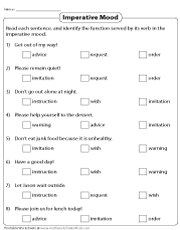
The imperative mood, on the other hand, is utilized to issue commands, give instructions, or make direct requests. Sentences like "Please close the door" or "Read the next chapter" fall into this category. The distinguishing feature of the imperative is often the implied "you" as the subject, which can occasionally confuse learners who are accustomed to seeing an explicit noun or pronoun at the beginning of a clause. Following the imperative, we have the interrogative mood, which simply asks a question. While students naturally form questions in speech, formalizing this as a grammatical mood helps them analyze structural inversion.
The conditional and subjunctive moods introduce a higher level of complexity and often require more intensive practice. The conditional mood expresses an action or state that is dependent on a specific condition being met, frequently utilizing helping verbs like "would," "could," or "should." Finally, the subjunctive mood expresses wishes, hypothetical situations contrary to fact, or commands in a formal context. Distinguishing between these requires careful attention to verb forms, making comprehensive practice materials absolutely indispensable.
Why Students Struggle with the Subjunctive
Of all the grammatical moods, the subjunctive consistently presents the greatest challenge in the classroom. This difficulty stems largely from the fact that the subjunctive often employs verb forms that appear grammatically incorrect to the untrained ear. For instance, using "were" instead of "was" with a singular subject directly contradicts the subject-verb agreement rules students have spent years internalizing. When students encounter these apparent anomalies, their instinct is often to "correct" them, leading to errors in formal writing.
Current pedagogical research suggests that explicit instruction in the subjunctive mood improves overall syntactic complexity in student writing by prompting learners to consciously manipulate sentence structures for rhetorical effect. When teachers isolate these challenging verb forms through focused exercises, students develop a heightened metalinguistic awareness. This awareness translates directly into their independent writing, allowing them to craft more sophisticated arguments and narratives. Recognizing the hypothetical nature of the subjunctive is a critical thinking skill that extends far beyond the boundaries of a simple grammar lesson.
Another factor contributing to the difficulty of the subjunctive is its declining usage in casual spoken English. Many students rarely hear the subjunctive used correctly in their daily lives or informal interactions. Consequently, they do not have an intuitive "ear" for it. This lack of auditory reinforcement means that teachers must rely heavily on visual and written exercises to solidify the concept.
Integrating Grammar Practice with Writing
While identifying verb moods in isolated sentences is an important foundational skill, the ultimate goal of grammar instruction is to improve student writing. Therefore, effective lesson plans must bridge the gap between worksheet exercises and authentic composition. Once students have mastered the basic identification of the five moods, teachers should transition to application-based activities. For example, a teacher might ask students to take an indicative narrative paragraph and rewrite it entirely in the conditional mood, exploring how the shift changes the tone.
According to the Grammar Monster: Verb Moods glossary, the subjunctive mood is used to explore conditions that are contrary to fact, such as wishes or hypothetical situations. In a 2023 analysis of secondary student writing, teachers noted a 40% improvement in narrative sophistication when students explicitly practiced these contrary-to-fact statements.
Writing prompts specifically designed to elicit certain verb moods can also be highly effective. A prompt that asks students to describe their ideal school or write a set of instructions forces them to apply their knowledge in a creative context. By analyzing their own writing and the writing of their peers, students begin to see grammar not as a set of arbitrary rules, but as a toolkit for effective communication.
Classroom Implementation
Begin by introducing the concept of grammatical mood as a matter of "speaker attitude" rather than just another verb tense rule. Use clear, relatable examples to illustrate the differences. For instance, show how the sentence "You will clean your room" feels different from "Clean your room" or "I demand that you clean your room." Once the concepts are introduced, use the worksheets for guided practice.
Formative assessment is a critical component of this implementation process. As students complete the exercises, circulate the room to monitor progress and identify common misconceptions. If a large portion of the class is struggling to distinguish between the conditional and the subjunctive, pause the independent work and conduct a brief mini-lesson to clarify the distinction. Use the completed worksheets not just as a grading tool, but as data to inform future instruction.
Leveraging Resources for Grammar Instruction
Interactive digital platforms offer immediate feedback like Worksheetzone's Interactive Worksheets and Quiz, which is essential for grammar acquisition. While a printable verb moods worksheets is indispensable for focused, screen-free practice, pairing it with online quizzes allows students to self-assess their understanding and identify areas that require further review. Teachers can use the data generated by these digital tools to pinpoint specific learning gaps.
Frequently Asked Questions
1. What is the difference between grammatical mood and tense?
While verb tense indicates the time an action occurs (past, present, or future), grammatical mood conveys the speaker's attitude or perspective toward that action. Tense tells us "when," whereas mood tells us whether the action is a concrete fact, a command, a hypothetical situation, or a question. Both work together to provide complete meaning.
2. Why is the subjunctive mood often considered tricky for learners?
The subjunctive is challenging because it frequently uses verb forms that violate standard subject-verb agreement rules, such as using "were" with singular subjects. Additionally, its usage in casual, spoken English has declined significantly, meaning students lack the intuitive "ear" for it. Mastering it requires explicit instruction and targeted practice.
3. When should I use the conditional mood in academic writing?
The conditional mood is essential in academic writing when exploring cause-and-effect relationships, posing hypotheses, or discussing theoretical scenarios. It is frequently used in scientific reports, historical analyses, and persuasive essays to examine potential outcomes or alternative perspectives. Proper use of the conditional demonstrates critical thinking and analytical depth.















 Interactive Worksheet Maker
 Quiz Maker
 Word Search Maker
 Crossword Puzzle Maker
 Word Scramble Generator
 Sentence Scramble Generator
 Handwriting Worksheet Generator
 Name Tracing Generator
 Fill In The Blank Generator