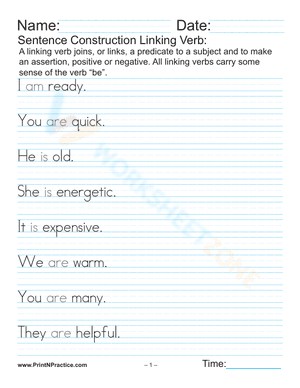
If your grade 3-5 students keep writing 'she are happy' or calling 'seems' an action word, you are not alone. Linking verbs trip up more students than almost any other part-of-speech concept, and it shows up again and again in writing conferences and grammar quizzes. Linking verbs worksheets give you a low-prep way to target this specific error pattern, whether you are running a whole-class lesson, a small-group pull-out, or a quick formative check before a writing unit.
What Makes a Verb a Linking Verb
A linking verb connects the subject of a sentence to a subject complement, which is a word or phrase that renames or describes that subject. Unlike action verbs, a linking verb does not show the subject doing something. The core group includes be, is, are, was, were, am, been, and being, along with sense verbs such as seem, feel, look, appear, and become. Students often meet this concept for the first time when a sentence like The soup smells delicious does not seem to follow the same pattern as The dog runs fast.
Worksheets that isolate this contrast, action verb on one side and linking verb on the other, help students build a mental checklist. Ask them: does this word show the subject doing an action, or does it connect the subject to a description? That question becomes the anchor for nearly every activity you assign afterward.
Where Linking Verbs Fit in the Grammar Sequence
Most classrooms introduce action verbs first because they are more concrete and easier for younger students to visualize. Once students are comfortable identifying action verbs in sentences, linking verbs become the natural next step, since the comparison between the two verb types is what actually builds understanding. Trying to teach linking verbs in isolation, without that contrast, tends to produce shakier retention.
CCSS L.3.1a introduces parts of speech, including verbs, as a third grade expectation, with the skill reinforced again in L.4.1 and L.5.1 as students refine their usage across increasingly complex sentences. That progression matters for planning: a worksheet set that feels appropriately challenging in October of third grade may need to shift toward editing and revision tasks by fifth grade rather than staying at the identification level.
Building a Linking Verb Practice Sequence
A single worksheet rarely moves the needle on its own. Sequence practice across a few sessions instead:
- Start with a sorting task where students separate action verbs from linking verbs pulled from familiar sentences.
- Move to fill-in-the-blank items where students choose the correct linking verb form to match subject-verb agreement.
- Add a labeling task where students mark the subject, the linking verb, and the subject complement in full sentences.
- Finish with a short writing prompt that requires at least three sentences using different linking verbs correctly.
This progression takes students from recognition to production, which is where the skill actually transfers into their independent writing.
Differentiating for ESL Students and Grade 2 Reinforcement
English learners often need extra time with linking verbs because the concept does not map cleanly across every language. Sentence frames such as The ___ is ___ or The ___ looks ___ give ESL students a structure to practice with before they are asked to generate original sentences. Keep vocabulary in these frames familiar so students are focused on the grammar pattern, not on decoding new words.
For grade 2 classrooms doing early reinforcement, keep the introduction simple: focus only on forms of be at first, since sense verbs like seem and become can wait until students are more comfortable with basic sentence structure. Adding too many linking verbs at once at this stage tends to overwhelm students who are still solidifying the action-versus-linking distinction.
Classroom Implementation
To put linking verb worksheets to work efficiently:
- Pre-teach the be verbs as a memorized list before introducing sense verbs, so students have a stable starting point.
- Use color-coding consistently across your grammar unit: one color for subjects, another for linking verbs, another for complements.
- Pair every identification worksheet with a short writing task so the skill does not stay purely receptive.
- Revisit linking verbs briefly during editing lessons throughout the year rather than treating the unit as a one-time topic.
- Group intervention students by error pattern, since students who confuse linking verbs with helping verbs need different support than students who miss sense verbs entirely.
Frequently Asked Questions
1. What is a linking verb and how is it different from an action verb?
A linking verb connects the subject to a subject complement that renames or describes it, rather than showing the subject performing an action. Be verbs and sense verbs like seem or feel are common examples.
2. What grade level should teachers introduce linking verbs?
Third grade is a common entry point, aligning with CCSS L.3.1a, with continued reinforcement in fourth and fifth grade as students apply the skill in more complex sentences.
3. What are the most common linking verbs students need to memorize?
The core be verbs, is, are, was, were, am, been, and being, along with frequently used sense verbs such as seem, feel, look, appear, and become.
4. How can teachers help students who mix up linking verbs and helping verbs?
Use visual scaffolds, such as an equal sign for linking verbs versus an arrow for action, and start with sentences where the verb is underlined so students only practice identifying its function.
5. How should linking verb worksheets fit into a broader grammar unit?
They work best sequenced from sorting to identification to sentence writing, and paired with reading-in-context tasks rather than used as a single isolated drill.















 Interactive Worksheet Maker
 Quiz Maker
 Word Search Maker
 Crossword Puzzle Maker
 Word Scramble Generator
 Sentence Scramble Generator
 Handwriting Worksheet Generator
 Name Tracing Generator
 Fill In The Blank Generator