Strengthening Literacy Foundations with Present Tense Verbs
Present tense verbs serve as the bedrock of functional communication in the English language. For students in the early to middle elementary grades, understanding how to express actions that occur regularly or are happening in the immediate moment is a vital step toward writing fluency. Teachers often find that a structured approach to grammar instruction, supported by high-quality resources, helps bridge the gap between abstract rules and practical application. These worksheets provide the repetition necessary for students to internalize the mechanics of verb conjugation without feeling overwhelmed by complex linguistic theory. Teachers can use these materials for morning work, homework assignments, or as part of a literacy center. The goal is to make the rules of grammar second nature, allowing students to focus more on their creative expression and less on the technicalities of word forms.
Differentiating Simple Present and Present Continuous Concepts
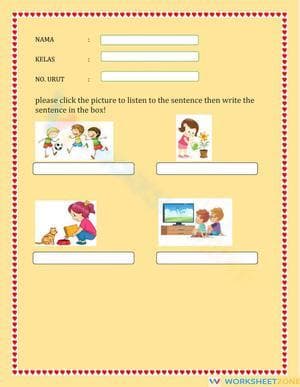
Distinguishing between the simple present and the present continuous tense is a common challenge for young learners. Simple present describes routines or general truths, like "He walks to school," while present continuous describes actions in progress, such as "He is walking right now." Providing clear, visual distinctions on worksheets can help students make this conceptual leap more easily. Using contrasting sentences and requiring students to identify the correct tense based on context clues is an excellent way to reinforce this learning. Teachers might use pictures of people performing various actions and ask students to write two sentences for each: one in the simple present and one in the present continuous. This dual approach helps solidify the functional differences between the two tenses in a practical way. Worksheets that focus on signal words like "usually" and "currently" provide students with a reliable framework for making correct choices.
Master Subject-Verb Agreement with Specialized Practice
Subject-verb agreement is frequently cited by teachers as a persistent area of error in student writing. The rule itself seems simple—singular subjects take singular verbs—but the addition of the "s" ending to verbs in the third-person singular often confuses students who are accustomed to "s" signaling plural nouns. Dedicated practice through worksheets helps demystify this rule by providing repeated exposure to correct patterns. By focusing on specific subject types, such as pronouns and proper nouns, teachers can help students identify exactly when the verb needs to change its form.
According to the British Council, mastering the present simple tense is foundational for English proficiency, as it is used for approximately 60% of daily communication regarding routines and universal facts. Teachers can utilize these percentages to emphasize the high utility of present tense mastery during grammar instruction cycles. This data point can be shared with students to help them understand why they are spending so much time on what might seem like a small detail. Knowing that a single letter 's' can impact the clarity of more than half of their spoken and written English can be a powerful motivator for accuracy.
Effective worksheets for subject-verb agreement should include a mix of sentence completion and error correction tasks. Asking students to identify "incorrect" sentences helps them develop an internal editor, a skill that carries over into their own creative and academic writing projects.
Effective Scaffolding for Diverse Student Needs
Scaffolding instruction is essential to meet the diverse needs of any classroom. Beginners often benefit from simple matching exercises or basic fill-in-the-blank sentences, which help build the confidence required for more advanced work. Teachers can also provide word banks to assist with spelling while students focus on grammatical rules. As students progress, the complexity of the tasks should increase, transitioning from identifying verbs to generating original sentences. For English Language Learners (ELLs), worksheets that provide pictorial support alongside text can be particularly effective. These visual aids help bridge the vocabulary gap, allowing students to focus on the grammatical structures being taught without being hindered by unknown words. Worksheetzone provides a broad spectrum of printable options to support this differentiated approach, ensuring that every student is supported in their grammar journey.
Teacher Tips: Maximizing Student Engagement and Mastery
To increase student engagement, try integrating worksheets into broader instructional strategies. Use them as springboards for classroom discussion; for example, students can share their own daily routines after completing a worksheet on habitual actions. Another effective strategy is the use of "grammar stations" where students rotate through different areas to work on specific types of present tense exercises. Using stations allows for:
- Targeted Intervention: Teachers can sit at a station to assist students who are struggling with a particular concept.
- Peer Collaboration: Students can work in pairs to solve worksheet problems, explaining their reasoning to one another.
- Varied Practice: Different stations can offer different types of activities, such as sorting, matching, or writing.
This movement and variety maintain student focus and allow for targeted teacher intervention. Incorporating fun, competitive elements like timers can also encourage students to work with greater efficiency and accuracy during their practice sessions.
Formative Assessment Strategies for Grammar Skills
Worksheets are invaluable tools for formative assessment. Reviewing student work on these printable resources allows teachers to quickly identify common misconceptions and adjust their instruction accordingly. This real-time data enables more responsive teaching, which is significantly more effective than waiting for a unit test to discover that students haven't grasped a key concept. Short, focused quizzes at the end of a week can provide a snapshot of student progress. These assessments should mirror the types of tasks students have practiced on their worksheets to ensure they are being evaluated fairly on what they have learned. Providing immediate feedback is also essential; when students understand exactly where they went wrong, they are much more likely to correct the error in the future. These feedback loops are the engine of academic growth in the grammar classroom.
Technology and Storytelling in Grammar Practice
Analyzing student writing samples often reveals that subject-verb agreement errors in the present tense are not merely grammatical lapses but frequently stem from a misunderstanding of phonological pluralization rules, where the 's' ending signals a plural noun but a singular verb. Addressing this specific phonics-grammar overlap can significantly improve retention rates among early writers. Teachers who explicitly point out this "inverted s" rule—where the 's' moves from the noun to the verb—often see quicker mastery. Integrating technology with traditional worksheets also provides a balanced approach to learning. While printables are excellent for focus and handwriting practice, digital tools offer interactive elements. For example, students might record themselves reading worksheet sentences aloud, reinforcing grammar through pronunciation and auditory feedback. Worksheetzone supports this blended learning by providing high-quality printables that can be easily integrated into any tech-enabled classroom.
Frequently Asked Questions
1. What is the difference between simple present and present continuous tense?
The simple present tense is used for actions that are habitual, repeated, or generally true, such as "The sun rises in the east." The present continuous tense is used for actions that are happening right now or are temporary, such as "The sun is shining today." Recognizing these differences helps students choose the correct verb form for their specific meaning.
2. How do I know when to add 's' or 'es' to a verb in the present tense?
In the simple present tense, we add 's' or 'es' to the base form of the verb only when the subject is in the third-person singular (he, she, it, or a singular noun). For example, "He plays" vs. "They play." Verbs ending in -sh, -ch, -s, -x, or -z usually require the 'es' ending, as in "she watches." Consistent practice with targeted worksheets can help make this rule second nature.
3. What are some common irregular verbs in the present tense?
While most English verbs follow regular patterns, some of the most frequently used verbs are irregular. The verb "to be" is highly irregular (am, is, are). Other common irregulars in the present tense include "to have" (has/have) and "to do" (does/do). Mastery of these high-frequency verbs is essential for basic communication.
4. How can I help my students practice present tense verbs at home?
Encourage parents to engage in "action talk" with their children, describing actions as they happen. This practices the present continuous tense. For simple present, children can describe their daily routines or interesting facts. Using printable worksheets as a supplementary home activity can also reinforce classroom learning.
5. Why is subject-verb agreement so difficult for students to learn?
The difficulty often arises from the inverse relationship between nouns and verbs regarding the letter 's'. In English, adding 's' to a noun makes it plural, but adding 's' to a verb makes it singular (in the third person). This can be counterintuitive for young learners who are just beginning to master the rules of pluralization and conjugation concurrently.
6. When should students transition from worksheets to creative writing?
The transition should be gradual and continuous. Worksheets are excellent for building foundational "muscle memory" of grammar, while creative writing provides the opportunity to use those skills in a real-world scenario. Ideally, students should engage in both types of activities regularly.















 Interactive Worksheet Maker
 Quiz Maker
 Word Search Maker
 Crossword Puzzle Maker
 Word Scramble Generator
 Sentence Scramble Generator
 Handwriting Worksheet Generator
 Name Tracing Generator
 Fill In The Blank Generator