


























Views
Downloads


Essential Helping Verbs Worksheet | Grade 4-5 Printable
Paste this activity's link or code into your existing LMS (Google Classroom, Canvas, Teams, Schoology, Moodle, etc.).
Students can open and work on the activity right away, with no student login required.
You'll still be able to track student progress and results from your teacher account.
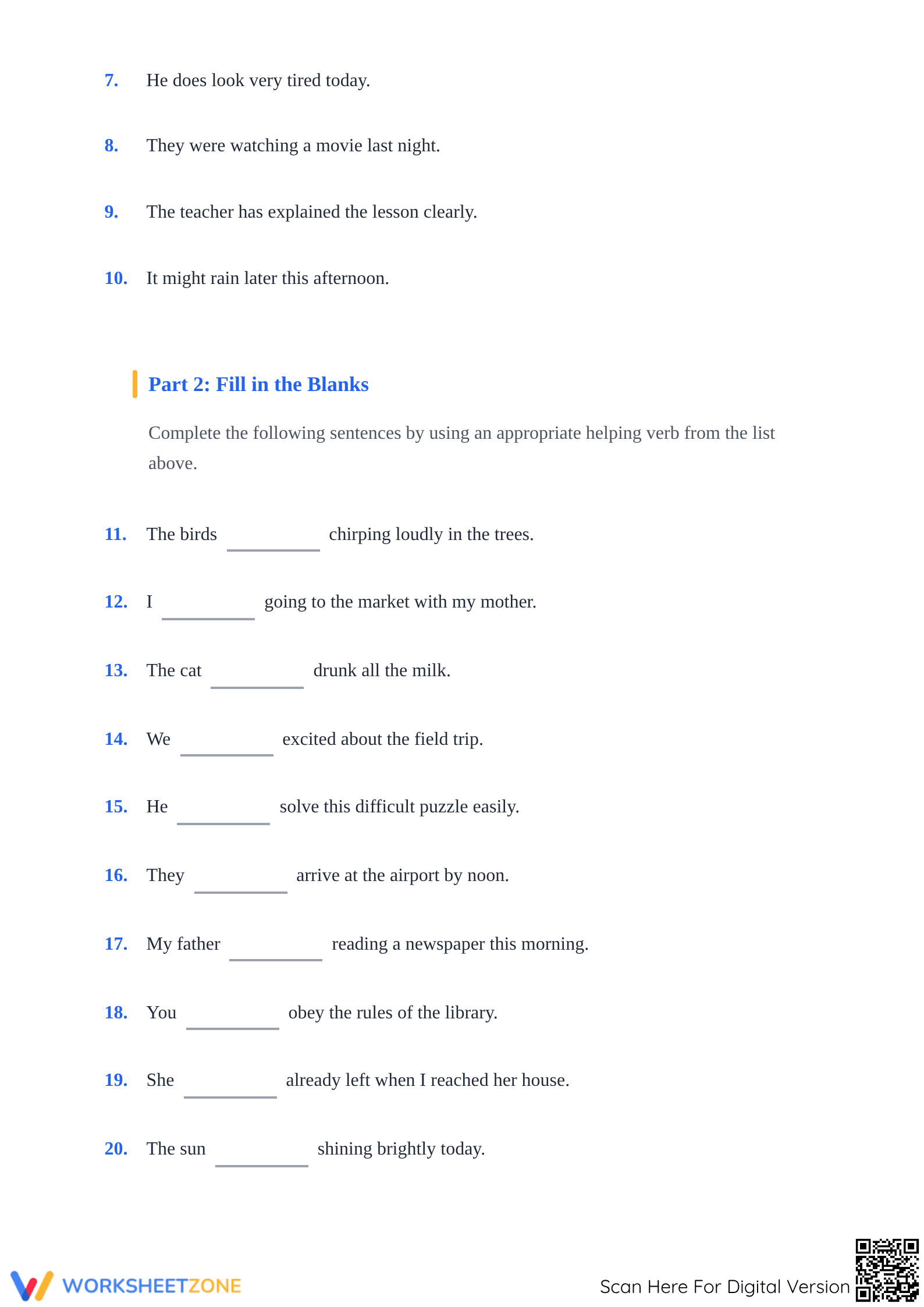
This comprehensive helping verbs worksheet provides Grade 4 and 5 students with a structured pathway to mastering auxiliary verbs. By engaging with 41 distinct tasks, learners move beyond simple recognition to active application in sentence construction and negation. This resource ensures students can accurately use verbs like "have," "will," and "should" to clarify the timing and mood of their writing.
At a Glance
- Grade: 4-5 · Subject: English Language Arts
- Standard:
CCSS.ELA-LITERACY.L.4.1— Use helping verbs to convey time and state of being accurately- Skill Focus: Auxiliary Verb Identification and Usage
- Format: 5 pages · 41 problems · Answer key included · PDF
- Best For: Independent grammar practice and formative assessment
- Time: 25–35 minutes
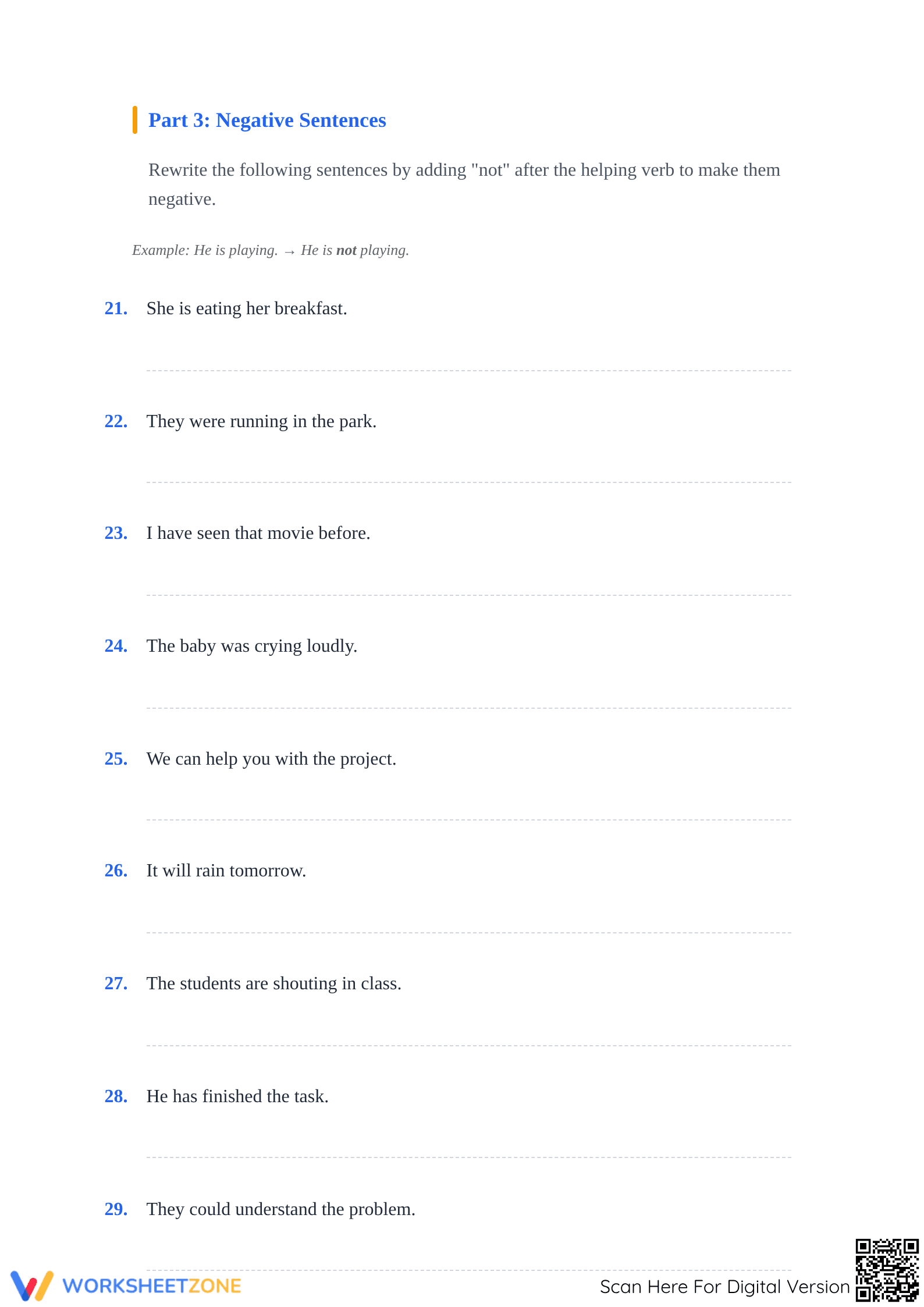
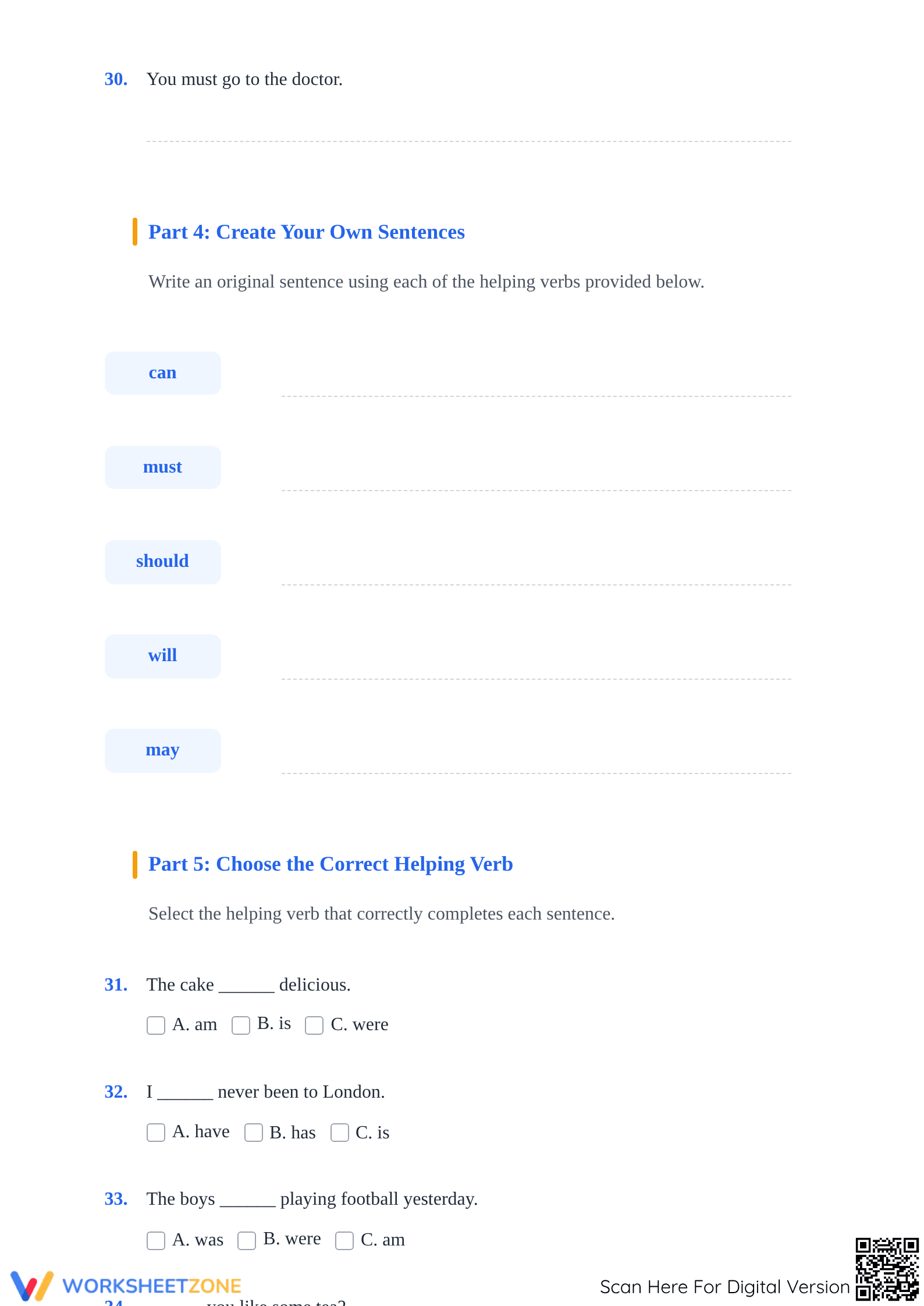
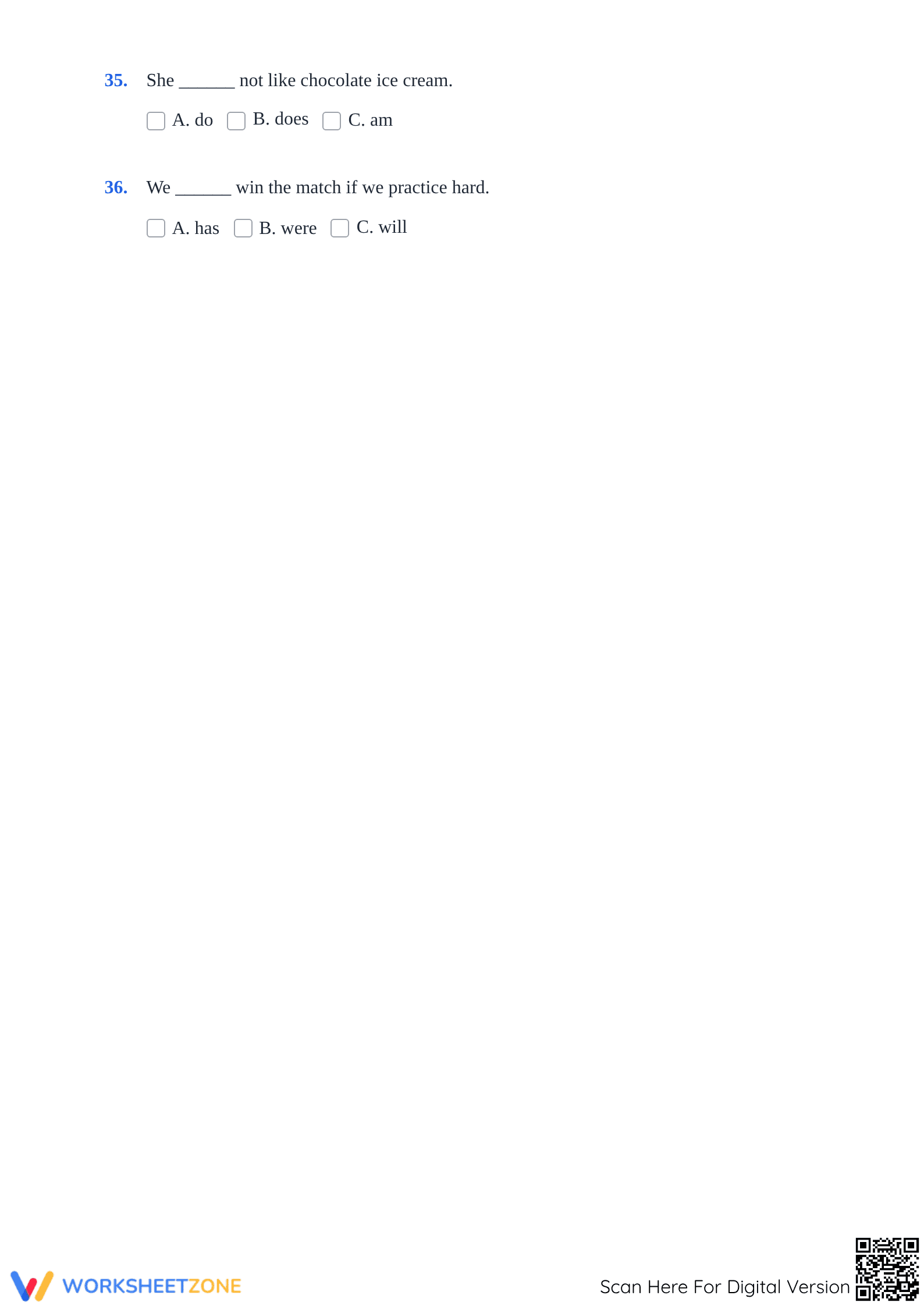
The five-page PDF is organized into five logical segments to prevent student overwhelm. It begins with a clear instructional header defining helping verbs and providing a visual word bank of common examples. Students then progress through identification exercises, fill-in-the-blank sentences, and a rigorous section on creating negative sentences by inserting "not." The final pages include sentence creation prompts and multiple-choice questions to verify conceptual understanding. A full answer key is provided for rapid grading.
The zero-prep design of this resource allows for immediate classroom integration. First, print the specific pages needed for your lesson or the full 5-page packet in under 60 seconds. Second, distribute the worksheets as a standalone sub-plan or a focused grammar supplement during your ELA block. Finally, use the included answer key to conduct a whole-class check or allow students to self-correct their work in under 5 minutes. Total teacher preparation time is less than two minutes.
This resource is primarily aligned with `CCSS.ELA-LITERACY.L.4.1`, which focuses on the conventions of standard English grammar and usage. Specifically, it addresses the use of modal auxiliaries and the formation of complex verb tenses. It also supports CCSS.ELA-LITERACY.L.5.1 by reinforcing the correct use of verb tenses to convey various times, sequences, and conditions. Both standard codes can be copied directly into lesson plans, IEP goals, or district curriculum mapping tools.
Assign this worksheet during the independent practice phase of a grammar lesson on verb phrases. It serves as an excellent formative assessment tool; teachers should observe Part 3 (Negative Sentences) to see if students correctly place the negation between the helping and main verb. Completion typically takes 25 to 35 minutes, making it an ideal choice for morning work or a quiet literacy center activity.
This packet is designed for general education students in 4th and 5th grade, but it is equally effective for older English Language Learners (ELL) who need explicit practice with English auxiliary structures. It pairs naturally with a mentor text passage or an anchor chart displaying the "Helping Verb Song" to reinforce the 23 common auxiliary verbs.
According to research by Fisher & Frey (2014) on the gradual release of responsibility, structured grammar practice is most effective when it moves from identification to generative application. This worksheet follows that pedagogical arc by transitioning students from underlining auxiliary verbs to constructing original sentences and transforming affirmative statements into negative ones. By isolating the function of helping verbs—such as "can," "must," and "should"—within the context of complete sentences, the resource directly supports the mastery of CCSS.ELA-LITERACY.L.4.1. This standard requires Grade 4 and 5 students to demonstrate a command of standard English grammar conventions. Systematic exposure to the 23 common auxiliary verbs helps learners clarify the mood, voice, and tense of their writing. This 5-page packet provides the high-repetition, low-stakes environment necessary for internalizing these mechanics before students apply them to complex multi-paragraph compositions or standardized assessments.


