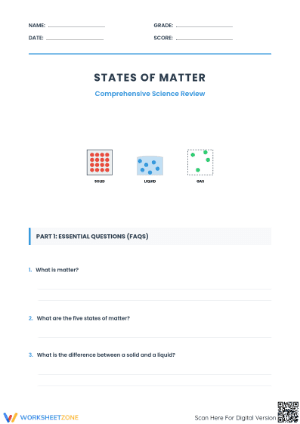
What Solid, Liquid, and Gas Worksheets Teach
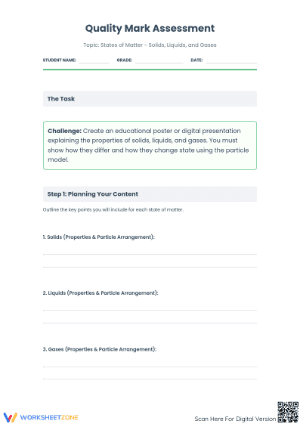
Solid, liquid, and gas worksheets give your class a structured way to observe, sort, and explain the three states of matter. In most US classrooms this unit lands in grade 2, where students are expected to classify materials by observable properties and describe what happens when matter is heated or cooled. A strong worksheet set turns an abstract idea, that matter is anything taking up space, into something second graders can point to, group by hand, and write about in a full sentence. That progression from sorting to explaining is what separates a quick coloring page from a worksheet that moves science thinking forward.
NGSS Alignment for States of Matter
These worksheets map directly onto the grade 2 matter standards, so they fit inside your existing science block instead of adding a separate activity you have to justify.
According to the Next Generation Science Standards, performance expectation 2-PS1-1 asks second graders to plan and conduct an investigation to describe and classify different kinds of materials by their observable properties. That single grade 2 standard anchors every sorting worksheet in this unit, from picture cut-and-paste pages to short written explanations of why an object belongs in a group.
The companion expectation, 2-PS1-4, addresses reversible and non-reversible changes caused by heating or cooling. Pairing a state-identification worksheet with cause-and-effect questions about ice melting or water boiling lets one page cover observable properties and change together, which is exactly how the standard frames the topic.
Sorting Matter by Observable Properties
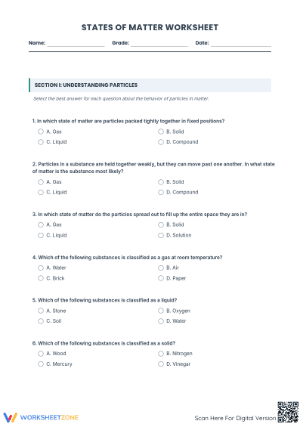
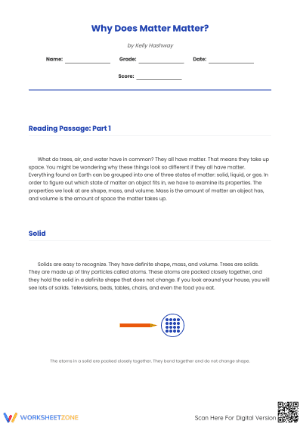
The core skill in 2-PS1-1 is classification, and sorting worksheets build it through repetition. Students look at an object, describe what they observe, and decide whether it holds its own shape, flows and takes the shape of its container, or spreads to fill any space. Effective pages ask more than one question per item:
- Does it keep its shape when you move it?
- Can you pour it or does it stay put?
- Can you see it, or do you only feel it move, like air from a fan?
Cut-and-sort formats work well for a science center, while a three-column recording sheet fits whole-class instruction. The point is to give students many small classification decisions rather than one, because sorting is a skill that strengthens with practice, not a fact they memorize once.
Connecting States to Heating and Cooling
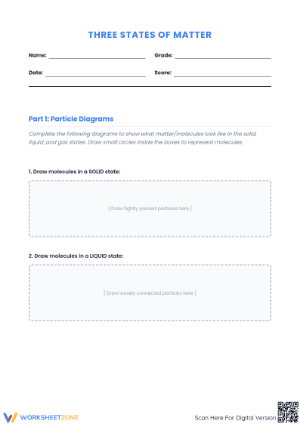
State changes are where sorting turns into cause-and-effect reasoning. Worksheets that support 2-PS1-4 pair a familiar example, ice to water to steam, with questions that ask what caused the change and whether it can be reversed. Students learn that the same water can be a solid, a liquid, or a gas depending on temperature, which directly counters the idea that a material has only one permanent state.
Good state-change pages ask students to label a before and after, name the cause as heating or cooling, and mark whether melting or freezing can be undone. Keep the examples concrete and drawn from a real demonstration your class watched, so the worksheet records thinking about something students actually observed rather than a picture they have never seen.
Classroom Implementation
One worksheet set can stretch across a full states-of-matter unit if you plan where each page fits. A few reliable placements:
- Whole-class introduction: use a simple three-way sort as guided practice after a demonstration, thinking aloud as you place the first two items together.
- Science center: set out a cut-and-sort page with real objects so pairs can match physical items to worksheet categories.
- Small-group intervention: pull students who confused gas with empty space and use explanation prompts to rebuild the idea that gas is matter.
- Formative assessment: a short exit ticket asking students to sort three new objects and justify one choice tells you who is ready to move on.
Because research recommends repeated hands-on classification rather than one-time practice, plan to reuse the same worksheet formats across several days with fresh examples. Familiar structure lets students focus on the science instead of decoding new directions each time.
Differentiation and Literacy Connections
The same topic supports a wide range of learners. For kindergarten and grade 1 preview, picture-based sorting with no writing keeps the focus on observation. For grade 2 and grade 3 review, add short-response lines where students explain their reasoning in a full sentence.
These pages also do double duty as early literacy work. Labeling, sentence frames such as I know this is a solid because, and repeated exposure to the words solid, liquid, gas, and matter build science vocabulary alongside classification. For students still developing as writers, a sentence frame lowers the writing load while still requiring the science explanation you want to hear.
Frequently Asked Questions
1. What grade level are solid, liquid, and gas worksheets appropriate for?
They fit best in grade 2, where states of matter is a core science topic, but they also work as a preview for kindergarten and grade 1 and as a quick review for grade 3 before students move toward particle-level ideas.
2. How do these worksheets align with NGSS standards for matter?
Sorting pages target 2-PS1-1, classifying materials by observable properties, while heating and cooling pages support 2-PS1-4, describing reversible and non-reversible changes caused by temperature.
3. What is the best way to use worksheets to address student misconceptions?
Choose pages that ask students to explain their choices, not just circle an answer. Explanation prompts reveal ideas like gas has no weight, so you can correct them directly during small-group time.
4. Can these worksheets be used for both instruction and assessment?
Yes. Use guided sorting during your lesson and a short sort-and-justify page as an exit ticket. The same format works for teaching and for checking who has mastered classification.
5. How can I pair worksheets with hands-on heating and cooling demonstrations?
Run the demonstration first, such as melting ice, then have students record the before, the cause, and whether the change can be reversed on the worksheet. Recording what they just watched anchors the writing in real observation.