


























Views
Downloads

Printable States of Matter Worksheet | Grade K Science
Paste this activity's link or code into your existing LMS (Google Classroom, Canvas, Teams, Schoology, Moodle, etc.).
Students can open and work on the activity right away, with no student login required.
You'll still be able to track student progress and results from your teacher account.
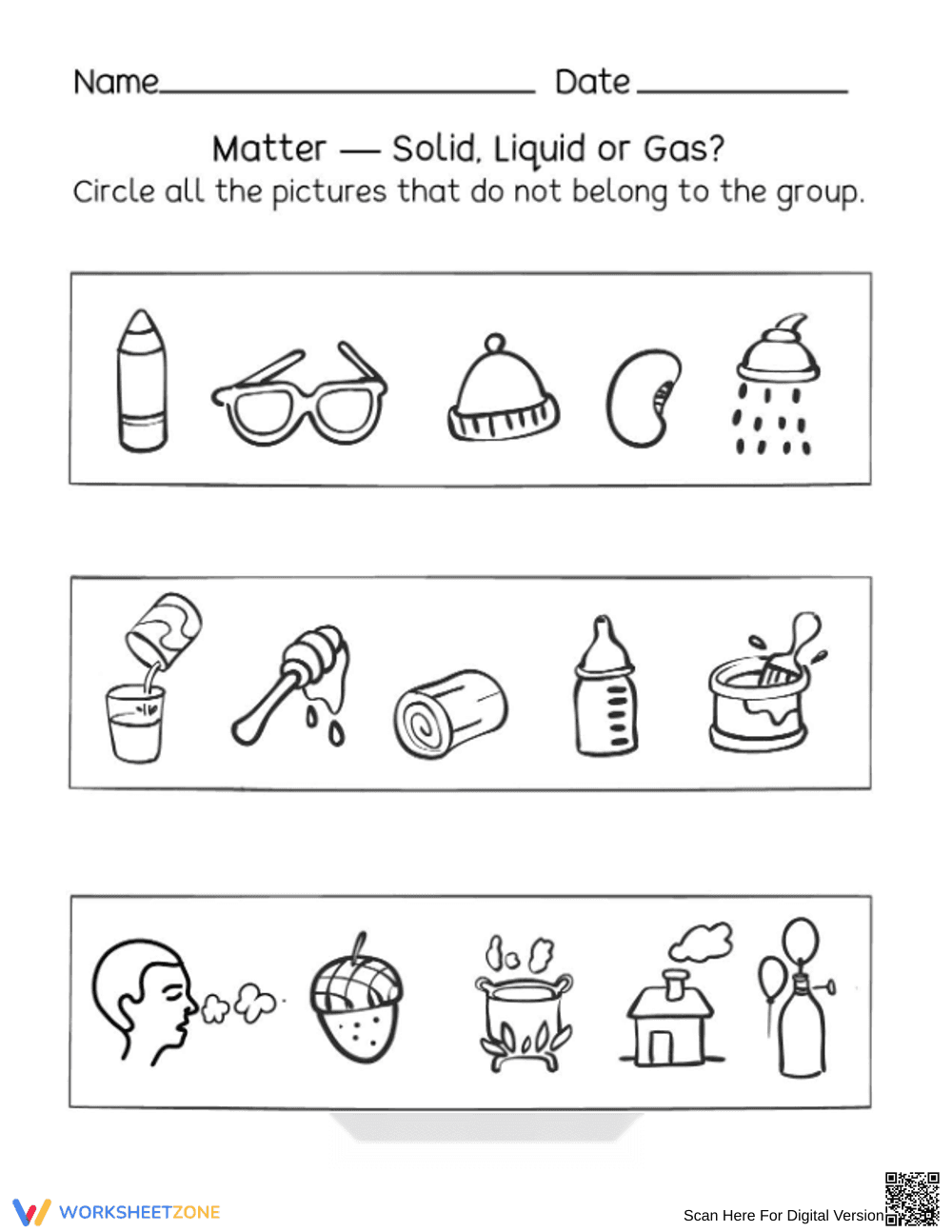
This Kindergarten states of matter worksheet helps students classify objects as solids, liquids, or gases by identifying which item does not belong in a group. By analyzing everyday items, young learners build foundational physical science skills and develop their ability to categorize materials based on observable properties.
At a Glance
- Grade: Kindergarten · Subject: Science
- Standard:
K-PS1-1— Plan and conduct an investigation to classify materials by their observable properties- Skill Focus: States of Matter Classification
- Format: 1 printable page · 3 classification problems · PDF ready
- Best For: Independent practice, science centers, or morning work
- Time: 10–15 minutes
Inside this single-page resource, educators will find three distinct visual classification tasks. Each row presents a series of five familiar objects, such as a crayon, a honey dipper, or a steaming pot. Students must evaluate the state of matter for each item and circle the picture that does not belong to the primary group. The clear line drawings are perfect for young students to color after completing the science task.
Zero-Prep Workflow
This resource is designed for immediate classroom use with minimal teacher setup:
- Print (1 minute): Download the PDF and print a class set.
- Distribute (1 minute): Hand out the worksheets along with pencils. The instructions are simple enough to read aloud once.
- Review (3 minutes): Go over the answers together as a class, asking students to explain their choices.
With under two minutes of total teacher prep time, this activity is highly suitable for sub plans.
Standards Alignment
This worksheet aligns with primary standard K-PS1-1: Plan and conduct an investigation to describe and classify different kinds of materials by their observable properties. By grouping objects into solids, liquids, and gases, students practice early scientific classification. Both standard codes can be copied directly into lesson plans, IEP goals, or district curriculum mapping tools.
How to Use It
This worksheet works exceptionally well as a formative assessment after direct instruction on the states of matter. Teachers can assign it during science centers to check for individual understanding. As a formative assessment observation tip, watch to see if students struggle more with identifying gases (like steam or helium) compared to tangible solids. The expected completion time range is 10 to 15 minutes, making it a perfect wrap-up activity.
Who It's For
This resource is primarily designed for Kindergarten and first-grade students developing early physical science concepts. For differentiation, teachers can support English Language Learners by naming each object aloud before they begin. It pairs naturally with a hands-on sorting lesson using real classroom objects or an anchor chart detailing the differences between solids, liquids, and gases.
Early exposure to physical science concepts, such as identifying states of matter, builds a critical foundation for future scientific inquiry. According to a ScienceDirect TpT Analysis, integrating visual categorization tasks into early childhood education significantly improves long-term retention of abstract concepts. This worksheet directly supports standard K-PS1-1, requiring students to classify materials by their observable properties. By asking children to identify the odd object out among solids, liquids, and gases, the activity promotes critical thinking. Young learners move beyond simple memorization, actively applying their knowledge to evaluate everyday items like crayons and steam. Consistent practice with these visual classification exercises ensures students develop the analytical skills necessary for more advanced scientific observation, making this an essential tool for early science instruction.


