




























Views
Downloads
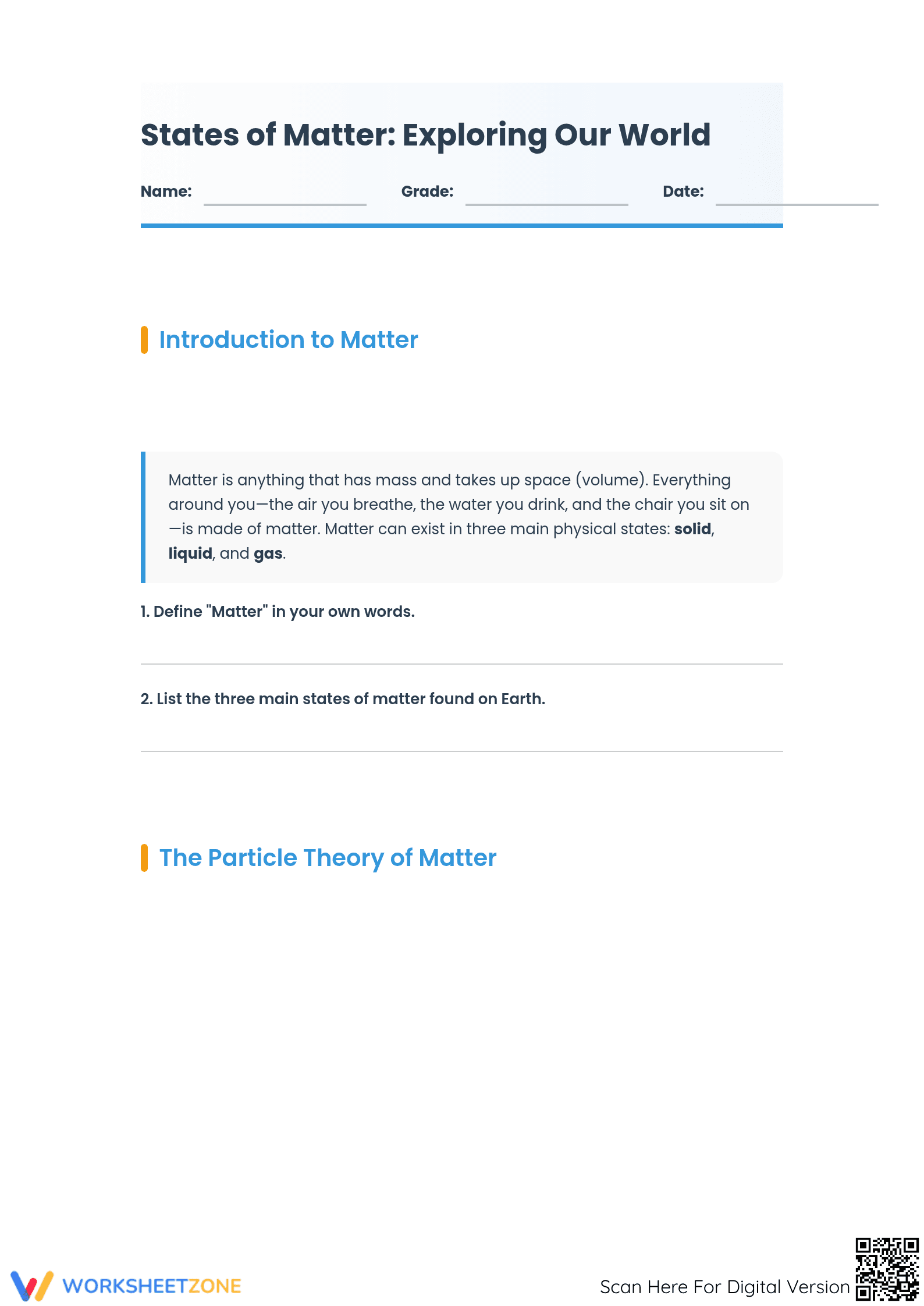


Grade 5-7 States of Matter — Printable No-Prep Worksheet

Paste this activity's link or code into your existing LMS (Google Classroom, Canvas, Teams, Schoology, Moodle, etc.).
Students can open and work on the activity right away, with no student login required.
You'll still be able to track student progress and results from your teacher account.
This comprehensive Grade 5-7 science worksheet helps students master the fundamental properties of solids, liquids, and gases. By engaging with vocabulary, conceptual true/false statements, and short-answer explanations, learners develop a concrete understanding of particle behavior and matter classification. Students will successfully identify phase changes and describe molecular arrangements in various physical states.
At a Glance
- Grade: 5-7 · Subject: Science
- Standard:
5-PS1-1— Develop a model to describe that matter is made of particles too small to be seen- Skill Focus: States of Matter Properties
- Format: 4 pages · 22 problems · Answer key included · PDF
- Best For: Independent practice or sub plans
- Time: 30–45 minutes
This 4-page instructional packet features a structured three-part layout designed for maximum clarity. It begins with a 10-item vocabulary section supported by a clear word bank to scaffold terminology. The second section includes 7 true-or-false conceptual checks, followed by 5 short-answer questions that require students to synthesize their knowledge in complete sentences. A full answer key is provided for rapid grading.
Zero-Prep Workflow
The workflow for this resource is designed for immediate classroom implementation. First, print the 4-page PDF (1 minute). Second, distribute the packets to students for independent or partner work (1 minute). Finally, use the included answer key to review responses as a whole class or for individual grading (5 minutes). This streamlined structure makes it an ideal choice for emergency sub plans or supplemental homework.
Standards Alignment
The primary focus of this resource is `5-PS1-1`, which requires students to develop a model to describe that matter is made of particles too small to be seen. The worksheet supports this by asking students to describe particle packing and movement in different states. Both standard codes can be copied directly into lesson plans, IEP goals, or district curriculum mapping tools.
How to Use It
Assign this packet as a summative review after a direct instruction unit on physical properties. During the session, circulate and observe students as they complete the short-answer section; specifically, look for their ability to explain why gases lack a fixed volume. The expected completion time is 30 to 45 minutes depending on the student's writing speed.
Who It's For
This resource is tailored for upper elementary and middle school science students, particularly those in Grades 5 through 7. It provides excellent support for English Language Learners through the provided word bank and sentence-level tasks. It pairs naturally with a physical science anchor chart or a laboratory demonstration involving dry ice or boiling water.
This science resource aligns with the 5-PS1-1 standard, focusing on the plain-English skill of describing matter through particle behavior and physical properties. According to the RAND AIRS 2024 analysis of instructional materials, structured worksheets that combine vocabulary scaffolding with open-ended explanation tasks significantly improve retention of abstract physical science concepts. By requiring students to differentiate between molecular density and intermolecular forces, the worksheet addresses common misconceptions identified in national science assessments. The inclusion of a word bank serves as a critical instructional scaffold, ensuring that students can focus on conceptual mastery rather than just terminology recall. This balanced approach to science literacy supports the gradual release of responsibility, moving students from simple identification to complex reasoning about the physical world. Educators can confidently integrate this tool into curriculum maps to meet rigorous state and national science frameworks.


