


























Views
Downloads


States of Matter Worksheet | Printable Grade 6 Science
Paste this activity's link or code into your existing LMS (Google Classroom, Canvas, Teams, Schoology, Moodle, etc.).
Students can open and work on the activity right away, with no student login required.
You'll still be able to track student progress and results from your teacher account.
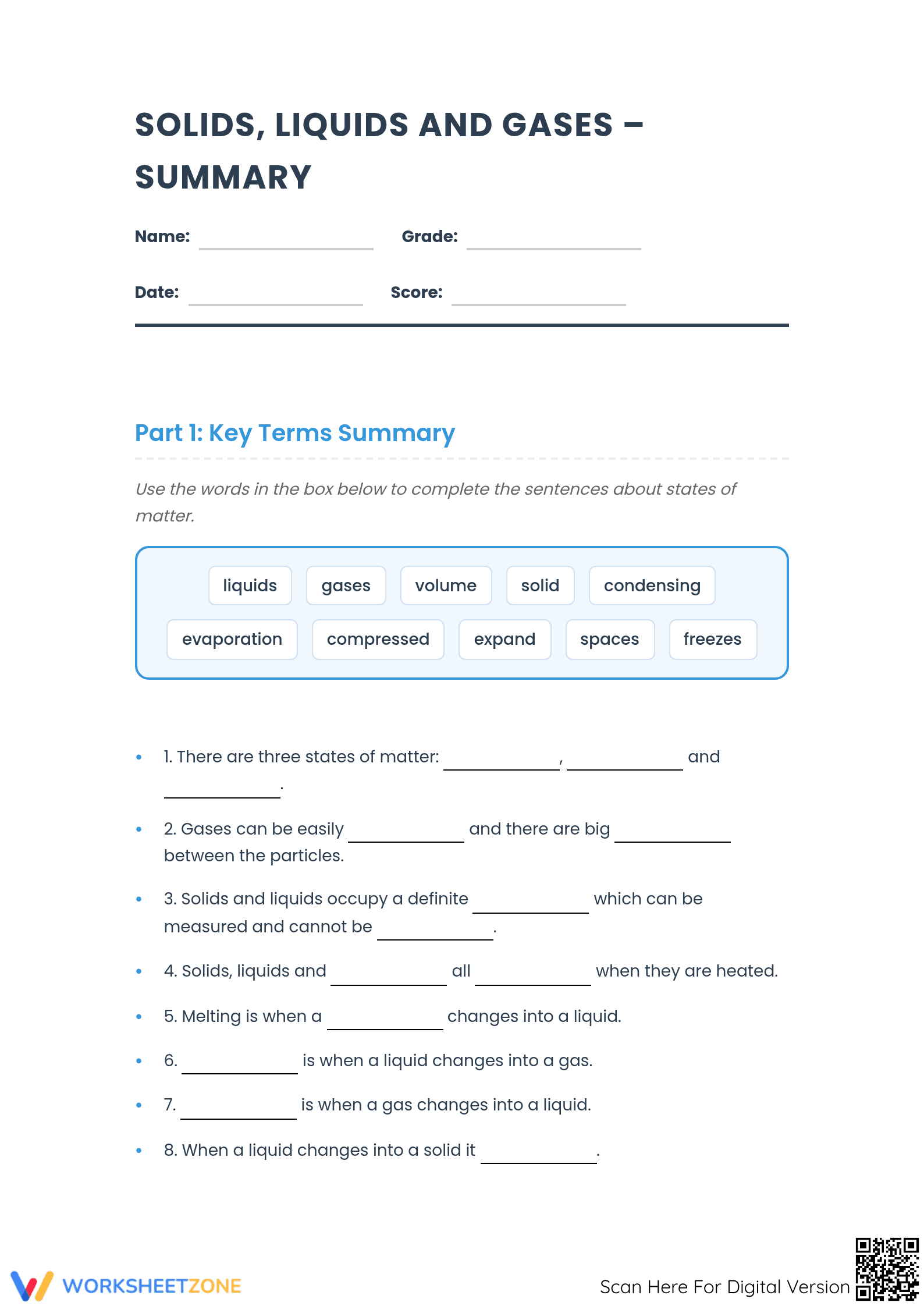
This printable states of matter worksheet helps middle school students consolidate their understanding of solids, liquids, and gases. By completing targeted fill-in-the-blank exercises, learners reinforce essential vocabulary related to phase changes, particle spacing, and volume. It provides a straightforward way to review core physical science concepts.
At a Glance
- Grade: 6 · Subject: Science
- Standard:
MS-PS1-4— Describe changes in particle motion and state when thermal energy is added or removed.- Skill Focus: States of matter and phase changes
- Format: 1 page · 8 problems · Answer key included · PDF
- Best For: Independent review or sub plans
- Time: 10–15 minutes
What's Inside
This resource features a single page containing eight fill-in-the-blank sentences. Students utilize a ten-word vocabulary bank to complete statements about the properties of matter, including how particles behave when compressed or heated. The bottom includes a visual diagram illustrating particle arrangements in a gas, liquid, and solid. A complete answer key ensures accurate grading.
Zero-Prep Workflow
This zero-prep resource is designed for maximum efficiency in the classroom.
- Print (1 minute): Simply download the PDF and print a class set. The black-and-white design is ink-friendly and copies clearly.
- Distribute (1 minute): Hand out the sheets as a warm-up, exit ticket, or independent practice activity. The clear instructions and word bank mean students can begin immediately.
- Review (3 minutes): Use the included answer key to quickly check student responses or project it for a whole-class self-correction session.
Total teacher preparation time is under two minutes, making this an ideal, self-explanatory activity for emergency sub plans.
Standards Alignment
This activity aligns with MS-PS1-4: Develop a model that predicts and describes changes in particle motion, temperature, and state of a pure substance when thermal energy is added or removed. It also supports foundational concepts from 5-PS1-1 regarding matter being made of observable particles. Both standard codes can be copied directly into lesson plans, IEP goals, or district curriculum mapping tools.
How to Use It
Teachers can deploy this worksheet during the middle of a physical science unit after direct instruction on phase changes. It serves as an excellent formative assessment; by observing which vocabulary words students struggle to place (such as confusing "condensing" with "evaporation"), educators can identify specific misconceptions about thermal energy transfer. Alternatively, assign it as a quick homework task to reinforce the day's lesson. Expected completion time ranges from 10 to 15 minutes.
Who It's For
This material is primarily designed for fifth through seventh-grade science students. The built-in word bank provides essential scaffolding, making it accessible for English Language Learners and students requiring modified assignments. It pairs perfectly with an anchor chart displaying the states of matter or a hands-on lab demonstrating the melting and freezing points of water.
Mastering the vocabulary associated with physical science is a critical step in developing broader scientific literacy. This worksheet targets MS-PS1-4, requiring students to describe changes in particle motion and state when thermal energy is added or removed. According to a recent ScienceDirect TpT Analysis, structured vocabulary practice combined with visual models significantly improves retention of abstract concepts like particle behavior and phase transitions. By connecting terms like "volume," "compressed," and "evaporation" to concrete sentence frames and visual diagrams, learners build a more robust mental model of how matter interacts with its environment. This targeted approach ensures that foundational knowledge is solidified before moving on to more complex thermodynamic principles. Consistent, low-stakes retrieval practice using tools like this fill-in-the-blank summary helps transfer these essential science concepts from short-term working memory into long-term retention.


