




























Views
Downloads


States of Matter MS-PS1-4 Worksheet — Grade 6 Aligned

Paste this activity's link or code into your existing LMS (Google Classroom, Canvas, Teams, Schoology, Moodle, etc.).
Students can open and work on the activity right away, with no student login required.
You'll still be able to track student progress and results from your teacher account.
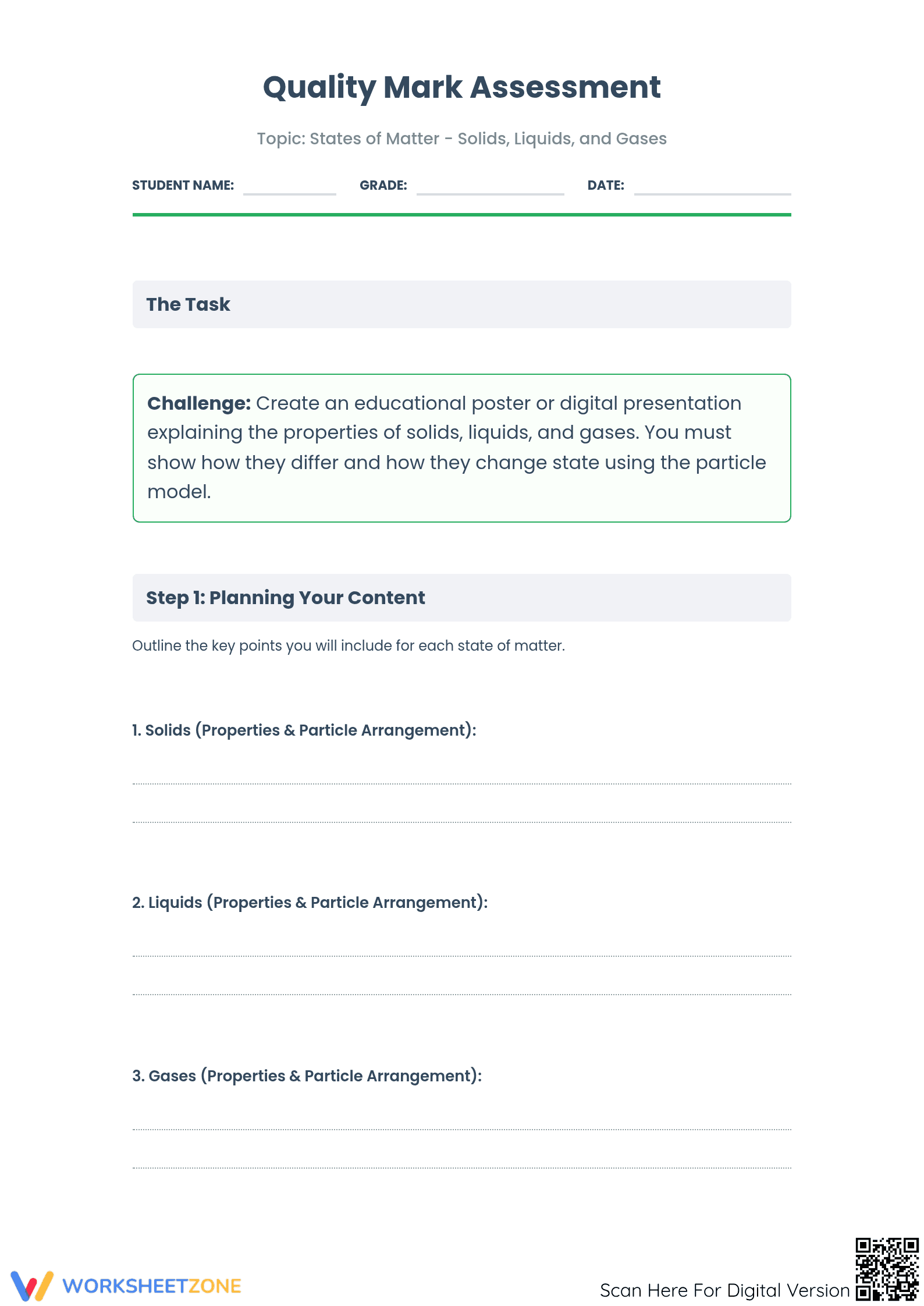
This states of matter assessment rubric helps students evaluate their understanding of solids, liquids, and gases. By using this structured evaluation tool, learners can track their mastery of particle theory and physical changes. The clear criteria guide students through self-reflection while providing teachers with a standardized grading framework.
At a Glance
- Grade: 6 · Subject: Science
- Standard:
MS-PS1-4— Describe changes in particle motion and state.- Skill Focus: Particle theory and states of matter
- Format: 1 page · 9 criteria · Rubric included · PDF
- Best For: Project assessment and self-reflection
- Time: 15–20 minutes
This single-page assessment tool features a comprehensive nine-row rubric designed to evaluate a student-created poster on the states of matter. The table outlines specific criteria ranging from basic classification of materials to advanced explanations of density and diffusion using the particle model. It includes dedicated columns for both student self-assessment and teacher evaluation, alongside structured reflection prompts for setting improvement targets.
The rubric provides clear mastery evidence by breaking down complex scientific concepts into observable behaviors. Students progress from foundational skills, like stating properties, to higher-order thinking tasks, such as linking particle movement to temperature changes. Each of the nine criteria maps directly to a sub-skill of the standard, allowing educators to pinpoint exact areas of proficiency. The dual-assessment format encourages student ownership, and the resulting scores can be entered directly into gradebooks or used for targeted intervention planning.
This resource is strictly aligned to MS-PS1-4: Develop a model that predicts and describes changes in particle motion, temperature, and state of a pure substance when thermal energy is added or removed. It also supports foundational understanding of matter classification and physical properties. Both standard codes can be copied directly into lesson plans, IEP goals, or district curriculum mapping tools.
Deploy this rubric after students complete a poster project on matter. First, have students use the "ME" column to self-evaluate their work, fostering metacognition and accountability. Next, the teacher reviews the project using the "MISS" column, providing a side-by-side comparison of expectations versus performance. As a formative assessment observation tip, monitor the target-setting section to ensure students are identifying specific, actionable steps for improvement rather than generic goals. Expect the evaluation process to take 15 to 20 minutes per student.
This assessment is ideal for middle school science students in grades five through seven who are studying physical science and thermodynamics. The explicit criteria make it highly effective for diverse classrooms, providing clear expectations that support students who need structured guidance. It pairs perfectly with a hands-on poster creation activity or a direct instruction lesson on the kinetic molecular theory, ensuring learners know exactly how their visual models will be evaluated.
Effective science instruction relies heavily on clear evaluation criteria and student self-reflection, particularly when addressing complex topics like the particle model of matter. According to a ScienceDirect TpT Analysis, providing explicit rubrics significantly improves students' ability to meet learning objectives. This resource targets MS-PS1-4, requiring learners to describe changes in particle motion and state. By breaking down the standard into nine distinct, observable levels of achievement, the rubric demystifies the grading process. Students who actively participate in self-assessment demonstrate higher engagement and better retention of scientific principles. Integrating this structured evaluation tool into physical science units ensures that both teachers and students have a shared understanding of mastery, ultimately leading to more accurate assessments and targeted instructional adjustments.


